Maryland oyster season collapse prompts calls for federal disaster aid
Published in News & Features
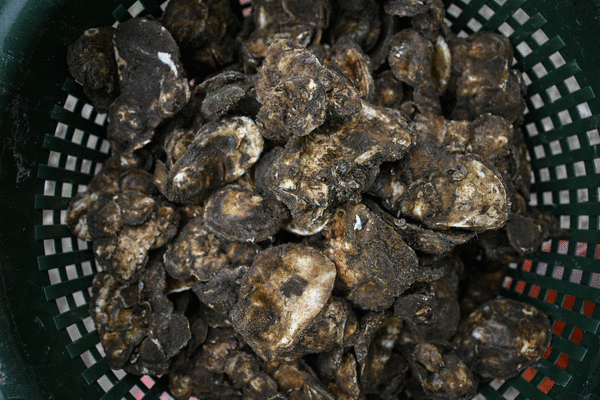
Maryland officials are asking for federal help after what they describe as one of the worst oyster seasons in state history, a collapse they say threatens both watermen and a cornerstone of the Chesapeake Bay economy.
U.S. Rep. Andy Harris, R-Md., this week asked the National Oceanic and Atmospheric Administration (NOAA) to declare an economic fishery disaster under the Magnuson-Stevens Fishery Conservation and Management Act. Such a designation can unlock emergency federal assistance for fisheries harmed by natural or market conditions.
“Severe weather this year, combined with shrinking market access and increased competition, left many crews effectively tied to the dock, with watermen able to fish for just one or two days all season,” Harris said in a statement. He said immediate relief is needed to offset financial losses.
Eastern Shore lawmakers say a combination of factors — prolonged freezing weather, weak demand and growing competition from out-of-state oysters — devastated the winter harvest. State Sen. Johnny Mautz, R-Middle Shore, said the normal Thanksgiving-to-Christmas peak selling period largely vanished.
“That is prime time oyster sales. This year, it just did not exist,” Mautz said. “There has not been a demand to buy Maryland oysters.”
Lack of orders leave boats docked
Because watermen typically only harvest when buyers are lined up, the lack of orders kept many boats docked, lawmakers said.
Del. Jay Jacobs, chair of the House Waters Caucus, said Maryland once held a dominant share of the East Coast oyster market, but increasing supply from other states has cut into demand. He said legislators are exploring stronger marketing efforts and plan to review strategies used by other seafood programs.
Lawmakers also warned of environmental consequences if the industry stalls. Mautz said working oyster bars — moving shell and tending bottoms — helps prevent sediment buildup and supports oyster reproduction. Reduced harvesting, he said, could slow the Bay’s ongoing oyster recovery.
“The fear is not only economic,” Mautz said. “This could set us back a decade if the bottoms aren’t worked the way they need to be.”
Mautz credited Harris and Maryland Sens. Chris Van Hollen and Angela Alsobrooks with seeking federal relief and called on Gov. Wes Moore to support the request.
In a statement to The Sun, Van Hollen said watermen were hurt “through no fault of their own” and urged approval of the request.
“This is about safeguarding the future and economic livelihood of our watermen, whose success is vital to the health of the Bay economy,” Van Hollen said.
How does it work?
According to NOAA officials, the disaster review process is typically initiated by a governor or other elected official and evaluated by the U.S. Department of Commerce. Mautz said it’s needed for several reasons.
“Federal disaster relief brings a number of things, including some monetary relief, but it also stays home foreclosures, bank notes, things like that. It’s a temporary thing, but at least it gives the people who are affected a little bit of wiggle room to figure things out,” he said.
At this point, Mautz said they’re awaiting a response to the disaster relief request.
“I just appreciate everyone is taking the time to take the request seriously and appreciate the magnitude of how this is affecting our district and all the districts that have shoreline and working waterfronts. It’s a terrible situation right now,” he said.
The governor’s office referred The Sun’s questions to the Maryland Department of Natural Resources, which said the state has limited options without federal action.
Officials say they are now awaiting a decision from NOAA as watermen face mounting financial pressure along the Chesapeake Bay’s working waterfronts.
________
©2026 The Baltimore Sun. Visit at baltimoresun.com. Distributed by Tribune Content Agency, LLC.




Comments