Mayor Johnson's ICE executive order would compromise investigations of immigration agents, state's attorney says
Published in News & Features
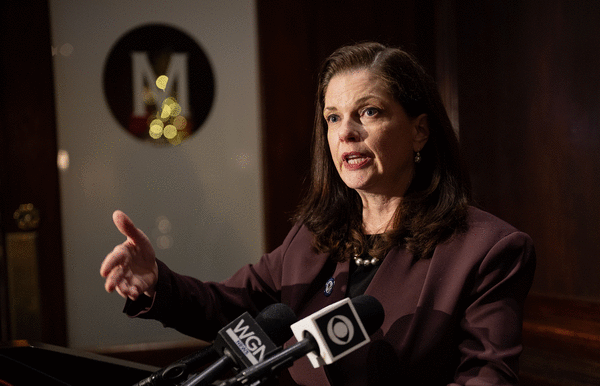
CHICAGO — In a memo sent to employees on Friday, the policy chief for Cook County State’s Attorney Eileen O’Neill Burke said the city’s “ICE on notice” executive order compromises potential prosecutions of federal agents by politicizing the investigations.
The executive order announced by Mayor Brandon Johnson last Saturday has resulted in ongoing strife between the mayor and the county’s top prosecutor, who would be responsible for bringing any charges against immigration agents whose conduct in the Chicago area has drawn scrutiny and condemnation.
In an email to staff sharing the memo, Burke called the executive order “wholly inappropriate” and said it “jeopardizes our ability to effectively prosecute and secure convictions when federal law enforcement agents have committed a crime.”
The document, signed by policy chief Yvette Loizon, sheds more light on the conflicts surrounding the executive order that led to unusually public quarrels between Burke and Johnson, who oversees the Chicago Police Department that would largely be responsible for investigating possible offenses in the city of Chicago and referring them to Burke’s office.
Johnson’s spokesperson Cassio Mendoza was not immediately available for comment Friday evening.
Earlier this week, he responded to Burke’s criticisms that his order would politicize investigations into federal officers by saying that concern will be addressed during a “rule-making process” laying out the process.
“This concern will be addressed through the rule-making process, which is built into the executive order,” Mendoza wrote in a statement on Wednesday. “We have attempted to clarify this with the CCSAO directly but they have been largely unresponsive to outreach, outside of their public statements to the press. It is premature of the CCSAO to draw conclusions about specific terms absent the interpretive guidance that will accompany the rules.”
The public rift is a first between Johnson and Burke who have mostly enjoyed a cordial relationship despite coming from different corners of the city’s political spectrum. Burke ran as the moderate Democrat in the 2024 primary, but Trump’s second term has made her a target of the city’s left amid frustration over federal immigration raids.
Later on Saturday, progressive groups including the Chicago Teachers Union, Johnson’s closest ally, planned to protest downtown to demand Burke prosecute ICE agents, according to a media advisory.
The memo, which was also shared with the mayor’s office, also says the prosecutor’s office has finished its legal review of the order.
The area of particular concern for the state’s attorney’s office is a line in the executive order that says: “CPD Supervisors must ensure preservation of evidence relating to the incidents and reports described above and, at the direction of the Mayor’s Office, make a referral of felony matters to the Cook County States Attorney.”
Usually, it is law enforcement that makes referrals to prosecutors asking them to approve felony charges, and involvement from the mayor’s office would not be typical.
“The injection of the Mayor’s Office into CPD’s decision to refer a case to CCSAO for felony charges compromises the integrity of the investigation and would similarly compromise the prosecution,” the memo says. “The defense would undoubtedly use this unprecedented approach as a mechanism for characterizing any prosecution of a federal immigration agent as political and would likely attempt to discredit CPD personnel called as witnesses by suggesting that their investigation was ‘directed’ by the Mayor’s Office.”
It also said that any written documents, notes or text messages created by the mayor’s office before giving direction to the Chicago Police Department to refer a case for charges would be subject to discovery by the defendant. Prosecutors have a legal obligation to turn over all potential evidence to the defense, which would include any such material generated by the mayor’s office.
“Whatever Mayoral staff member that gave the directive to refer the case to the CCSAO would also likely be called as a witness, creating serious litigation issues and jeopardizing our ability to secure a conviction and justice for victims of crime,” the memo says.
According to the memo, the office will not “conduct felony review on cases that have been referred to us at the direction of any non-law enforcement or non-investigative entity.”
Johnson’s executive order directs Chicago police to collect evidence, investigate and potentially refer for felony prosecution criminal charges against federal immigration agents accused of misconduct.
The move came as advocacy groups for months have pushed city, county and state officials to investigate and potentially prosecute immigration agents in connection with confrontations with civilians during the Trump administration’s aggressive Operation Midway Blitz this fall.
“These rogue federal agents are taking us backwards as a city,” Johnson said last weekend. “The people of Chicago asked me to do more, so I’ve done more.”
But the announcement quickly received pushback from Burke, who posted on X that her office “did not receive the Executive Order until it was released to the public. We do not provide legal approval of any matter until we’ve reviewed it.”
©2026 Chicago Tribune. Visit chicagotribune.com. Distributed by Tribune Content Agency, LLC.


Comments