Cuban leaders dig in, vow to resist Trump's pressure, warn of difficult times ahead
Published in News & Features
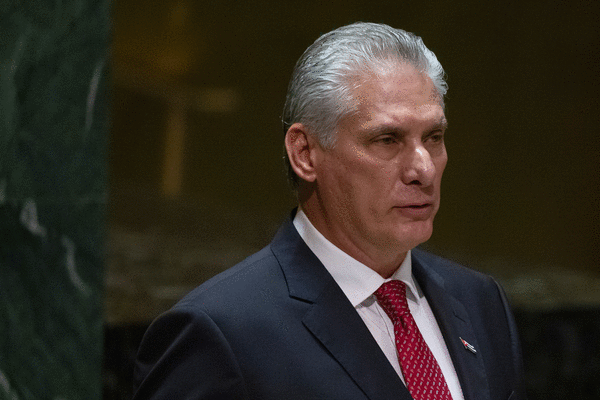
In a defiant gesture, Cuba’s handpicked president Miguel Díaz-Canel blasted President Donald Trump on Thursday and vowed his government will resist the U.S. “oil blockade” with creativity, but warned the population will go through difficult times.
“The collapse lies in the imperial mindset, but not in the mindset of the Cubans,” he said at a rare press conference Thursday morning. “I know we are going to live through difficult times, but we will overcome them together with creative resilience.”
Cuba’s economy has been in free fall in recent years and the country was already going through its worst economic crisis before Trump moved to cut oil supplies to the island in an effort to bring the Cuban government to the negotiating table. But Díaz-Canel signaled his government would not make political changes, preparing instead to resist at all costs.
Díaz-Canel said the island’s Council of Ministers prepared a plan to deal with “acute” fuel shortages based on Fidel Castro’s directives during the so-called Special Period, the crisis following the fall of the Soviet Union. Díaz-Canel said the plan updated directives for the so-called Option Zero, a situation of extreme scarcity.
He said the country would have to adjust to live off of its national production of crude oil and the population would have to face “restrictive” measures.
“I know people would question more sacrifice, but if we don’t sacrifice, if we don’t resist, what are we going to do? We have shared that surrender is not Cuba’s option. There’s much to defend.”
Díaz-Canel also said his government will still try to get oil from foreign suppliers. “It is our right,” he said.
He said there were governments and companies “willing to work with Cuba,” after mentioning statements of support from Russia and China. The Cuban leader said he could not provide details but hinted his government would continue trying to find ways to skirt U.S. sanctions.
“The financial pressure on the energy sector is so intense that we know we have to work intelligently to overcome these obstacles,” he said.
Díaz-Canel also said his government has updated its defense plans and has mandated military training at all levels on Saturdays. The training involves both regular army units and civilians, as a part of the doctrine of ”Guerra de todo el pueblo” — war of the people — that aims at mobilizing the population.
Throughout the two-hour long press conference, Díaz-Canel blasted Trump’s actions as “criminal,” “vulgar” and “inhumane.” At one point he compared them to “those of Hitler’s hordes.”
His statements come after Trump moved to cut oil supply to the country and urged Cuban leaders to strike a deal, following the capture of Venezuelan strongman Nicolás Maduro. Trump also signed an executive order to impose tariffs on countries like Mexico that provide oil to the island.
Trump has said several times that his administration is talking to Cuban leaders.
Díaz-Canel denied such contacts but on Wednesday. Cuba’s vice minister for foreign affair Carlos Fernandez de Cossío, told CNN there were exchanges of messages at the highest levels, though he refrained from calling them a negotiation or dialogue.
Cossío also said the Cuban government is willing to engage in dialogue with the United States, but that changes to its political and economic system, or the country’s socialist constitution, are off the table. He also ruled out negotiating the release of political prisoners, and precluded discussing the changes many Cubans living on the island and abroad have been advocating.
U.S. Secretary of State Marco Rubio previously said the U.S. welcomed political changes on the island and did not rule out the administration was seeking regime change in Havana.
Cuba’s foreign ministry issued a statement this week proposing resuming cooperation with the United States, but solely on security matters.
“Cuba is willing to engage in dialogue with the United States on any topic they wish to discuss, without pressure or preconditions, on equal footing, with respect for our sovereignty, our independence, and our self-determination, and without addressing issues that we might interpret as interference in our internal affairs, “ Díaz-Canel said.
“It’s a position of continuity,” he added, citing Fidel and Raúl Castro. He said the agenda could include security, the fight against drug trafficking, migration and science cooperation.
Trump has given few details of what sort of deal he would like to strike with Cuban authorities.
He has called Cuba a “failing nation” with a government that was about to fall on its own. He has said the country needs humanitarian aid and that he would like to see Cuban Americans be able to return to the island.
It’s unclear what that means. Most Cuban Americans can travel to Cuba to visit relatives, though they cannot live there permanently unless they were born in Cuba and go through a lengthy legal process of repatriation. Cuban Americans also are not allowed to invest in Cuban businesses nor own property. Cuban authorities also routinely deny entry to Cuban Americans who have been critical of the government.
©2026 Miami Herald. Visit at miamiherald.com. Distributed by Tribune Content Agency, LLC.



Comments