Zelenskyy warns Russia's new onslaught will impact peace talks
Published in News & Features
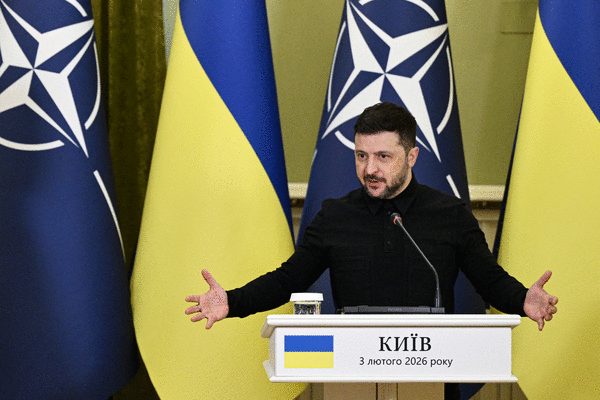
Ukrainian President Volodymyr Zelenskyy said Russia’s resumption of attacks on the country’s energy infrastructure with the biggest assault this year will have consequences for Kyiv’s negotiating team in this week’s peace talks.
As winter temperatures remain frigid, Russia delivered an overnight assault with scores of missiles and hundreds of attack drones, the Ukrainian leader said the work of his team negotiating with Russia “will be adjusted accordingly.”
“The Russian army exploited the U.S. proposal to briefly halt strikes not to support diplomacy, but to stockpile missiles and wait until the coldest days of the year,” Zelenskyy said in a post on X Tuesday.
The winter assault, which has crippled the war-battered nation’s energy system and left millions without heat or electricity, ends a brief moratorium on strikes against energy infrastructure sought by U.S. President Donald Trump ahead of trilateral talks on Wednesday.
Zelenskyy didn’t elaborate on how the work of his envoys will change.
Russia hit Ukraine with 32 ballistic missiles as well as 11 missiles of other types that approached their targets along a ballistic trajectory, as well as 28 cruise missiles, Zelenskyy said. The attack also included 450 attack drones, most of them explosive-laden “Shaheds,” according to the president.
The attack did the greatest damage to energy facilities and civilian infrastructure in Kharkiv in Ukraine’s east and Dnipro in the country’s center, Zelenskyy said. Kyiv and other Ukrainian regions including Odesa and Zaporizhzhia in the south also suffered from the strikes as temperatures dipped below -20C (-4F), he said.
Residents in two eastern districts of Kyiv are without heating as part of emergency power cuts, Mayor Vitali Klitschko said. Heating was cut off for at least 820 buildings, including multi-story residential blocks in Kharkiv, Mayor Ihor Terekhov said on Telegram. Some 50,000 people in Odesa region are without power, Governor Oleh Kiper said.
The strikes resumed as NATO Secretary General Mark Rutte arrived Tuesday in Kyiv, where he met with Zelenskyy. In an address to parliament, Rutte also lauded the country’s resilience and reinforced allied pledges for postwar military aid.
Ukraine’s biggest private energy company DTEK said its thermal power plants suffered significant damage to equipment in Tuesday’s attacks.
Neighboring Poland scrambled military jets as part of standard preventative measures to protect its airspace.
Ukrainian, Russian and U.S. officials are due to resume trilateral negotiations aimed at reaching a peace deal in the United Arab Emirates on Wednesday, after meeting for two days of talks in Abu Dhabi last month. After those talks, Trump said on Thursday that Russian President Vladimir Putin agreed to his request for a weeklong halt to strikes on Kyiv and other cities because of the freezing winter conditions.
In return, Ukraine said it would hold back from its regular attacks targeting Russian oil refineries and other facilities.
“Taking advantage of the coldest days of winter to terrorize people is more important to Russia than turning to diplomacy,” Zelenskyy said in a post earlier. “Without pressure on Russia, there will be no end to this war.”
Kremlin spokesman Dmitry Peskov said on Friday that Putin agreed to a pause in attacks on Kyiv until Feb. 1. On Monday, he gave no indication of any extension to the agreement.
Russian strikes continued on other infrastructure including transportation during this time.
DTEK Chief Executive Officer Maxim Timchenko told Bloomberg on Monday that the company needs at least two to three weeks of a ceasefire to restore operations at its energy plants, and said he couldn’t rule out further winter blackouts in Kyiv and other cities.
--------
—With assistance from Tony Halpin.
©2026 Bloomberg L.P. Visit bloomberg.com. Distributed by Tribune Content Agency, LLC.






Comments