The unprecedented challenge of prosecuting federal agents for killing Renee Good, Alex Pretti
Published in News & Features
When Antonio Romanucci, the attorney representing the family of Renee Good, was admitted to practice before the United States Supreme Court, he wanted to purchase something to commemorate the honor.
In the court souvenir shop, he noticed porcelain turtles for sale.
“Why the turtle?” he asked a clerk.
The clerk responded, “The wheels of justice turn slowly.”
Romanucci keeps the turtle on his desk, directly in front of him, for all of his clients to see.
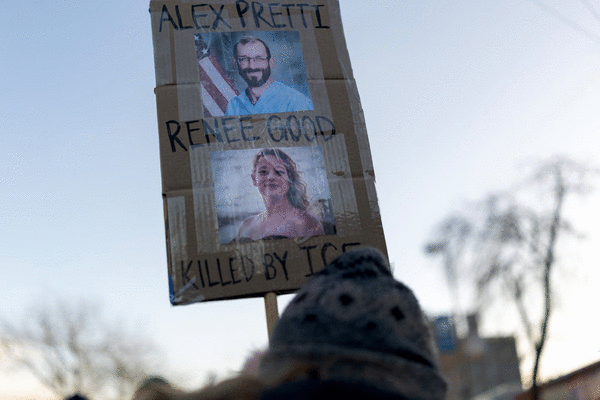
The Twin Cities have erupted this month in the wake of federal agents killing Good and Alex Pretti. Activists and protesters clamor outside federal buildings and Gov. Tim Walz’s office demanding arrests and criminal charges against the federal officers.
Meanwhile, lawyers are looking at the long game and considering the likelihood of a courtroom scenario that has no modern precedent in state history: criminal charges being filed by the state, without the cooperation of the federal government, against federal officers for use of deadly force.
If charges are brought, the cases would first focus on arguments over federal vs. state court jurisdiction and whether federal officers have immunity from state prosecution. That’s before any potential trial involving the federal officers who shot and killed two 37-year-old Minnesotans on the streets of south Minneapolis.
The legal process could take years to play out.
Defense attorney Eric Nelson, who represented former Minneapolis police officer Derek Chauvin in his criminal trial for the murder of George Floyd, said anytime a law enforcement officer is charged for killing a citizen, the case occupies a rarified space in society.
“They captivate the community,” Nelson said. “They’re political. They’re sociological ... and they are very, very complicated.”
In April 2019, when then Assistant Hennepin County Attorney Amy Sweasy secured a guilty verdict of third-degree murder and second-degree manslaughter against Minneapolis police officer Mohamed Noor for the shooting death of Justine Ruszczyk Damond, it was the first time in modern history a former Minneapolis police officer had been convicted of murder.
That prosecution started with a nine-month investigation to determine whether to even file charges.
“Fatal use-of-force incidents involving law enforcement shooting or killing civilians in their line of duty is a totally different kind of investigation, just right out the chute,” Sweasy said.
Minnesotans’ understanding of that process has evolved tremendously over the last decade amid the high-profile police killings of Jamar Clark, Philando Castile, Damond, Floyd, Daunte Wright, Winston Smith, Amir Locke and Ricky Cobb II.
Sweasy said the creation of the Bureau of Criminal Apprehension's Force Investigations Unit in 2020 has provided Minnesota with a firm expectation of how any law enforcement shooting will be investigated.
“We need the officers’ uniforms, we need their guns, we need a blood draw, et cetera,” she said.
If criminal charges are brought for the killing of Good and Pretti, it would mark the first prosecution against law enforcement for a shooting in the Twin Cities area in more than two years and the first BCA force investigation involving federal officers since the killing of Smith on the roof of an Uptown parking garage in 2021.
But the cases are already unlike anything the state has seen before, Sweasy said, because the federal government is refusing to let the BCA into the investigation, crippling evidence gathering and transparency for the state.
“If you can’t get the information you need, it’s all the more difficult to figure out what a charging decision is going to be and what the theory of the case is going to be.”
In his 25 years of working as a defense attorney, Nelson said this level of breakdown between state and federal agencies is “virtually unprecedented” and creates real problems for prosecutors.
“Whether it’s the firearm itself the officer used, the firearm that was reported to be retrieved from (Pretti), whether it’s the autopsy, the body-worn camera footage, that physical evidence has significance.”
On Jan. 26, a handful of the top prosecutors from the Minnesota Attorney General’s Office and the Hennepin County Attorney’s Office made their way into Judge Eric Tostrud’s federal courtroom in St. Paul.
They were arguing for a temporary restraining order against the federal government to preserve crime scene evidence from Pretti’s killing, but the hearing also provided foreshadowing of what a potential criminal case might look like.
Tostrud raised a hypothetical scenario to Assistant U.S. Attorney Friedrich Siekert:
The state brings criminal charges against a federal agent for a killing. The officer files a petition for removal and the case is moved from state court to federal court. The state files a subpoena for investigative evidence from the killing that they haven’t been given access to.
“Would the federal government respond to that?” Tostrud asked.
“I don’t know the answer to that,” Siekert responded.
The exchange of legal uncertainty spoke to the uniqueness of this situation.
Certain procedural elements appear likely if the County Attorney’s Office files charges.
The state would maintain prosecutorial authority over the case but it would likely be moved to federal court and proceed under federal rules with a federal judge and, if it goes to trial, a federal jury. That means selecting a jury of citizens throughout the state, not just Hennepin County.
But first, a judge would have to determine whether a state criminal case can even be brought against a federal officer for killing a civilian during the course of federal operations.
If federal agents were to be criminally charged for the killings of Good and Pretti, they would immediately seek to have the claims dismissed based on the supremacy clause, which gives federal agents immunity from state prosecution, in certain instances.
While Vice President JD Vance initially said ICE agent Jonathan Ross, who fatally shot Good on Jan. 7, had “absolute immunity” because he was doing his job, he has walked that back, slightly.
Hennepin County Attorney Mary Moriarty said that no matter what the federal government says, the state has jurisdiction “even if it is merely to bring the case forward for charges and then see where it goes from there. And whatever arguments the federal government would want to make is a completely different element of this.”
Federal courts have given wide protection to federal agents from state prosecution throughout history, but that protection is not absolute. A 2001 decision by the 9th Circuit Court of Appeals involving the FBI standoff at Ruby Ridge in Idaho established that ”federal agents enjoy immunity from state criminal prosecution." However, “That immunity has limits.”
Nelson explained it further:
“The presumption of that immunity rests upon the officer acting within the scope of their employment and are they doing their job the right way. If someone obviously deviates from these standards a federal agent could face prosecution.”
Nelson said defense attorneys would work to show that the shootings of Good and Pretti were justified based on how the agents were trained and the expectations of their duties during Operation Metro Surge.
“You almost want to put the agency on trial with you,” Nelson said.
The deaths of Good and Pretti have played out in a dramatic fashion because both shootings were filmed by multiple citizens, who were also observing and protesting Operation Metro Surge; the videos were on social media almost instantly.
Those videos have been slowed down, synchronized and stabilized. Little moments have been analyzed extensively, from the position of Good’s tires as she drove forward to the removal of Pretti’s gun from its holster by a Border Patrol agent.
The actions of the officers who shot Good and Pretti have come under intense public scrutiny, from their posturing to their perceived escalation. Meanwhile officials at the highest level of the federal government labeled Good and Pretti as domestic terrorists for disrupting immigration enforcement and have justified the use of force.
But at trial, historic Supreme Court decisions of what constitutes excessive force — namely law enforcement action that goes against what a reasonable officer would do in a “tense, uncertain and rapidly evolving environment” — would be the standard.
Nelson noted that Chauvin’s trial started in public with a social media video. But the trial also included body-camera footage from five officers, surveillance cameras at businesses and squad-car cameras — a “plethora of video evidence.”
The same would likely hold true in these killings.
He said it’s natural for the public to devour those initial images on social media but that is not quite the same as what a jury would do.
“It comes from a moral and ethical temptation to look at everything,” Nelson said. “Were the wheels pointing left or right? Was he pulling the pistol or did someone disarm him? You look at all of this. Then you circle back to what did that individual officer know at that moment and under those circumstances without the benefit of being able to break down the video millisecond by millisecond.”
Federal officials have said they are not going to investigate Good’s killing, and while the Justice Department has started a civil rights investigation into Pretti’s killing, Deputy U.S. Attorney General Todd Blanche downplayed its significance, calling it a “standard investigation by the FBI.”
The BCA told the Minnesota Star Tribune this week that the federal government has still not named Ross as the agent who shot Good — his name was first reported by the Minnedota Star Tribune — or provided the names of the agents who shot Pretti.
If the federal government does not release the name of the officers who shot Pretti, it raises a scenario where the state could potentially have to file John Doe warrants on the officers if they wanted to pursue criminal charges.
President Donald Trump said this week he will review the federal investigation into Pretti’s death and a preliminary report was provided to Congress, but it remains unclear if any investigative materials will be shared with the state.
Even without federal assistance, an incredible amount of community-based evidence, along with state investigative work, has provided material to open case files. Official records in Good’s killing have also been released, including incident reports from the Minneapolis fire and police departments. After its autopsy, the Hennepin County Medical Examiner’s Office ruled her death a homicide — a medical definition, not criminal — and is also performing the autopsy of Pretti.
While Romanucci did not want to wade into the question of whether or not criminal charges should be brought against Ross for killing Good, he said video evidence and an independent autopsy showed “with a high degree of confidence” that it was an unlawful shooting and excessive use of deadly force.
Whether or not this all leads to criminal charges remains to be seen, and Romanucci is preparing for what is likely to be his own lengthy legal process.
He said his office hasn’t submitted any paperwork to file a lawsuit yet, as it continues to carry out its due diligence. Once the paperwork is submitted, the federal government has six months to either accept, reject or ignore the lawsuit. Until that happens, Romanucci doesn’t even have a case number to file a subpoena.
It’s why he keeps the turtle close at hand. So when families, filled with unimaginable grief, sit in front of him and say, “Oh, my God, it’s going to take two years, four years, maybe five years?”
He can reply, “Yes. The wheels turn slowly, but we promise to get you there.”
_____
©2026 The Minnesota Star Tribune. Visit startribune.com. Distributed by Tribune Content Agency, LLC



Comments