Power outages cascade as big winter storm reaches US East Coast
Published in News & Features
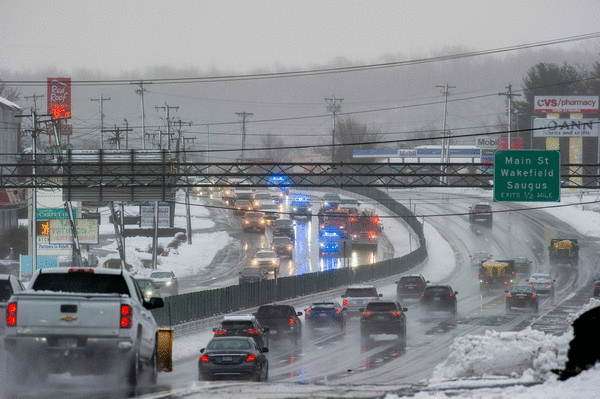
A massive winter storm reached the U.S. Atlantic Coast on Sunday, bringing heavy snow and ice, straining power grids and grounding thousands of flights at levels not seen since the pandemic.
Temperatures plunged on the storm’s eastward path. Parts of Texas and the Mid-South were coated in freezing rain — and a layer of ice thick enough to take down power lines. Up to 0.75 inches (1.9 centimeters) of ice is expected to accumulate across Nashville and surrounding areas through Sunday night.
Almost 933,000 homes and businesses across the U.S. — the majority of them in Tennessee, Mississippi and Louisiana — were without electricity at 12:36 p.m. ET.
Air travel has all but ground to a halt in some cities. The storm forced more than 16,000 cancellations from Saturday through Monday, according to data from FlightAware.
By 10 a.m. Sunday, with snow falling, more than 80% of departures were canceled at Newark Liberty International Airport, LaGuardia and John F. Kennedy International Airport, based on data from aviation analytics company Cirium. Cancellations at Washington Reagan airport topped 90%.
New England may see up to 18 inches of snow through Monday, according to the U.S. Weather Prediction Center, with up to a foot possible in New York City. Some of that snow may fall as sleet, potentially icing roads.
New York City officials announced that its approximately 500,000 public-school students would have remote instruction on Monday.
Electric grids
The Texas grid will face tight conditions through Monday as demand continues to climb. The U.S. Energy Department ordered the state’s grid operator to use backup features at data centers in periods of extreme stress. Electricity usage there will approach 76 gigawatts Sunday evening and then top 84 gigawatts Monday morning, which would be a winter record and close to the all-time high, according to the Electric Reliability Council of Texas, the grid’s operator. (A traditional nuclear reactor has a capacity of one gigawatt.)
Early Sunday morning, the Energy Department said it had issued an emergency order that authorizes the biggest U.S. grid — PJM Interconnection — to run resources regardless of limits established by environmental rules or state law. The goal is to help the mid-Atlantic mitigate blackouts during the storm. PJM spans 13 states and includes Washington, DC.
Wholesale electricity prices rose to about $1,200 per megawatt-hour in Virginia, Maryland and Washington as of 10:30 a.m. That was more that double the grid-wide price on PJM’s system. Demand has surged in northern Virginia as data centers crowd the area, leaving that section of the grid particularly constrained.
Another grid, ISO New England, on Sunday issued a precautionary alert, citing the cold temperatures and snow in the forecast. New England was generating 40% of its electricity by burning oil as of 10:30 a.m., as wholesale natural gas prices soared.
On Saturday, the grid managed by the Midcontinent Independent System Operator, which stretches from the Great Lakes to the Gulf Coast, faced an energy shortage and need to reduce demand.
Even as snow and sleet precipitation begin to taper off, the risk of power shortages or blackouts will increase in some places Monday.
Snow and ice are unlikely to melt anytime soon. Temperatures are forecast to remain “bitterly cold,” forecaster Paul Ziegenfelder of the Weather Prediction Center wrote Sunday, making travel difficult and likely causing power demand to remain stubbornly high for days.
The country’s natural gas system also faces greater risk of equipment failures and wells freezing off, which risk curtailing critical fuel supplies to generators. Refiners and chemical plants on Texas’ Gulf Coast, meanwhile, shuttered units amid the deep freeze, according to filings.
_____
(With assistance from Brian Eckhouse, Brian K. Sullivan and Mary Hui.)
_____
©2026 Bloomberg L.P. Visit bloomberg.com. Distributed by Tribune Content Agency, LLC.






Comments