'Let Politicians Lie Act' struck down by Missouri Supreme Court. What that means
Published in News & Features
The Missouri Supreme Court on Friday unanimously struck down a state law deployed by Republicans to fight abortion access, a sweeping ruling that wrestles power away from top statewide officials.
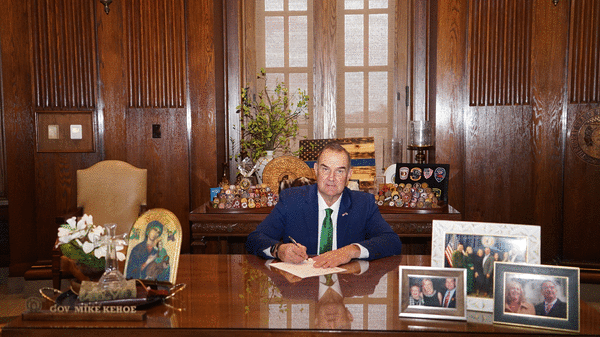
The law, signed by Republican Gov. Mike Kehoe last year, marked a key tool in Republican officials’ yearslong effort to halt abortions. It severely restricted judges from rewriting misleading ballot questions and gave the state’s attorney general the ability to appeal temporary court decisions.
Together, those provisions led to the law’s downfall. The state’s highest court ruled that the law, called SB 22, violated the Missouri Constitution’s requirement that lawmakers cannot amend bills to change the legislation’s original purpose.
“SB 22 as enacted violated its original purpose,” Chief Justice W. Brent Powell wrote in the majority opinion. “The power (the law) grants to the attorney general goes beyond SB 22’s initial purpose related to ballot summaries.”
The law, which critics dubbed the “Let Politicians Lie Act,” has played a central role in a series of courtroom battles over abortion. It provided the Missouri Secretary of State’s Office and the Attorney General’s Office, both led by staunch anti-abortion Republicans, newfound powers over court rulings and ballot measures they disagree with.
In recent months, the law allowed Republican Secretary of State Denny Hoskins two shots at writing his own ballot question for a proposed abortion ban that will appear on the ballot in 2026. Hoskins’ language, which did not mention the ban, was ultimately struck down.
Before that, former Attorney General Andrew Bailey, a Republican, deployed the law to appeal a temporary court decision that restored abortion access. Bailey’s fights against the ruling led to a temporary statewide abortion ban for months last year despite voters legalizing access in 2024.
Chuck Hatfield, a prominent Missouri attorney who sued to strike down the law, told The Star on Friday that the ruling was a reminder to state lawmakers, who often combine multiple provisions in bills in violation of the state constitution. He said he hopes lawmakers learn from the decision.
“This is a unanimous decision of the Missouri Supreme Court and I would think that the legislature should take note of that,” said Hatfield, who sued on behalf of Sean Soendker Nicholson, a Missouri activist. “This wasn’t a close call.”
Spokespeople for Attorney General Catherine Hanaway, whose office defended the law in court, and Hoskins did not immediately respond to requests for comment.
Despite the criticism, top lawmakers repeatedly defended the law. Senate Majority Leader Tony Luetkemeyer, a Parkville Republican, told The Star last year that the legislation gave statewide elected officials more of a say over ballot language.
“It doesn’t completely take away the power of the courts to rewrite ballot language,” he said. “It just says if the court finds fault initially with the legislature’s language, that we have other representatives of the people that have an opportunity to then weigh in and try to correct those mistakes.”
In addition to abortion, Friday’s ruling could have sweeping implications for a series of ongoing fights over direct democracy. Republican statewide officials will no longer have the power to recast statewide ballot measures on abortion access and other issues they disagree with in politically charged language.
The decision also came amid an ongoing trial in Kansas City over the fate of abortion access, the state’s most consequential test of abortion rights in recent history. The looming court decision could either widely expand abortion services in the metro and across the state or sharply curtail them indefinitely.
_____
©2026 The Kansas City Star. Visit at kansascity.com. Distributed by Tribune Content Agency, LLC.





Comments