State doesn't have enough money for affordable housing fund, lawmakers say
Published in News & Features
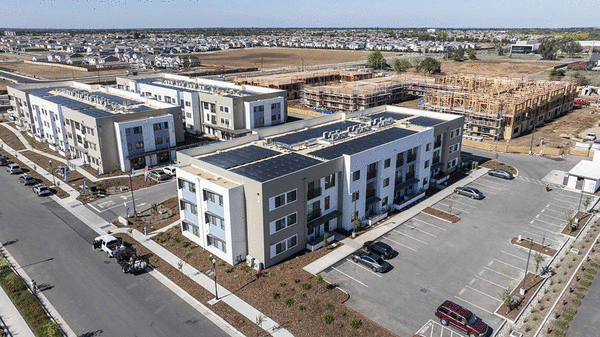
SACRAMENTO, Calif. — California lawmakers halted a legislative proposal to pump funding into combating homelessness and housing insecurity on Thursday, as the Assembly Appropriations Committee confronted a state budget deficit that may not let them address one of California’s most troubling issues with funding at the scale they would like.
Bills that did not escape the committee are effectively dead for the year because of a Jan. 23 deadline. The Assembly and Senate appropriations committees issued fateful rulings on legislation Thursday, together killing 13 bills. The powerful committees weigh in on any legislation that carries a meaningful cost for state government.
On the housing front, the Assembly committee killed a proposed constitutional amendment that would have earmarked 5% of the state’s general fund — more than $12 billion under this year’s budget projections — to build housing and fund services to the state’s homeless. The committee’s chairwoman, Democratic Assemblymember Buffy Wicks, was a cosponsor on the bill, called the Housing Opportunities Made Equal Act.
But Wicks told reporters after the hearing that considering estimates from the Legislature’s fiscal analyst put the deficit at $18 billion, lawmakers have to halt for now, some initiatives they would otherwise advance. “Our budget realities are what they are this year,” Wicks said, “yet again.”
However, Wicks is pushing for the Legislature to pass Assembly Bill 736, which would put a housing bond in front of voters across the state. The goal of the measure is to generate billions for affordable housing developments. The effort has stalled in recent years, but she and other advocates are hopeful it will move forward this year and be on the ballot in one of this year’s statewide elections. Democratic state Sen. Christopher Cabaldon also has his own housing bond bill.
Lawmakers who sit on both appropriations committees have already decided the fate of the bills before they take the dais. The bills move through a swift process as the committee votes are announced.
On the Assembly side, Wicks denoted which bills died by describing them as “held in committee.” Of the 54 bills up in committee Thursday, 10 were killed, including the housing funding measure.
On the Senate side, the Appropriations Committee held back three of 32 bills.
In the Senate, legislation that is killed goes unmentioned in the hearing, but among the fallen was Senate Bill 347, which would have lowered an annual state tax on limited liability companies and was expected to cost the state $400 million annually; Senate Bill 277, which would have only allowed police officers to request to search someone who they reasonably suspected had criminal evidence on them; and Senate Bill 560, which would have scaled back existing penalties for welfare fraud, including raising the threshold for punishment from $950 obtained or retained to $25,000. The committee made no comment on why it decided to kill the bills, and the authors were not present.
The Senate Appropriations Committee also removed provisions related to stricter regulation of the supplements kratom and 7-Hydroxymitragynine, otherwise known as 7-OH, from a bill cracking down on the sale of nitrous oxide. The bill, SB 758, will now move forward as a more narrow effort to prohibit retailers from selling nitrous oxide except for culinary purposes.
Among the nine other bills killed by the Appropriations Committee were Assembly Bill 405, which would have required the fashion industry to begin reporting its carbon emissions, and a measure carried by GOP Assemblymember James Gallagher that sought to create a new, eight-letter vanity license plate. Funding raised by selling the plate would have supported rural programming like open-space protections and state fairs.
©2026 The Sacramento Bee. Visit sacbee.com. Distributed by Tribune Content Agency, LLC.





Comments