Michigan nears ban on phones in school during instructional time
Published in News & Features
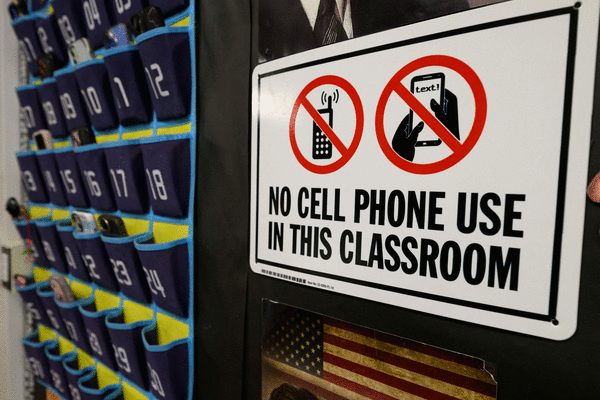
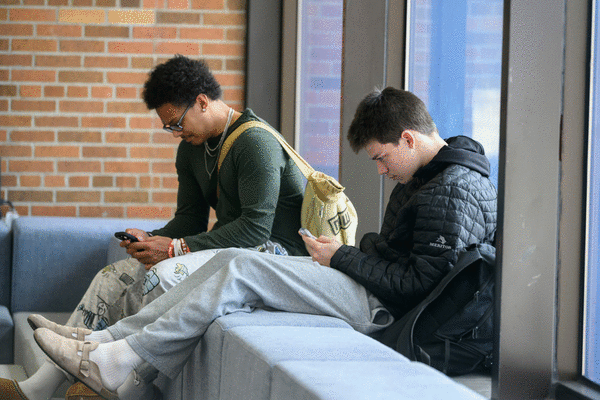

LANSING, Mich. — The Michigan Senate voted overwhelmingly Thursday to ban students from using cellphones in public schools during instructional time, setting the legislation on a path to Gov. Gretchen Whitmer's desk.
Under the proposals, which represent a compromise between the Republican-controlled House and Democratic-controlled Senate, school districts would have to create their own policies by next school year that, at a minimum, prohibit cellphones from being used during instructional time. Districts could also act earlier or go further to completely outlaw phones and other devices, but the decision on whether to exceed the new minimum standard would be up to local officials.
The Senate voted 34-1 in favor of the main bill in the package. Only Sen. Michele Hoitenga, R-Manton, voted no. The House approved the same measure last week in a vote of 99-10.
Sen. Dayna Polehanki, D-Livonia, a former teacher, told reporters Thursday that by putting the blanket ban into law, she hoped it would help school staff with enforcement.
"There's a basic agreement among everyone that students should not be scrolling social media and doing other things that are not related to school during instruction," Polehanki said.
Polehanki worked on the bills, across party lines, with state Rep. Mark Tisdel, R-Rochester Hills, who first introduced similar legislation in 2023.
Tisdel has estimated that about 40 of the more than 500 school districts in Michigan already have cellphone policies that are enforced. But the landscape of rules is a patchwork in Michigan, and a uniform state law on the issue gives school policies greater weight when challenged by students or parents, the Republican lawmaker contended.
About 18 states already have bell-to-bell bans on cellphones on school grounds, Tisdel said.
Hoitenga said Thursday that while she agrees that limiting cellphone use in schools can lead to positive educational outcomes, she doesn't believe more laws are necessary.
"Schools can already establish their own phone policies at the local level without a government mandate," said Hoitenga about the reason for her no vote.
Emergency exception bill passed
During Gov. Gretchen Whitmer's 2025 State of the State address, she called on lawmakers to pursue bipartisan legislation restricting cellphone use in classrooms. The Democratic governor cited "encouraging data" showing that restricting phone use during class leads to greater learning and less bullying.
"Kids listen, raise their hands and make more friends," Whitmer said in February 2025. "They talk during field trips. Three-quarters say they feel happy or peaceful without their phone. That’s what school should be about."
The governor is expected to sign the new bills when they reach her desk.
The main bill, sponsored by Tisdel, has already passed the House and Senate. However, a companion measure, sponsored by Polehanki, has only passed the Senate and could be voted on by the House as soon as next week. It would require districts to have protocols in place for allowing students to use their devices during emergencies.
The legislation affects more than just cellphones in school. It prohibits the use of "wireless communications devices" that are capable of text messaging, voice communication, accessing the internet or receiving photos and videos.
Tisdel said he believes the prohibition would affect devices like Apple Watches because they can access the internet and be synced with a cellphone for text messaging.
There are exemptions for school district-owned devices, such as tablets, and medically necessary devices.
Leader, students weigh in
Northville Public Schools Superintendent RJ Weber said his district changed its policy to allow students to carry their phones in their backpacks or keep them in their lockers, but the devices can’t be used during the day.
Weber said the district held focus groups with high school students who said they felt banning phones altogether wouldn’t be effective.
“My belief personally and the belief of the board…, we would rather educate and teach our kids with strong, clear policy about appropriate use, than to lock it down and take it away in such a way that feels more controlling,” he said.
Weber said parents also raised concerns about safety and about being able to communicate with their child in an emergency. Weber said he was empathetic to that.
At Farmington High School, a protocol is already in place for students to place their phones in pouches during instructional time. It's enforced on a case-by-case basis, Spanish teacher Jennifer Michaels said, based on how each teacher manages their classroom.
"I'm the one who says, 'No, when you're done with your work, you can talk to somebody,'" Michaels said. "You can play Jenga, you can play Uno, you can read a book."
The socialization, she said, is her biggest concern about kids having phones at school. They often struggle to plan ahead, she said, because they can text their parents throughout the day.
"I would love to see them not be able to access their phone," Michaels said. "It will be a learning curve."
As for the timing of the new ban taking effect across the state, it's set to begin next school year. But Polehanki said school districts might decide to get ahead of that deadline and begin their policies at some point this year.
"If I was a school leader, I would definitely jump on this this year, either through planning or community discussion," Polehanki said.
©2026 www.detroitnews.com. Visit at detroitnews.com. Distributed by Tribune Content Agency, LLC.






Comments