Is Haiti safe for TPS holders to return to? A federal judge hears arguments
Published in News & Features
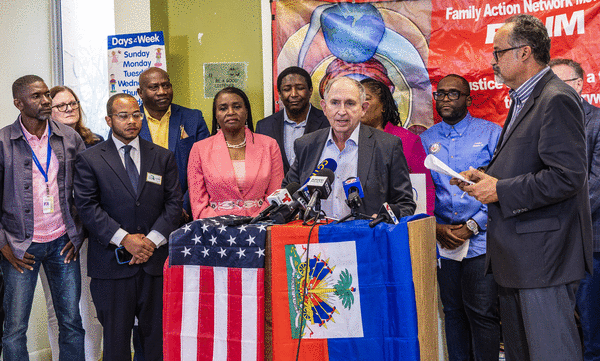
A federal judge weighing one of several court challenges to the Trump administration’s decision to revoke temporary legal protections for hundreds of thousands of Haitians in the U.S. is questioning how a dozen countries with the same benefit suddenly arrived at the same fate.
Judge Ana C. Reyes of the Federal District Court in Washington told government lawyers during two days of hearings that she’s having a hard time believing that the termination of temporary protected status designation for a dozen countries experiencing conflict, including Haiti, was not arbitrary.
“I just cannot believe that there was an individualized, not preordained decision, that objectively looked at every country,” Reyes said Weenesday. “That would be the first time in humankind… something like that had been found.”
Since starting his second term, President Donald Trump has focused on dismantling immigration protections for Haitians, Venezuelans and others in the U.S. as he pursues mass deportations. One of the targets has been TPS, which was created by Congress to protect people from countries experiencing armed conflict or humanitarian crises.
Under Homeland Security Secretary Kristi Noem, Trump has ended or initiated terminations affecting over 1 million people who had been allowed to legally live and work in the United States. The countries affected include Afghanistan, Cameroon, Ethiopia, Haiti, Honduras, Myanmar, Nepal, Nicaragua, Somalia, South Sudan, Syria and Venezuela.
The moves have triggered a slew of lawsuits, including the class-action lawsuit, Miot et al. v. Trump, before Reyes. Plaintiffs in the case argue that Noem violated administrative law and the Constitution when she terminated Haiti’s TPS designation as of Feb. 3, 2026. Last year, their lawyers, including those with the firm of Miami-based immigration attorney Ira Kurzban, successfully persuaded another federal judge in New York to block an earlier attempt by the administration to end protections for Haitians before their expiration date.
After the department announced in the Federal Register that TPS protections will end in February, the plaintiffs sued again, arguing that the decision was unlawful and unsupported by conditions on the ground in Haiti. They are arguing that the decision was also based on racial animus rather than on the required assessment of safety in Haiti and want Reyes to put the revocation on hold while the case proceeds.
Over two days, Reyes pressed government lawyers on the scope of Noem’s authority, particularly her power to make determinations based on what the administration characterizes as the national interest. Justice Department attorneys argued that the secretary has broad discretion to make such determinations, and they are not reviewable by the courts.
Reyes, however, seemed unconvinced. As the government argued that Haitian migrants were a strain on local communities, she cited estimates that Haitian TPS holders contribute roughly $10 billion to Florida’s economy alone, and then asked: “You think it’s in Florida’s national interest to get rid of these people?” At another point, she posed a hypothetical aimed at whether Noem’s decision is arbitrary: Could the secretary decide it was in the national interest to end TPS for Haitians because she doesn’t “like vanilla ice cream?”
Justice Department attorney Dhruman Sampat responded, “I don’t know,” and after being challenged by Reyes, he said, “Yes, your honor,” Noem’s authority can go that far. “That sounds like an economic consideration to me,” he said.
Reyes also noted that Secretary of State Marco Rubio, who in May designated Haiti’s most powerful gangs as foreign and global terrorists, acknowledged the “immediate security challenges” in the Caribbean country. The judge also read documents about the Federal Aviation Administration barring U.S. aircraft from flying into the country’s main international airport after gangs fired on three U.S. airliners.
As Reyes turned her attention to the department’s own justification for ending TPS for Haiti and what she said was “a dozen countries,” she laid out the contradictions in the Federal Register.
“It seems odd to me to say it’s perfectly safe to return to Haiti and then, in the same breath, say that there are gangs running rampant in Haiti,” Reyes told government lawyers, questioning the administration’s rational in acknowledging the country has no functioning government, yet saying it’s safe for Haitians to return.
She added that she was troubled by what appeared to be a “preordained” decision by Noem. “I have to say that is one of my biggest concerns here,” she said.
2010 earthquake
TPS was first granted to Haitians after the devastating Jan. 12, 2010, earthquake. Since then, Haiti has endured repeated disasters and prolonged political instability, including the 2021 assassination of President Jovenel Moïse.
Today, armed gangs control large swaths of the capital, where the United Nations says a quarter of the population lives in a gang controlled neighborhoods, and roughly half of the population, around 5.7 million people, do not have enough to eat. The incessant violence, which includes rapes, kidnappings and killings, have forced more than 1.4 million to flee their homes and is spreading to other regions.
Nevertheless, the Trump administration argued to Reyes over two days that there are safe havens in Haiti that migrants could go to, even though it was unable to cite them.
On Wednesday, the government’s lawyer even painted a positive image, saying that Haiti was making progress. “Things seem to be trending in the right direction,” the lawyer told Reyes.
As proof, he said, a new constitution was being drafted, there was aggressive prosecution of corruption and voters were being registered for elections.
Those assertions are sharply disputed. Plans to rewrite the constitution were abandoned last year, no corruption cases have been prosecuted despite investigations, and government officials in December approved a decree shielding themselves from prosecution after leaving office. Meanwhile, after being installed in April 2024 to help run the country, a nine-member Transitional Presidential Council is set to end its mandate on Feb. 7 without scheduling elections, which last took place in 2016. The approaching deadline has raised concerns of more political turbulence.
Reyes, who before becoming a judge litigated immigration cases as an attorney, also brought up a discrepancy in the number of Haitians that could be affected if the Trump administration’s revocation is allowed to stand.
While Homeland Security’s Federal Registry notice said there are 352,959 people under Haiti’s TPS designation, a public record search shows 568,545 Haitians would be vulnerable to deportations. Reyes noted that based on the Homeland Security’s number of Haitians found to have had committed some sort of fraud to get TPS, it constitutes 0.4% of the larger number.
The government lawyer, who struggled to do the math, acknowledged he did not know the nature of the fraud. “I’m not sure how they define fraud when they ran that,” he said.
Reyes said she plans to make a decision as of Feb. 2, the day before the designation is set to end.
©2026 Miami Herald. Visit at miamiherald.com. Distributed by Tribune Content Agency, LLC.






Comments