Baltimore County has received $29 million in opioid settlements. Where is the money going?
Published in News & Features
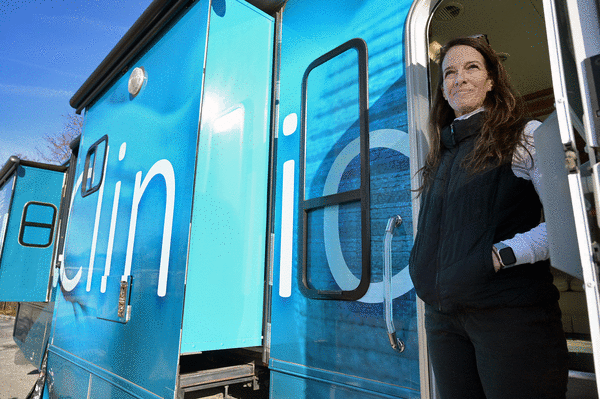
Ten years ago, Lauren and Dan Reck opened the doors of the first two MATClinics offices in Dundalk and Towson, intending to improve access to outpatient addiction treatment services.
The for-profit venture, which provides medication-assisted treatment, behavioral health services and case management, has since expanded to eight offices across the state. Despite the broader offerings, some patients are still struggling to get in-person care, whether they’re from a rural corner of the county or are facing barriers accessing public transit.
Now, those services are available beyond the confines of a brick-and-mortar office: inside a bright blue, 35-foot RV funded by a roughly $200,000 grant from Baltimore County’s opioid abatement fund, which aims to address harm caused by the opioid epidemic.
Since February 2023, Baltimore County has received more than $29 million from various legal settlements, according to a state report outlining distributions and spending by each county and municipality. The county has spent about $4.2 million as of the end of fiscal 2025 — June 30.
Elise Andrews, Baltimore County’s opioid strategy coordinator, said the county is trying to carefully plan out distributions to various agencies and organizations to ensure that the programs that get funding are sustainable.
“The last thing we want to do too is start a bunch of initiatives that then, all of a sudden, we’re going to have to tell them to stop,” Andrews said. “Because once people start relying [on them], whether it’s harm reduction and a mobile harm reduction van where they’re getting safe supplies and receiving that trusting relationship, or if they’re receiving mobile treatment, or if they’re going to the STEP clinic, we need to make sure that they can continue to access that, [or] else we’re going to be right back in the same position.”
For those working in drug addiction prevention and recovery, the money has been a welcome means of improving services in the county.
The mobile unit is one of several newer programs supported by the fund, which receives money from the national opioid settlement agreement — legal settlements with pharmaceutical manufacturers and distributors spurred by the damages caused by opioid overdoses over the decades.
MATClinics bought and renovated the RV earlier this year, transforming it into a mobile treatment unit that hits the road three days a week, parking at the Westside Men’s Shelter in Catonsville, the Essex library and a shuttered Rite Aid on Reisterstown Road in Pikesville, to provide nearly all of the same services found within a typical doctor’s office setting.
“I thought it was a really good opportunity to take what we do and put it on wheels,” Lauren Reck, co-founder and program director of MATClinics, said of her decision to apply for the grant.
Baltimore County has struggled with high overdose death rates. From 2014 to 2018, the number of opioid-related overdoses doubled, according to Maryland Department of Health data, before dropping slightly in 2019. However, the numbers ticked up again in 2020.
“COVID happened, and people became more stressed. They lost access to their treatment. The world turned on its head for people,” Andrews said. “The fragile state … of treatment and recovery, it just eluded people’s ability in those tough times to be able to maintain that.”
While in-person harm reduction efforts and treatments were hampered at the time, the illicit drug supply didn’t stop, Andrews added. But over the past three years, the number of overdose deaths in the county dropped from 361 in 2021 to 179 in 2024, state data show.
“What does the evidence tell us helps?” Andrews said. “Harm reduction, access to medication, engaging people in treatment and recovery, getting peer support professionals out there.”
Where the money is going
The settlement funds may only be used for specific purposes such as the distribution of naloxone — which can reverse opioid overdoses — and training for administering the drug, medication-assisted treatment and recovery services for people who are pregnant or postpartum as well as treatment for babies affected by drug withdrawal. The funds also may be used for prevention and harm reduction efforts, as well as treatment for people who are incarcerated.
Much of the county’s initial spending has funded a state-mandated medication for an opioid use disorder program at the Baltimore County Detention Center, making three Food and Drug Administration-approved medications available for people incarcerated there, county records show.
The money has also paid for a provider that treats substance use disorder and mental health, and gives medication for opioid use disorder, all at one centralized location, for participants in Baltimore County Circuit Court’s drug treatment court program.
Some of the funding has supported additional staff for a Department of Social Services program for babies born exposed to substances, Andrews said, as well as vending machines that dispense naloxone. The machines are posted at county health clinics, several government buildings and all 19 library branches as of this summer.
“Every penny of this is significant because it is lives lost — that’s why we have this money,” Andrews said.
Last year, the county set aside $1 million to launch a grant program to support opioid remediation projects, focusing on harm reduction, mobile services, expanding access to medication for opioid use disorder and serving people who are homeless or pregnant. Applicants submitted plans detailing their budgets and goals, which a committee reviewed to determine whether the proposals aligned with the county’s overdose response priorities before funding was approved.
MATClinics was one of five grant recipients — and the second to bring their services on the road.
The Daniel Carl Torsch Foundation — a nonprofit founded by Toni and Carl Torsch in 2011 after their 24-year-old son, Dan, died from a drug overdose — also received nearly $184,000 for an orange van stocked with food and other supplies. It offers one-on-one case management services as well. The money also funds extra peer support staff for the foundation, which serves about 400 people a month.
Enduring ‘stigma’ of addiction treatment
Toni Torsch said transportation and stigma about getting help for substance use remain an issue in Baltimore County, even when people seek help from county-run clinics for clean syringes, for instance.
“They feel the stigma, whether it’s there or not; they just, they feel something,” she said. “We’re bringing services to them … no judgment — the only thing that we pack is a lot of compassion and services. We no longer ask why. We’re asking, ‘What. What can we do for you? How can we help?'”
MedStar Franklin Square Medical Center in Rosedale received nearly $250,000 to help pregnant women and new moms with opioid use disorder when they enter the health care system.
“There’s often (a) shame component tied to opioid use — fear of retribution or fear of what the consequences could be for them or for their child,” said Lucas Carlson, an emergency medicine physician and regional medical director for care transformation at MedStar. “What we are doing is working to make sure that that stigma is reduced across the health continuum.”
Another part of MedStar Franklin Square’s funding is creating a recovery health navigator position to help new and expectant mothers get treatment and resources. The hospital is also developing an opioid use disorder treatment protocol for its OB-GYN practices as well as its inpatient labor and delivery units.
“We don’t want to shame patients, and we don’t want to shame our providers for what they don’t yet know,” said Susanna Derocco, who coordinates the Healthy Babies Collaborative at MedStar. “There’s not a lot of training in medical school for this particular patient population, and we want to offer tools to help create an environment where people feel equipped to provide the best care possible.”
More in-person services
Other health care organizations that received funds for opioid abatement are trying to bolster their in-person care services.
In June, Chase Brexton, a nonprofit medical center, expanded its STEP (Substance Use Treatment Enhancement Program) Clinic to Security Square in Woodlawn after launching a similar clinic at its Mount Vernon headquarters last year. The health care provider received more than $214,000 in opioid grant money for the new clinic, as well as salaries for providers there and outreach to the community, said Jessica Friedman, a family medicine physician and the program manager for the STEP Clinic in Woodlawn.
The clinic aims to give patients peer support and medication-assisted treatment like buprenorphine or Suboxone for substance use disorder, as well as primary care services, in a less regimented way to provide flexibility for people who are recovering and balancing other life responsibilities, like a job or caring for family.
“Particularly for opioid use disorder, we know that medication itself is treatment, that the medication has a remarkable success rate in terms of reducing overdose and the harms of substance use, and helping people to enter and maintain recovery from addiction,” Friedman said. “So these medications can and should be prescribed in a primary-care setting to people who want and need them.”
Health Care for the Homeless, a Baltimore-based federally-qualified health center that provides medical, dental and behavioral health care, as well as housing services, also is boosting its suburban services.
The organization is working to set up a walk-in medication-assisted treatment space at its Rosedale location to deliver services to patients the same day, said Laura Garcia, its chief medical officer. It has also added a full-time nursing role and plans to add community health workers to help patients access services, all of which are aimed at helping a person’s physical and mental health, and ultimately, finding housing for them.
“It’s really helping us deliver more robust wraparound services to our most vulnerable neighbors,” she said. “This really allows us to focus on physical and mental health that, in the end, really furthers supporting rehousing efforts. Because, in the end, housing is health care.”
_____
©2026 Baltimore Sun. Visit baltimoresun.com. Distributed by Tribune Content Agency, LLC.



Comments