The fire took his sister and his lifelong home. He's been fighting to get back ever since
Published in News & Features







LOS ANGELES — Shortly after his childhood home burned down in west Altadena, Zaire Calvin learned his mom's insurance carrier had dropped her months before. He handled her bills but said he hadn't received any email or notice from Allstate before the January wildfire.
For weeks, he tried to get answers, waiting on returned calls, asking for proof of the warning, requesting to speak with managers to make sense of what happened. He never got any resolution.
The situation was infuriating, just one small piece of the pain and madness that consumed his life.
The fire didn't just take his mom's house. It killed his older sister.
It took his own home next door.
It destroyed the sanctuary his family set roots in more than 50 years before, at a time Black people struggled to buy homes in much of Los Angeles County.
As with so many others who survived the firestorms of Jan. 7, his days are about managing grief and logistics.
In the early months after the fire, Calvin, 48, logged hour after hour on freeways coordinating temporary housing for his wife and baby girl in Jurupa Valley and his mom in Glendale, while getting to his coaching jobs in Pasadena and Westlake Village. At some points, exhausted, he slept in his car outside his family's burned properties, watching over the space. Sometimes he crashed at friends' homes.
"To go from having multiple homes to couch-surfing is insane," he said. "You feel homeless."
Calvin, known throughout Altadena as "Coach Z," has refused to allow the insurmountable loss to immobilize him. He has become a voice for Altadena at large and especially for the Black community, which made up nearly 20% of the town. He speaks against insurance gouging and predatory behavior among developers, and he makes sure the students he coaches in football and physical training, many affected by the fire, listen too.
All the while, he juggles calls and texts from residents, family members and local representatives seeking advice on recovery efforts.
When should I start rebuilding?
When should the community return?
Who can I trust to help?
The questions never end.
Earlier this year during a state Assembly hearing, he spoke in favor of legislation to protect against unsolicited requests from developers seeking to buy properties from fire survivors as they reeled from the crisis. Lawmakers said Calvin's testimony helped them understand the true breadth of the problem and how in those early months, vulnerable residents were preyed upon. The bill ultimately passed.
It's easier to stay in motion than to sit still with the pain, he says.
As night fell on Jan. 7, the Santa Ana winds picked up in Altadena. Below the foothills at Charles E. Farnsworth Park, the coach and his students from schools throughout the area and one of his football players from Oaks Christian High School had gathered for a physical training circuit through Calvin's Xtreme Athletics program.
In the distance, an orange haze was growing in the mountains to the east. They nervously headed home.
Calvin turned on East Las Flores Drive, threading under the canopy of crape myrtles, pines and deodar cedars, and pulled up to his Midcentury ranch home and ran next door to check on his mom.
His mom, Evelyn Yates Cathirell, bought his childhood house in the 1970s. She wanted to be close to nature and, at a time discriminatory lending and real estate practices kept people of color out of many neighborhoods, it was one of the few places that a Black family could own property.
Her family had come to Los Angeles in the late 1800s from Texas. Cathirell grew up in Echo Park, the daughter of Evelyn Thurman Gratts — an influential pioneer in education who pushed for desegregation.
Cathirell made her own mark on her community in Altadena. She helped found the town's first mosque, Masjid Al Taqwa, which would burn down in the fire. She was a longtime karate instructor and was also tied to the arts community. Zorthian Ranch, the zany artist compound, was a second home for Calvin, who loved to ride horses there.
When Calvin's big sister Evelyn would come home from college at Loyola Marymount University, they'd play board games for hours. Monopoly and Life — times he cherished while sitting on the living room floor's plush red carpet, so famous for its comfort that it was his John Muir High School football teammates' favorite place to nap in between Hell Week practices.
Shortly before 4 in the morning, he was standing on that carpet telling his 84-year-old mom they had to leave. The wind was roaring now, up to 65 miles an hour.
His sons, 19 and 25, and 30-year-old nephew evacuated. He thought his sister, who lived in his mother's back house, had already left.
It was pitch-dark when he drove out through the tree-lined street, as heavy embers and fiery debris rained down.
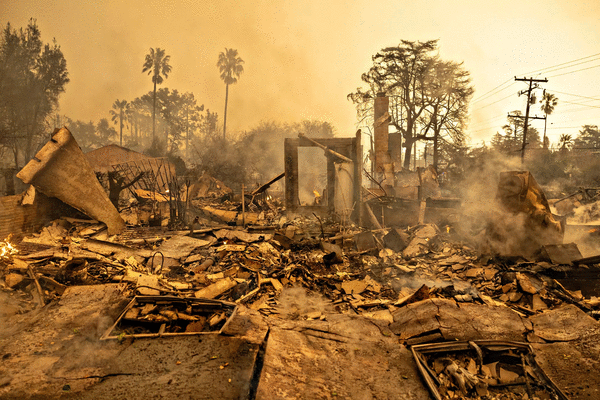
He doesn't quite recall the next morning, or how he learned his sister, Evelyn McClendon, never escaped. Both houses burned to the ground. At some point, he and his cousin dug through the rubble, futilely looking for her remains.
"When you're moving in panic, everything moves in slow motion — like war," he said. " I don't even know who told me everything was gone — all that's blocked out. I don't remember any of that. I don't have a memory of when I saw it."
McClendon, 59, became one of the first reported fatalities in an inferno that took 19 lives. All but one person who died in the Eaton fire was from west Altadena, where officials waited to issue evacuation orders long after the fire had erupted.
Staring out the window of her room at the senior care facility in Glendale, Cathirell , 85, longs to be back in her neighborhood where family and friends were never far away. She misses her daughter, her namesake, and weeps at the sight of school buses. They remind her of the younger Evelyn, who drove them for a living before retirement.
"I shed tears for her every day," Cathirell said.
She misses her home, where she raised her six children. It was the hub for family gatherings. She misses the kitchen, her favorite room. She had a background in culinary arts and cooking had always been her passion. Collard greens, fried chicken, navy bean pie and tacos were a constant inside her home. Outside, she grew bell peppers and squash and tended to the avocado and fig trees.
"I just want to visit my land," she tells Calvin often.
Time is ticking for him to rebuild and bring her back.
"It's a scramble to try to put everything back together," he said. "I'm in the exact same limbo as the community where I'm trying to help everyone move forward."
Evelyn, who was more than 10 years older, poured advice on Calvin as a kid that grew into deep heart-to-heart talks as adults. She told him that no matter how difficult life got, to always "stop and smell the flowers." That mantra has stuck with him as a reminder that he must always take time to be present on whatever journey he takes.
She talked at length about her faith in God. The only comfort Calvin has in grappling with his sister's death is knowing that she believed in a higher protector and an afterlife. But he still hasn't been able to process her loss.
"It's hard to reflect when you're still in denial. When I'm still wondering why she's not here," he said. "She deserves to be here."
He always loved the house next door. As a kid, he'd dart between the hedges that separated the two, playing in both yards. When he was young, he told his next-door neighbors it was his dream to live in it one day.
He purchased the property more than a decade ago. Calvin recently stripped the house to the studs for a remodel, making the window-lit Midcentury Modern home truly his own.
His daughter's safari-themed nursery was lined with custom giraffe wallpaper. The main bedroom opened onto the backyard, where on warm days, music would play while family and friends lounged in the pool and jacuzzi or sat around the fire pit. In the backyard, his daughter learned to walk in the grass.
A month before the fire struck, he and his wife held a "Winter Wonderland"-themed birthday party for their 1-year-old. About 200 people attended; many were neighbors and friends from Altadena. Relatives who lived on the same block and around the town were also there. Of the more than 10 homes that he, his mom and extended family had throughout the area, only three would survive.
Before the fire, more than 41,000 people lived in the unincorporated town below the San Gabriel Mountains. As with Calvin, it wasn't uncommon for people who grew up in Altadena to raise their own families here as adults, sometimes in the same homes they'd grown up in.
The fire wiped out more than 5,000 single-family homes and displaced thousands more residents, many of whom are still awaiting remediation for smoke damage. In recent months, frustrations have mounted amid ongoing fights with insurance carriers over coverage and a repayment proposal from Southern California Edison, whose equipment ignited the fire.
Calvin has resolved to rebuild both of his family's homes. He's working with a local architect who lost his own home and trying to move forward to set an example for other residents unsure of the road ahead. But he doesn't know how much of the cost will end up being out of pocket, or what the total cost will be.
"I just built my house from scratch," he said. "I understand how predatory the industry, the steps of confusion and just how frustrating the process can be. It's not something that you want a community to deal with."
He estimates that after the renovation, his house was worth about $2.1 million. He got a check from Farmers, his insurance company, for less than $300,000. He was underinsured, he said, and insurance hadn't finished updating its new estimate since his house had been renovated a year before.
"It's not like we did anything wrong," he said. "We did everything we were supposed to do."
At news conferences with the Eaton Fire Survivors Network and panel discussions about wildfire recovery, he has urged Gov. Gavin Newsom to call for state Insurance Commissioner Ricardo Lara's resignation and called for Edison to pay more. On a recent morning he made an impassioned speech about how his community was being taken advantage of by insurance carriers.
"We're tired of it. We're tired of fighting and being denied benefits," he said. "We're asking for justice. And justice is literally what we paid for. That's like paying for a car and someone taking your car away from you saying that you don't deserve it. It doesn't make sense."
That night, he sat on a panel at Victory Bible Church in Pasadena about recovery efforts. In a room filled largely with Black residents, he urged the crowd to keep pushing Edison for more in its repayment proposal.
Calvin's family sued the utility company earlier this year over the death of McClendon. He and many other residents believe the power company's current offering is a paltry sum that will cover only a fraction of what they lost.
"As a community, we have to stop feeling like 'I have just enough and that's OK. This is for somebody else.' That [payment] does not cover your pain and suffering and everything that we've gone through as a community," Calvin said.
"Make sure you do not bite your tongue when it comes to the Edison case."
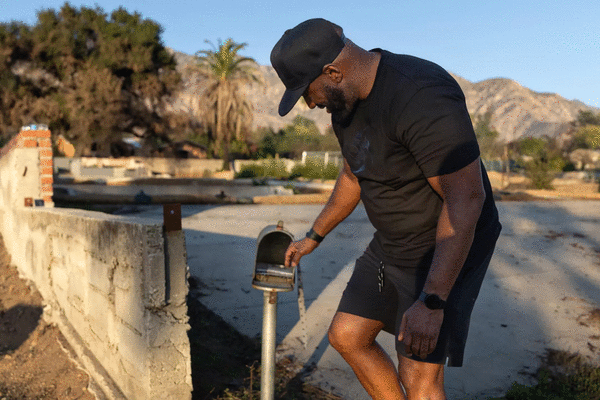
Calvin returned to his land on a recent fall day. He walked through the spaces where he and his sister used to reunite as kids, where his mother used to cook, where his daughter used to sleep. All just dirt now.
The mail keeps coming. Mortgage bills arrive each month.
Perched on what's left of the brick wall that used to surround his fire pit, Calvin takes in the view of the town he's known forever.
The reality of all that was lost nearly a year ago is staggering. As the holiday season picks up, it's hard not to think about who and what are missing now; celebration feels forced when grief persists.
Calvin doesn't think he'll be able to fully process the devastation until he's back — whenever that may be.
His sister is buried at the nearby cemetery; her memory lives here. The idea of leaving this place behind is something he can't fathom. He wants to bring his mother back to her land; he wants to give his daughter a chance to know her first home. He wants to see his town thrive again.
"We can build this community back," he said. "We deserve that."
©2025 Los Angeles Times. Visit at latimes.com. Distributed by Tribune Content Agency, LLC.






Comments