Chicago Public Schools lunchroom workers near 6 months without a contract: 'No one sees us'
Published in News & Features
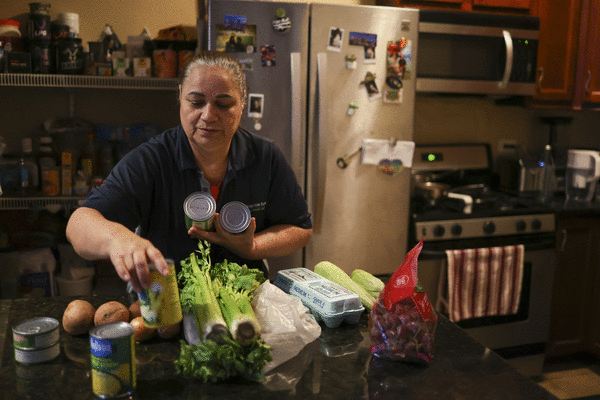
CHICAGO — Irma Garcia’s life revolves around food. Eight hours a day, she prepares hundreds of meals for students at James Russell Lowell Elementary School in Humboldt Park. She can list the menu offhand — popcorn chicken, pepperoni pizza, mozzarella sticks.
But at home, her kitchen shelves are often empty: Once a month after work, she leaves Lowell and visits a food pantry down the block. Bundled in layers on a recent afternoon, she walked home with four bags of produce and canned goods.
“We either pay our bills, or buy food,” Garcia, 55, said.
Garcia makes $21 an hour as a cook, which last year totaled $34,000 after taxes. She’s worked for Chicago Public Schools for 23 years.
Wages are the sticking point in the bargaining process for CPS lunchroom workers, who have been without a contract for nearly six months. The 1,800 members of UNITE HERE Local 1, including lunchroom attendants, cooks and porters, remain among the lowest-paid CPS employees. Many, like Garcia, say they struggle to afford basic expenses.
The union’s four-year contract expired June 30. Bargaining sessions began in early May, and negotiations have continued monthly, according to the district. But UNITE HERE maintains that there has been little progress.
“It’s been incredibly slow,” organizing director Patrick Griffin said. “I’ve been in a lot of different negotiations over the time that I’ve been with the union, and these are probably some of the slowest I’ve ever been in.”
The union is pushing for increased staffing, citing a ballooning workload after gradual position cuts. The number of lunchroom attendants — who assist with meal prep and cleaning — has dropped about 38.5% over the past decade, from 1,140 to 701 this fall, according to the district’s employee rosters. (District enrollment has declined too, though only 19.4% over the same period.)
This summer, CPS also eliminated about 250 vacant kitchen positions to help plug its $734 million budget deficit. Reduced staffing means simplified menus and fewer hot meals for the school year, the district told families.
_____
In her Humboldt Park bungalow, Garcia pointed to her wedding album, perched above her dining room table. Hours after her shift, she still wore her uniform, proudly sporting the district logo. She met her second husband, a now-retired cook, in a CPS kitchen in 2000.
Before she remarried, Garcia was a single mother raising four young children. Even then, money was tight: She shuffled through odd jobs in between shifts, from cleaning houses to delivering food. More than two decades later, she relies on her 30-year-old son for help covering bills.
After visiting the food pantry — where she also volunteers — Garcia carefully stacked cans on her kitchen shelves. “They don’t see us,” she said of the district. “No one sees us. They just know that the kids get fed.”
Pay for lunchroom workers is based on experience and position. A first-year attendant makes $16.78, just above the city’s $16.60 minimum wage. The most senior role, an associate lunchroom manager, makes $23.36. Under the union’s previous contract, each position received annual raises ranging from 1.5% to 2%.
In its new wage proposal, CPS offered across-the-board raises ranging from 8.6% to 31.5%. (To be sure, only 22 associate lunchroom managers would receive a 31.5% raise. More than 1,600 employees would receive raises under 12.6%.) The district also proposed eliminating a tiered system for associate managers and cooks, which would provide more predictable pay, a spokesperson said in a statement.
“CPS values the dedication and hard work of its staff and remains committed to working closely with its labor partners,” the spokesperson said.
UNITE HERE officials countered that it isn’t enough. “We have a long way to go,” Griffin said. “The folks that work in the lunchroom … are so far behind the other people that might work as janitors, or any of the support staff positions.”
UNITE HERE is a smaller player compared to CPS’ other unions, including the powerful Chicago Teachers Union, whose contentious bargaining this year soured relations with district leadership. Under CTU’s new, four-year contract, the average teacher salary is expected to exceed $110,000. The entire agreement will cost the district $1.5 billion over four years, with 80% of those costs allocated for raises to offset the cost of living.
Under the district’s proposals, future annual raises for lunch workers would follow the cost-of-living adjustment formula applied to the CTU and SEIU Local 73, which represents school-based support staff.
_____
Ivery Pierre held her daughter’s hand tight as they weaved through icy Chicago Lawn sidewalks. The sun had just begun to rise above Marquette Elementary School. Pierre’s daughter, 10-year-old Somaya, bounded through the doors of the red-brick building.
This was their ritual: Pierre, 27, starts her shift as a cook and prepares students’ breakfasts. About 8 a.m., she takes her break to walk Somaya to McKay Elementary, five blocks south. Then, back to work.
“I love the kids. I come to the school for the kids. I make it my business to be known in children’s lives,” Pierre said, her breath fogging in the cold air. “When I was that age, I wanted someone to love me, and be there for me.”
Pierre was a 16-year-old CPS student when she became pregnant with her daughter. As a young mother, she completed her high school’s culinary program and started working as a district cook shortly after graduation.
But Pierre’s CPS wages only stretch so far, especially during the holidays. She makes $23 hourly. “I’m thinking, ‘How am I going to be able to pay my rent?’” she said. “Then, we have Christmas coming up. And (Somaya’s) birthday is in December. … I struggle very hard.”
Across the country, many school districts are experiencing high vacancy rates and turnover in cafeterias — largely because of low wages, according to Jennifer Gaddis, a University of Wisconsin Madison associate professor who studies food labor and policy. A 2024 study found that school food service workers make an average of $3.16 less than custodial staff.
“It is much harder to not only improve meal quality, but also to provide a really caring, constructive environment for young people in schools when you’re dealing with that much turnover,” Gaddis said.
Lunchroom workers are significantly more female and older than the average workforce, Gaddis noted. More than 90% of UNITE HERE Local 1 members are people of color, according to the union.
Staffing has been trending downward nationally as more schools shift from scratch kitchens to pre-made meals. In 2012, UNITE HERE Local 1 officials negotiated a contract temporarily preventing CPS from converting more full-cooking kitchens into warming kitchens.
But after summer budget cuts, fewer hot lunches are being served in schools, according to CPS officials. The district’s supplemental afterschool programs transitioned from hot suppers to pre-packed snacks because of reduced staffing.
_____
Alexis Camarena always dreamed of being a chef. As a teen, he watched videos of celebrity chefs Jacques Pépin and Julia Child making elaborate French meals. He’s still passionate, even after eight years in CPS kitchens.
“When I present it, if it’s broccoli, I want to make sure it’s thawed all the way out, so when they get it, it’s not mushy,” said Camarena, 29, a cook at Cesar Chavez Multicultural Academic Center. “I want it to be authentic. I want to make sure when they get it, it’s good, not just like, ‘Oh, I just put this in the oven and I burned it.’”
He bounced his 1-year-old daughter, America, on his lap in his West Lawn home. She babbled happily. It was a rare, quiet afternoon for the pair: Most days, Camarena works a second job as a security guard. He’ll spend the day in the lunchroom, then pick up an hourslong shift for an event.
“I can’t just sit around knowing that we’ve got these bills to pay,” Camarena said from his couch. His wife also works full time.
Camarena sits on the union’s rank-and-file bargaining committee. He seethed at the district’s latest raise and tiered-pay proposals. “What they presented, I think it’s a slap in the face,” he said.
_____
©2025 Chicago Tribune. Visit chicagotribune.com. Distributed by Tribune Content Agency, LLC.






Comments