Virginia Gov. Youngkin's last budget includes $50 million to improve Child Protective Services, foster care
Published in News & Features
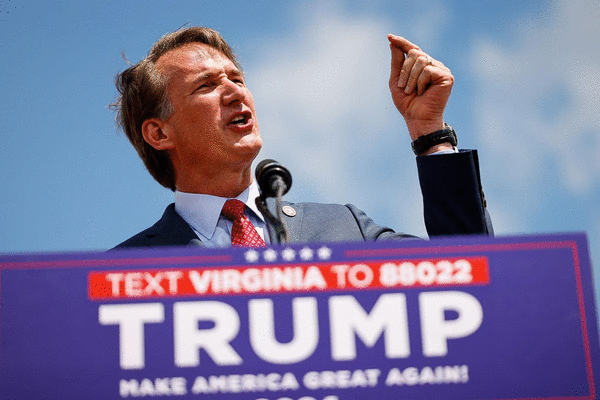
Virginia Gov. Glenn Youngkin will present his final budget proposal to the General Assembly on Wednesday. Part of that proposal will include $50 million for child welfare, he announced at an event in Richmond Monday.
The funding is part of a three-year child welfare strategy that includes centralizing the Child Protective Services intake process and getting better pay for social workers.
“When there is a system that isn’t working, no single bill, no single program, no single person can change it,” Youngkin said.
The first pillar of the plan, billed as Safe Kids, Strong Families, is strengthening the workforce.
“This work takes a toll, both personally and professionally,” said Virginia Secretary of Health and Human Resources Janet Kelly. “Family services specialists have a turnover rate of 44% every year … and vacancy rates (are) at 67% at some local Department of Social Services offices.”
A portion of the budget, $10 million, would go toward raising the minimum salary for family services specialists. In 2024, an entry level social worker at DSS — a job that requires a bachelor’s degree — made $37,000.
The second component of the plan involves revamping and standardizing the Child Protective Services intake process. The bulk of Youngkin’s child welfare budget item, $32.7 million, would go toward building 24/7 statewide intake system with 132 people on staff. The current system is fragmented, the outgoing Republican governor said.
“And it’s fragmented in a way that the initial intake is done an inconsistent way over the commonwealth,” he said. “Therefore there are drastic differences in that intake process, and therefore oftentimes children aren’t getting the services that they need.”
In Virginia, most — 60% — of cases that are referred to Child Protective Services are screened out. That’s compared to a national average of 43%. Nearly a quarter of child fatalities in Virginia had a previously screened-out case, according to the Department of Social Services.
The number of referrals to CPS has grown from 74,000 in 2021 to 94,000 in 2024. Of the cases that did make it past the initial screening process as warranting further investigation, most moved slowly. “Nearly 75% of local departments had safety assessment timelines that fell below national benchmarks,” a new Safe Kids, Strong Families report found.
Most cases were closed and allegations of abuse or neglect labeled unfounded or determined to be low or moderate risk. But identifying a case as high or very high risk didn’t mean help was coming; only 23% of those cases were opened to receive in-home services.
“We’re also seeing our ability to respond to childhood abuse hotline calls remain static while experiencing a 10% year-over-year increase in the number of calls coming into the system,” Kelly said. “The consequences of our current reality are grim.”
Youngkin’s budget proposal allocates $424,000 for changing the overtime rules for CPS to pay overtime for priority response to children aged 0-3 — currently that only goes up to age 2.
Approximately 5,700 children in foster care across the state. Virginia has more than twice as many youth aging out of the foster care system, and a third fewer parental reunifications than the national average. Part of the Safe Kids, Strong Families program aims to increase “permanency” among the foster care population.
“Currently, Virginia ranks 50th in the nation for children aging out of foster care, and what that means is a place to belong,” Kelly said. “Who do you call when you turn 18, and you have a flat tire? When you found the guy that you want to talk to someone about? When you have a job interview and you need someone to help you prepare? That’s what permanency means.”
There are ongoing initiatives to address the issue, including increasing father involvement in child welfare cases and addressing safety concerns to prevent unnecessary child removals. Youngkin also signed bipartisan legislation in 2024 to, whenever possible, place children removed from the home with a relative. The goal is to keep kids out of the foster care system in the first place and increase supports of other adults around them.
The plan also calls for an integration of child welfare systems with behavioral health access.
“An estimated 60% to 80% of kids enter the child welfare system due to abuse and neglect that is caused by their parents’ substance use or mental illness,” Kelly said.
And nationally, children in foster care are four times as likely to be diagnosed with behavioral health conditions. Kelly said DSS was exploring pilot programs with local social services agencies to ensure that newborns who are born with substance exposure receive behavioral health services and child welfare services and that their parents are getting treatment.
The remaining pillars of the plan aim to prevent entrance into the foster care system before it happens and modernizing the oversight and infrastructure of Virginia’s child welfare system.
Gov.-elect Abigail Spanberger will take office next month, and Democrats are likely to make major adjustments to Youngkin’s budget proposal before it is adopted next year.
But state Sen. Emily Jordan, R-Suffolk, said she hopes the legislature votes to keep in that budget commitment when it reconvenes in January.
“I think one of the most impactful things that (Youngkin) talked about that he’s going to introduce when he speaks about his budget on Wednesday that I hope stays in and people champion truly, is making sure that it’s a centralized process,” she said. “We have workers that care about kids. It’s not that they’re not doing their jobs, it’s because they’re overwhelmed and they need support.”
_____
©2025 The Virginian-Pilot. Visit pilotonline.com. Distributed by Tribune Content Agency, LLC.





Comments