U.S. Treasury targets Maduro nephews, oil shippers in major sanctions push
Published in News & Features
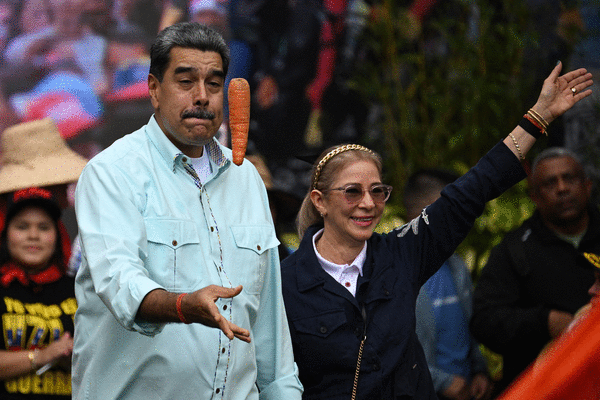
The United States on Thursday unveiled a new round of sanctions aimed at tightening pressure on Venezuelan strongman Nicolás Maduro, targeting three nephews of First Lady Cilia Flores, a network of foreign business partners and a cluster of overseas shipping companies that U.S. officials say have helped move sanctioned Venezuelan oil through covert maritime routes.
The Treasury Department’s Office of Foreign Assets Control said the measures are designed to disrupt what it described as a persistent web of corruption, narcotrafficking and sanctions evasions that continues to sustain Maduro’s “illegitimate” government. The move also signals a sharp reversal from the Biden administration’s 2022 decision to relax some restrictions in hopes of enticing Caracas into free and fair elections — an effort Treasury officials now say clearly failed.
“Treasury is holding the regime and its circle of cronies and companies accountable for its continued crimes,” Treasury Secretary Scott Bessent said in announcing the designations. “Nicolás Maduro and his criminal associates in Venezuela are flooding the United States with drugs that are poisoning the American people.”
The sanctions fall heavily on Maduro’s extended family, including two of the best-known figures in U.S.-Venezuelan relations: Efraín Antonio Campo Flores and Franqui Francisco Flores de Freitas. The cousins — long labeled the “narco-nephews” by Venezuelans — were arrested in Haiti in 2015 while attempting to finalize a deal to smuggle hundreds of kilograms of cocaine to the United States. They were convicted in New York the following year but were released in 2022 after receiving presidential clemency from Joe Biden in a prisoner exchange the White House said was necessary to secure the release of detained Americans.
Since returning to Venezuela, the two men have resumed drug trafficking activities, Treasury said. They were designated under a 2021 executive order targeting people involved in the proliferation of illicit drugs.
The third nephew, Carlos Erik Malpica Flores — Venezuela’s former national treasurer and later a senior executive at the state oil company PDVSA — had already been sanctioned in 2017. The Biden administration delisted him in 2022 in an effort to encourage political talks. With Maduro refusing to permit free elections, Treasury said it is reversing course and redesignating Malpica under a 2015 order targeting officials tied to corruption and democratic backsliding.
With Thursday’s action, all three nephews now rejoin Maduro, Flores, the couple’s son Nicolás Maduro Guerra, and Flores’ other sons on the Specially Designated Nationals and Blocked Persons List.
Treasury also sanctioned Panamanian businessman Ramón Carretero Napolitano, accusing him of securing “lucrative contracts” with the Maduro government and partnering in joint ventures with members of the Maduro-Flores family. U.S. officials say he played a key role in moving petroleum for Caracas as the country’s crippled oil sector struggled under sanctions. He was designated under a 2018 executive order aimed at Venezuela’s oil industry.
The largest portion of Thursday’s measures targets maritime companies based in the Marshall Islands, the British Virgin Islands, the United Kingdom and the Cook Islands. Treasury says the firms used six tankers to move Venezuelan crude throughout 2025 while employing deceptive tactics such as switching off tracking systems, falsifying location data and using “dark” shipping techniques to avoid detection.
The vessels — identified as the White Crane, Kiara M, H. Constance, Lattafa, Tamia and Monique — are now considered blocked property. Their owners and operators — Myra Marine Ltd., Arctic Voyager Inc., Poweroy Investment Ltd., Ready Great Ltd., Sino Marine Services Ltd., and Full Happy Ltd. — were sanctioned for operating in Venezuela’s oil sector in violation of U.S. restrictions.
U.S. officials noted that PDVSA has been under sanctions since 2019 and that Maduro’s government increasingly relies on complex, loosely regulated shipping networks to move crude oil to buyers in Asia. Such “deceptive practices,” Treasury said, undermine sanctions and create environmental risks by allowing tankers to sail without proper tracking.
Under the sanctions, all property of the designated individuals, companies and vessels under U.S. jurisdiction must be frozen and reported. U.S. persons are generally barred from doing business with those sanctioned, and foreign entities that knowingly facilitate transactions could face penalties or secondary sanctions.
Treasury reiterated that sanctions violations carry civil and criminal liability and that enforcement may occur on a strict-liability basis—meaning intent is not required. Banks, traders, insurers, shippers and other service providers were urged to review their exposure.
Thursday’s action came a day after U.S. forces seized an oil tanker off the coast of Venezuela, the latest escalation in a widening U.S. campaign of military and law-enforcement pressure on the Maduro regime.
Washington has amassed what analysts describe as the largest U.S. military deployment in the Caribbean in decades as part of a sweeping operation targeting Latin American drug cartels — a mission that has become a defining pillar of President Donald Trump’s foreign policy.
At the center of the campaign is Venezuela’s so-called Cartel de los Soles, which the Justice Department claims is led by Maduro and senior members of his inner circle.
In recent weeks, the Pentagon has surged additional air and naval assets into the region, including the USS Gerald R. Ford aircraft carrier and several guided-missile destroyers. The expansion coincides with a series of U.S. strikes on boats in the Caribbean and eastern Pacific that officials say were ferrying narcotics for transnational criminal groups.
Trump has repeatedly defended the strikes by declaring that the United States is engaged in an “armed conflict” with drug cartels operating near Venezuelan waters. In an interview published recently by Politico, he warned that Maduro’s “days are numbered” and refused to rule out the use of American troops on Venezuelan territory.
The mounting military pressure builds on years of legal action against Maduro. In 2020, the Justice Department charged him with narcoterrorism, and more than a dozen senior Venezuelan officials were indicted as well. The State Department later offered a $50 million reward for Maduro — the largest bounty ever placed on a sitting head of state.
_____
©2025 Miami Herald. Visit miamiherald.com. Distributed by Tribune Content Agency, LLC.




Comments