Reports reveal chilling details of deadly farmworker crash in Central California
Published in News & Features

FRESNO, Calif. — It was a dark and cold morning as Victor Cirilo Hernandez set out on his usual long drive to pick up farmworkers and deliver them to the fields.
For some low-wage immigrant farmworkers, such rides for a fee, often arranged by their employers, are a common way to get to work.
Those who saw Hernandez in those early hours of Feb. 23, 2024, said the 30-year-old seemed in good spirits and alert. He woke up at his usual time, 4:40 a.m., ready to take himself and seven other farmworkers to their job site in western Madera County.
The sun had yet to rise as the eight workers — all Mexican immigrants living in Kerman — rode westbound in a gray 2001 GMC Safari van on Avenue 7 in rural Madera. At 6:15 a.m., their van was struck head-on by an eastbound black 2021 Chevrolet Silverado pick-up that had swerved into the westbound lane.
Glass, debris and fluid from the vehicles covered Avenue 7, set between two almond orchards just west of Road 22. More than 30 law enforcement, fire and medical professionals responded.
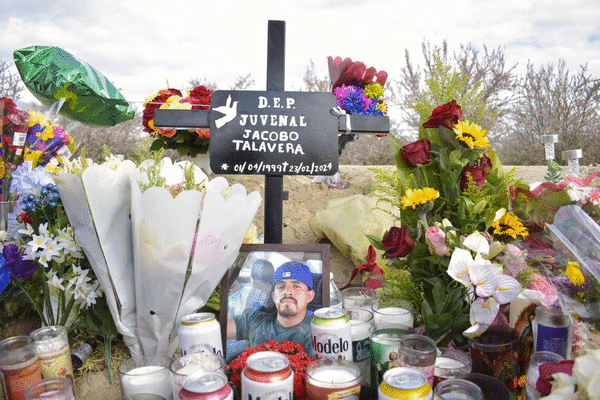
The driver and lone rider in the Silverado, 78-year-old Robert Jerry Kovar of Auberry, was killed. So was Cirilo Hernandez and six of the other farmworkers he was driving: Fidel Filomeno Ojeda, 34, Pedro Hernandez Ojeda, 35, Juvenal Jacobo Talavera, 24, Alfredo Sanchez Morales, 30, Roberto Flores Bañuelos, 57, and Hector Manuel Orozco Ordoñez, 34.
Of the nine people involved in the crash, one survived: Benito Perez, 33, who was riding in the farmworker van.
The tragedy and death toll highlighted in a very public way the problem of farmworker safety on roads in California and especially the Central Valley. Historically, the traffic deaths of farmworkers were connected to an extremely unsafe system that has included ripping out factory-installed seating in vans and adding unsecured benches so more laborers could fit into vehicles for transportation.
A crash in Fresno County that killed 13 farmworkers in 1999 led to new regulations, but the tragedies still happen. Farmworkers accept rides coordinated by their management, which sometimes skirt government regulations for farmworker transportation — seatbelt use, insurance, and other requirements — as supervisors intend to ensure their crews arrive to work on time.
This latest crash led the U.S. Department of Labor to investigate the farmworkers’ employer, Fresno County-based Lion Farms. It also led to a lengthy investigation by the California Highway Patrol, which found only two of the farmworkers were wearing seatbelts and that Kovar, the driver of the Silverado, may have been dealing with a serious medical condition at the time of the collision.
The investigative findings were referenced in a federal lawsuit against Lion Farms filed earlier this year by Secretary of Labor Lori Chavez-DeRemer, a Trump cabinet member who grew up in the Central Valley. Her complaint accused the company of coordinating farmworker transportation while ignoring federal farmworker transportation safety requirements. Lion Farms, which has repeatedly declined to comment to The Fresno Bee, settled the suit in August.
The Bee has obtained a copy of the CHP’s complete traffic crash report through a California Public Records Act request. The 204-page report includes interviews with the sole survivor, witnesses to the crash scene and others who knew some of the victims. It also includes the findings from the CHP Central Division’s Multidisciplinary Accident Investigation Team (MAIT), which studies the human, environmental and mechanical factors associated with a traffic collision, according to CHP’s website.
Using the CHP report and the federal complaint against Lion Farms, The Bee has created a timeline of the crash — one of the deadliest involving farmworkers in recent years. Family members of those riding in the vehicles declined to speak with The Bee for this report.
Lion Farms supervisor ‘instructed’ farmworker driver, feds say
On the day before the crash, Hernandez made it home from work at around 4:30 p.m. He was coming from the same work site he would head to the next morning: Newstone, a ranch owned and operated by Lion Farms in Madera County, according to the federal complaint against the company.
CHP investigators spoke to his brother, Nasareo Cirilo, who said his brother had nothing to drink that evening. Cirilo Hernandez bathed and prepared for the next day’s work before going to bed early, at around 7 p.m., his brother told investigators.
At some point the next morning, a Lion Farms crew supervisor “instructed” Hernandez to drive himself and seven other Lion Farms workers from their homes in Kerman to Newstone, the federal complaint says. The supervisor told him to use the GMC van “even though he knew Mr. Hernandez did not have a valid driver’s license,” the complaint says.
The complaint says the van also did not have minimum liability insurance coverage, but that the crew supervisor regularly called on Hernandez to drive farmworkers to Lion Farms fields. The workers were charged $13 a day, the complaint says.
Hernandez picked up the seven farmworkers, including Perez, the sole survivor of the crash, at about 5:40 a.m. They took their usual route from Kerman to Newstone: east on Highway 180, north on Highway 99 and then east on Avenue 7 in Madera. That drive could take over an hour
Perez — who suffered injuries to his head, face, chest and left leg, the CHP report says — spoke to investigators from Community Regional Medical Center in Fresno, a day after the crash. He told them Hernandez “did not appear tired or sleepy and seemed to be happy and joyful,” the CHP report says.
The group stopped at a Chevron gas station on Avenue 7 and Golden State Boulevard, just west of Highway 99. Hernandez bought some coffee before the farmworkers pulled away from the gas station. That’s where Perez’s memory went blank, he told investigators.
The farmworkers resumed their journey west on Avenue 7 into rural Madera, where traffic control devices can be sparse.
Heading toward them was a driver with a heart condition.
Chevy pick-up driver lived with heart problems, witness says
Kovar was heading east in the Silverado.
A long-time employee of Velasco’s Mexican Restaurant in Prather, where Kovar regularly ate breakfast, told investigators the 78-year-old was always punctual, well-dressed and groomed. He was also “very proud of his black Chevrolet pick-up truck,” which he took good care of, according to the CHP report.
But Kovar’s behavior began to change about a month before the crash, the restaurant worker told investigators. He would arrive early or late to breakfast and say the clocks in his house “were all wrong.” He stopped dying his hair and it began to gray and also looked unkempt. The restaurant worker said Kovar stopped bathing and the others in his breakfast group also noticed.
He arrived at the restaurant after closing time one night and attempted to order, but he was told he could return in the morning. The restaurant worker said she arrived for work at 5:30 a.m. the next morning and saw Kovar sitting in his truck in the parking lot, waiting for the eatery to open.
The restaurant worker told CHP investigators she suspected the changes in Kovar’s behavior were caused by new heart medication. She said Kovar had received heart surgery three years prior and saw the same cardiologist as another man in his breakfast group.
After that other man died as medical staff were checking his pacemaker, Kovar began talking to his breakfast group about finding a new doctor, the restaurant worker told investigators. He stopped taking some of his prescriptions, the worker told investigators, and found a new cardiologist around the time his behavior began to change.
As Kovar drove east on Avenue 7 the morning of the crash, he swerved into the westbound lane. His Chevy pick-up clipped a westbound vehicle and damaged Kovar’s left-side mirror. The CHP investigation found he had not been drinking.
Kovar “continued driving ... eastbound within the westbound lane,” the wrong side of the road, the CHP report says. He was traveling between 62-63 MPH.
Avenue 7 and Road 22 in Madera County
At Road 22 in Madera County, Avenue 7 is a two-lane route with a 55 MPH speed limit. But the CHP report says there was no posted speed limit sign facing eastbound drivers — such as Kovar — between the crash scene and Firebaugh Boulevard about 10 miles west.
In fact, there were no traffic control signs on Avenue 7 facing eastbound or westbound traffic within one mile of the crash location, the report says.
And it was 6:15 a.m., when “the sun had not risen, the moon had not set, and civil twilight had not begun,” the report says. “The lighting conditions met the definition of darkness.”
Hernandez and his van full of farmworkers continued westbound on Avenue 7 at about 55-56 MPH as a van of female farmworkers followed. The driver of that van told CHP investigators she normally drove the women every day.
She reported seeing Kovar’s eastbound Chevy pick-up swerving into the westbound lane as it drove toward the farmworker van ahead of her.
“She told the right front passenger in her van to call the other van in front of her to watch out,” the report says. “As the right front passenger was opening her phone to call, she saw the other vehicle cross into their lane and crash head on.”
Kovar never hit the brakes. Hernandez hit the van brakes one second before impact.
Chevy pick-up connected to OnStar after crash
Kovar’s pick-up spun counterclockwise as it kept moving eastbound before coming to rest on the asphalt of Avenue 7’s eastbound lane. Hernandez’s van also spun counterclockwise but moved northeasterly before coming to rest on the dirt and grass shoulder north of Avenue 7’s westbound lane.
The woman driving behind Hernandez pulled over and ran to check on the men’s van, “but realized all occupants appeared to be deceased.”
Someone called 911 at 6:17 a.m.
Before first responders arrived, a man drove up. He had not witnessed the collision, but told investigators he checked on the occupants. As he walked up to Kovar’s pick-up, he could hear an OnStar operator speaking who had connected to the Chevy after the crash.
He told the operator two men were lying on the ground outside the farmworker van. One was “conscious and breathing” and had “apparent injuries to his face and was rolling around making noises,” the man told investigators.
The man connected with the OnStar operator on his phone, and the operator assisted him as he attempted to perform CPR on the other man who was lying on the ground.
Highway patrol arrived about three minutes later.
By 7:29 a.m., eight of the nine men in the crash were pronounced dead.
_____
©2025 The Fresno Bee. Visit fresnobee.com. Distributed by Tribune Content Agency, LLC.





Comments