'Haiti wants peace,' head of presidential council tells world leaders, pleads for help
Published in News & Features
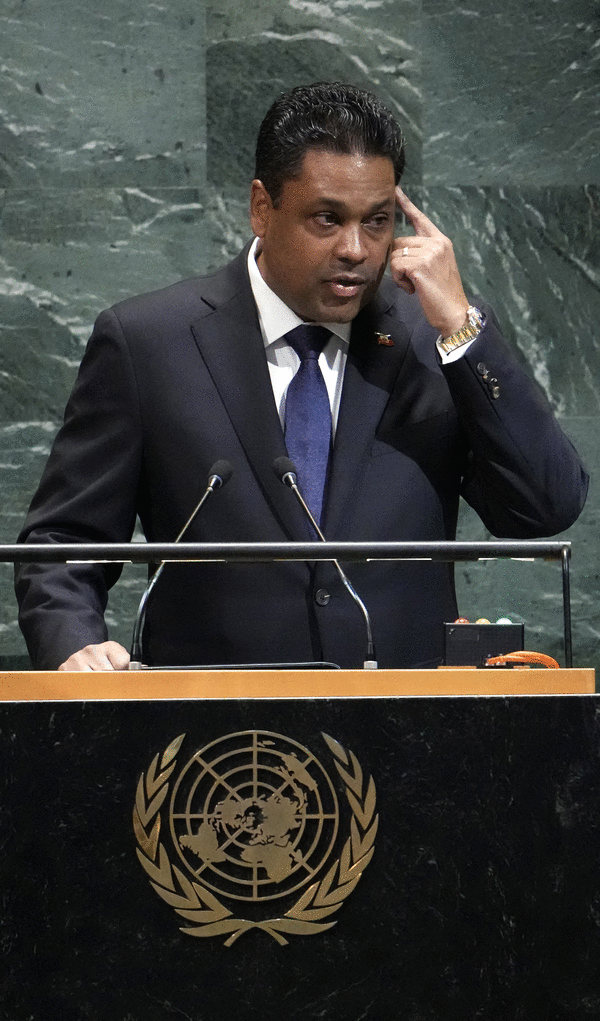
Mere hours from the United States, thousands of people have been condemned to despair, entire neighborhoods have disappeared, hospitals are being vandalized and burned, doctors are fleeing and women and girls are being raped as lives are extinguished “by bullets, fire, fear.”
“This is the face of Haiti today, a country at war,” Laurent Saint-Cyr, the head of Haiti’s ruling presidential council, told global leaders on Thursday as he took the stage at the United Nations General Assembly. “A human tragedy at the doors of America… experiencing a war, a war between criminals that want to impose violence as their social order, and a population, an unarmed population, that is fighting for human dignity and freedom.”
Against a backdrop of raging global crises, apathy and shifting U.S. foreign aid priorities, Saint-Cyr delivered an impassioned speech, asking for the world’s help and saying Haitians want peace. It’s “the most pressing need” of the country’s 12 million population, he said, who are being squeezed by armed criminal groups driving record displacements and hunger, and whose escalating violence have caused more than 3,000 deaths this year.
“Every minute lost means human lives sacrificed and an erosion of democracy,” he said. “Haiti wants peace. Haiti expects peace. Haiti has the right to peace.”
Saint-Cyr’s plea comes as members of the U.N. Security Council face an urgent decision about the fate of the current multinational security support mission in Haiti. Led by Kenya for the past 15 months, the mission’s current mandate expires on Oct. 2.
Rather than renew it, the council is being asked by the U.S. and Panama to create a new successor mission. A draft resolution calls for a “Gang Suppression Force” with five times the current number of the Kenya-led mission and supported by the U.N. However, a lack of clarity about the new force’s makeup, its relationship with groups inside the country, concerns about its name and uncertainty about its financing have created roadblocks.
On Wednesday, in one of many Haiti-focused events taking place on the sidelines of the General Assembly, the U.S. chargé d’affaires in Port-au-Prince, Henry Wooster, told journalists in New York that there is no crisis bigger in the Western Hemisphere than Haiti. The country is in a fight, he said, for the survival of its sovereignty against “a nasty admixture of terrorists” that had recently been designated as foreign terrorists organizations by the Trump administration. They need to be tackled with a 5,000-member ground force with a more vigorous mandate to pursue them, he said.
“It is about moving from a support mission to a suppression mission,” Wooster said, explaining the new name. “Words matter: They express what we seek to accomplish—a more robust, stronger mandate, with the freedom of action needed to take the fight to the gangs.”
The urgency to support Haiti in its fight to restore security and democracy — the country has been without an elected president since Jovenel Moïse was assassinated in July 2021 — was underscored during a meeting on Thursday. One of three-high level talks on Haiti, the meeting was sponsored by the International Organization of the Francophonie and the Caribbean Community and featured representatives of the U.N., Haiti and other countries.
“I know that there are questions that still abound, lack of clarity about the precise nature of the Gang Suppression Force and its architecture,” Jamaica’s representative said. “We understand that, but we need the strategic shift from the current” mission. U.N. Deputy Secretary-General Amina J. Mohammed said the global organization is committed to supporting a path “from urgent humanitarian relief to strengthening governance, from empowering women and youth to mobilizing financing for jobs and livelihoods, from accountability for violence to a credible political horizon.”
But the U.N., whose secretary-general first recommended the framework of the Gang Suppression Force that the U.S. finally endorsed after six months, and which faces billions of dollars in cuts and a slow response to its own humanitarian appeal for Haiti, can’t do it alone, she added.
“We need a coordinated international push,” she said. “Fragmented projects will not deliver the stability if we want Haitians to feel the impact we want, and if we want to shift the course in this crisis, every actor, every dollar, every intervention must pull in the same direction.”
Time to act, Haiti says
Saint-Cyr, speaking at the same event, underscored the message he’s been delivering all week: “It’s urgently important to act.”
“Powerful and heavily armed criminal networks are trying to destabilize our country,” he told the General Assembly. “If we lose this battle on our soil, it would be illusionary to contain them elsewhere in the region. That is why we must show the same determination, the same resolve and the same unity that we showed in the fight against terrorism.
“Haiti cannot, could never overcome this challenge single-handedly,” Saint-Cyr added.
The new Gang Suppression Force, he said, has been endorsed by the Haitian government because the current efforts have been handicapped by a lack of money, equipment and personnel, which has led to armed groups controlling up to 90% of Port-au-Prince and quickly expanding north.
Haiti needs help mobilizing a strong force with a clear mandate, adequate equipment and logistical and financial resources, he said. It also needs heightened international cooperation based on intelligence sharing and on rigorous border control to curb the flow of weapons, drugs and money to gangs because Haiti, he said,“is at the epicenter of an unprecedented regional threat.
“Together, we can, and we must resolve this crisis which has lasted for too long,” said Saint-Cyr. “Twelve million women, men and children are expecting this of us.”
Saint-Cyr touted efforts his beleaguered council, whose mandate expires in February, to prepare the country for elections. The elections panel has already identified more than 85% of voting centers, mobilized more than 70% of election personnel and identified a guaranteed $65 million in financing to hold the vote.
“The state wants credible elections,” said Saint-Cyr, who did not provide a timeline for general elections. “Our greatest challenge remains restoring security.”
Reparations and deportations
In last year’s address to the General Assembly, the head of the transitional council at the time, Edgard Leblanc Fils, told world leaders that the debt the country had to pay France for its independence deprived it of funds for development and created many of the challenges Haiti faces today.
Saint-Cyr also brought up the debt, saying Haiti’s call for reparations is “not out of bitterness or vengefulness, but out of a desire for justice and truth.” Haiti, he said, has established a national reparation and institution committee to pursue the matter.
He also recognized the role of the Haitian diaspora, millions of whom are living in the U.S. and the Dominican Republic, and the uncertainties they face about their livelihoods amid mass deportations.
“We call for the patience, patience and understanding from our partners and friends, so that our nationals are always treated with respect and dignity,” said Saint-Cyr. “Behind every migrant there is a face, a family, a history and a contribution to be made to their new country of residence.”
_____
©2025 Miami Herald. Visit miamiherald.com. Distributed by Tribune Content Agency, LLC.





Comments