Feds blast Sean 'Diddy' Combs' argument that filming 'freak-offs' is protected by First Amendment
Published in News & Features
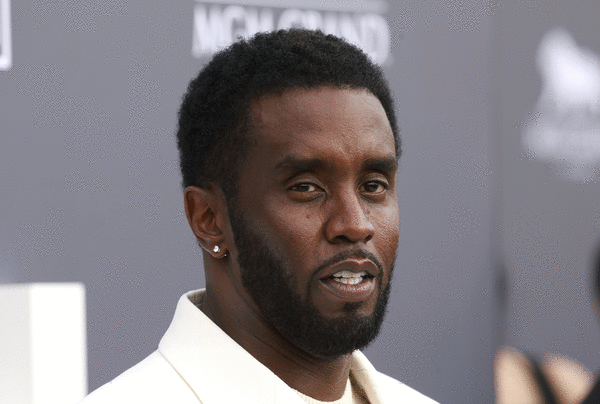
NEW YORK — Federal prosecutors in Manhattan at a court hearing Thursday asked the judge presiding over Sean “Diddy” Combs’ case to reject his bid to get his conviction overturned and the argument he’s made that filming his girlfriends in humiliating sexual encounters with strangers was protected First Amendment activity.
The disgraced mogul, sporting a grey beard, looked disheveled as he walked into the courtroom shortly after 11 a.m., wearing beige prison scrubs. He has asked Manhattan Federal Judge Arun Subramanian to throw out his conviction, grant him a new trial, or, in the alternative, to impose an effective term of time served when he’s sentenced next week on Oct. 3, more than a year after his high-profile arrest.
At Thursday’s hearing, Assistant U.S. Attorney Christy Slavik said Combs could not establish that the evidence against him was insufficient and that no reasonable juror could have found him guilty based on what was presented at trial — necessary elements for acquittal motion to succeed.
“That is simply not a burden the defendant can (meet),” she said.
The Bad Boy Records co-founder, 55, was found guilty July 2 of two counts alleging he transported people domestically and internationally to engage in prostitution in violation of the Mann Act. He faces up to 10 years on each count.
But in a stunning loss for the Manhattan U.S. attorney’s office, the jury ultimately found prosecutors had not proven beyond a reasonable doubt that the women were forced to participate in the events by force, fraud or coercion, or that his network of staff facilitated the depraved sex parties as part of a RICO conspiracy. Those charges could have sent him to prison for the rest of his life.
In graphic detail, former romantic partners of the rap mogul, Casandra “Cassie” Ventura, and a woman who took the stand under the pseudonym Jane, testified at his seven-week trial about suffering for years under a temperamental Combs’ wrath, including in bloody beatings and chokings, and his insatiable sexual desires.
Jurors heard from the women about hundreds of sordid and dehumanizing performances that Combs choreographed and often filmed in dimly lit hotel rooms across the U.S., events he called “freak-offs,” “hotel nights,” and “wild king nights,” involving male commercial sex workers hired off sites like Craigslist. Jurors watched several clips of the sex sessions, scenes the press and public were not permitted to view.
In legal arguments submitted ahead of the hearing, Combs’ lawyers said he had not paid for prostitution, but engaged in legally protected voyeurism — that he was paying for escorts’ time, not sex.
“(The) meaning of prostitution has never been fixed or settled, was overbroad at the time of enactment, and remains hopelessly vague,” Alexandra Shapiro wrote, asking Subramanian to find that paying someone to have sex with a third party was not tantamount to prostitution.
Combs’ team has additionally argued that he was exercising his free speech rights when he filmed the “freak-offs.” They argued that the First Amendment applied “regardless of whether the person directing or producing a pornographic film is aroused while he or she films others having sex or not.”
In their opposition, the feds said Combs’ team had its facts wrong, as well as the law, arguing the sex sessions, often marred by violence and copious drug use, were anything but lawful.
“(While) the defendant may wish to cabin his participation to mere voyeurism, he was, in reality, an active participant in the sexual activity. The defendant’s argument is premised on the idea that he did not himself participate in sexual activity. However, as described above, the defendant fully participated in the sexual activity with escorts by directing the sexual conduct between escorts and victims and masturbating throughout the sexual episode,” Assistant U.S. Attorney Meredith Foster wrote.
Foster said First Amendment arguments by the mogul’s lawyers had “(twisted) the record beyond recognition.”
“The record shows that the defendant was anything but a producer of adult films entitled to First Amendment protection — rather, he was a voracious consumer of commercial sex, paying male commercial sex workers on hundreds of occasions to have sex with his girlfriends for his own sexual arousal.”
At trial, Ventura and Jane said that when they resisted participating in the baby oil-laden sessions, Combs could become violent and menacing, threatening to cut them off financially and hinder their professional prospects. Ventura said he had, on occasion, threatened to release footage of her at so-called “freak-offs” in accounts corroborated by witnesses, including her mother and a close friend.
Subramanian did not rule after hearing dense legal arguments from both sides at Thursday’s proceeding, but stated he would do so very soon.
Combs is still facing a slew of civil lawsuits brought by men and women containing accusations of sexual violence and exploitation that date back decades. He denies all allegations.
_____
©2025 New York Daily News. Visit at nydailynews.com. Distributed by Tribune Content Agency, LLC.




Comments