Remote work policies could have contributed to sex offenders having access to Maryland kids, Senate President says
Published in News & Features
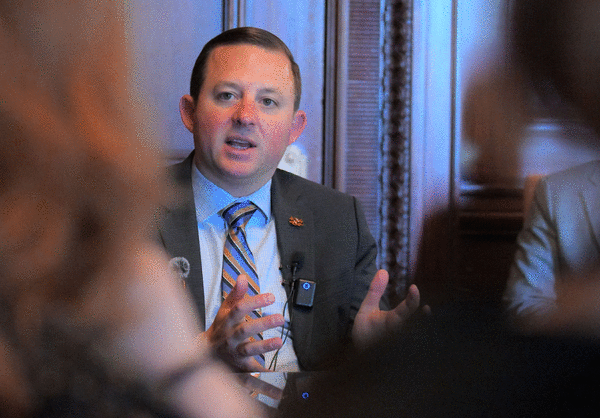
BALTIMORE — Maryland Senate President Bill Ferguson wants to know if COVID-era remote work policies for state government employees contributed to sex offenders having access to foster children.
Ferguson’s comments, made on WBAL Newsradio Wednesday morning, came after a Maryland Department of Legislative Services audit released last week found that two state agencies, the Department of Human Services and the Social Services Administration, failed to administer proper background checks for vendors with access to minors in their care. This oversight allowed seven registered sex offenders to reside at the same “approved guardianship home” as 10 children in August 2024, according to the audit.
While the Senate president said he has a “hard time believing that anybody could intentionally overlook” background checks for foster kids, he suggested that DHS and SSA employees who started during the COVID-19 pandemic may have had “less direct training and oversight” than more experienced colleagues.
“I think that remote work can be a very, very absolutely critical tool, but where I see the biggest gaps are for new employees who don’t get the level of training and interaction and build the relationships,” Ferguson said on the “C4 and Bryan Nehman” show. “And in the case here, this is the state agency that has oversight over local social services departments.”
State Sen. Justin Ready, a Republican who represents Carroll and Frederick counties, told The Baltimore Sun that the impact of remote work on state government effectiveness is “actually not an unreasonable question.” He said that by raising this issue, Ferguson “sounds like he’s making the Republican argument we’ve made for a long time.”
“I think it’s pretty clear everybody overreacted in a lot of ways to things, but to try to go back in time and say, that’s the reason that we’re not monitoring whether sex offenders [were] involved with… watching juveniles in foster homes in 2024 is a bit much,” Ready said.
Remote work policies were common for many Maryland government workers from the start of the pandemic in 2020 through the spring of 2024, when Gov. Wes Moore ordered state employees to return to the office at least two days per week. Moore added more than 5,000 government jobs statewide during his first two years in office, according to the Maryland Department of Labor.
While the federal Bureau of Labor Statistics notes that employee productivity increased early in the pandemic, a 2021 study by the University of California-Berkeley found that working remotely “caused workers to spend about 25% less of their time collaborating with colleagues across groups, compared to pre-pandemic levels.”
“I would like to see whether or not there’s any evidence that the entire remote nature of a lot of these roles — and how quickly they shifted over — whether we built the systems in to have the same level of training and oversight so that these things didn’t slip through the cracks,” Ferguson said.
Ferguson plans to probe if “losing that culture” of in-person work made it harder for new employees to ask administrative questions needed to avoid such a disastrous oversight.
“In any office, you have a question, you walk next door and you can ask, ‘Hey, how does this work? It’s harder in a remote environment,” Ferguson said.
A spokesman for Ferguson did not respond to multiple requests from The Baltimore Sun to clarify or expand on his comments.
---------------
©2025 The Baltimore Sun. Visit at baltimoresun.com. Distributed by Tribune Content Agency, LLC.






Comments