Rights advocates denounce Haiti drone strike that killed several children
Published in News & Features
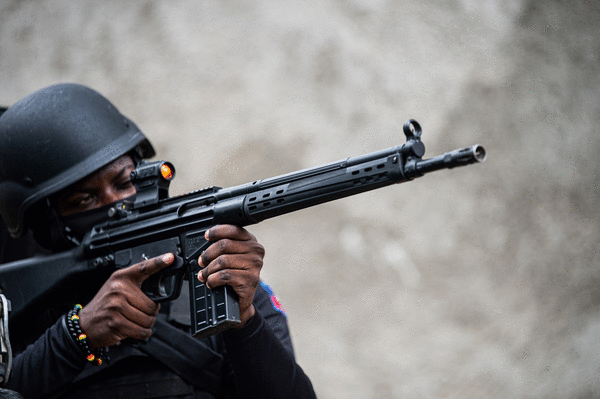
United Nations human-rights and children’s advocates are denouncing a recent Haitian government drone strike that took the lives of several children and a pregnant woman in a gang-controlled Port-au-Prince neighborhood.
The head of the U.N.’s child welfare agency, UNICEF, in Haiti and the world organization’s independent human-rights expert said children need to be protected. The human rights expert demanded that Haiti’s transitional government carry out an “independent, prompt and thorough investigations into these attacks and guarantee reparations for the victims and their families.
“Any use of lethal force by law enforcement officers should always be in accordance with human rights law and abide by the principles of legality, necessity, proportionality, non-discrimination, precaution and accountability,” William O’Neill said in a statement provided to the Miami Herald.
Between 16 and 25 people, including children and a pregnant woman, were killed Saturday in Port-au-Prince’s Simon Pelé neighborhood, when two “Kamikaze” drones, launched by a government task force, missed its target and exploded. There were also a number of injuries. The drone’s propeller may have gotten caught in power lines and exploded over a packed field.
Among the dead was a 4-year-old girl whose mother and grandmother told the Miami Herald in an interview she was playing with other neighborhood children outside their home when her head was shattered and her knees broken when the drone struck.
Gang leader survived
The target of the drone strike was allegedly a local gang leader named Djouma who was celebrating his birthday with the neighborhood and other gang leaders. Gangs have vowed retaliation after sharing photos of some of those killed on social media.
Djouma, also known as Jouma, survived the deadly attack, but a deejay was reportedly killed. UNICEF said four children were killed, although the local National Human Rights Defense Network in Port-au-Prince said at least eight children died.
“International law clearly states that children, as well as the essential services they rely on, must be protected,” Geeta Narayan, the Haiti representative for the U.N.’s leading child welfare agency, said. “Every effort must be made to prevent and avoid harm to the population, especially children.”
Narayan said that days prior to the strike, four children were killed on Sept. 11 “in an attack by armed groups while they were inside their home, a place that should have been safe and protective.
“For far too long, children in Haiti have been caught in relentless cycles of violence,” she added. “These incidents have once again torn families apart and shattered any sense of safety for children who should simply be able to learn, play and grow in peace.”
The shocking incident triggered outrage among Haitians, aid workers and security experts who have been quietly warning of the dangers of the Haitian government using explosive drones to target leaders of criminal gangs. So far no major gang leader has been killed, while the collateral damage has been documented in three separate incidents, including the deaths of two SWAT officers.
The growing use of weaponized drones by Haiti comes as armed gangs continue to expand and gain territory outside of Port-au-Prince. In the last week, a number of communities in the Artibonite region and in the Northwest have come under siege.
“The intentional use of lethal force by law enforcement is legal under international human rights law only when it is strictly unavoidable to protect life facing an imminent threat and as a last resort when other less extreme measures such as capture or less-lethal incapacitation have been exhausted,” O’Neill, the human rights expert on Haiti, said
On Tuesday, Canada’s ambassador to the United Nations, Robert Rae, who has been calling for the protection of children amid Haiti’s escalating violence, highlighted the drone strike in his opening remarks during a high-level meeting sponsored by the Economic and Social Council in New York. The meeting took place on the sidelines of the U.N. General Assembly, where several leaders have been calling for more international attention to be paid to Haiti’s worsening crisis.
“We need to understand that this is not a problem of theory,” Rae said. “This is a problem that is affecting the daily lives of people, and it’s important for us to reflect on the importance of this moment and the assistance and partnership that we need to continue to establish with Haiti.”
Canada says donated drones accounted for
Some Haitians have blamed the strike on the government of Canada, which has been providing surveillance drones to the Haiti National Police as part of its law enforcement assistance.
A spokesperson with the Royal Canadian Mounted Police said in a statement to the Miami Herald that “the reporting that Canadian donated drones were involved is incorrect.” All drones donated by Canada to the Haitian national police “have been accounted for today, meaning they were not used in the attack,” Kristine Kelly said.
“The intent of drones donated by Canada is surveillance. These drones are used to help reduce the danger faced by uniformed officers as they conduct patrols and anti-gang operations,” she added. “None of the drone models that have been provided by Canada were designed or intended for lethal use.”
_____
©2025 Miami Herald. Visit miamiherald.com. Distributed by Tribune Content Agency, LLC.





Comments