Kenya President Ruto calls out world on Haiti response, asks for support in gang fight
Published in News & Features
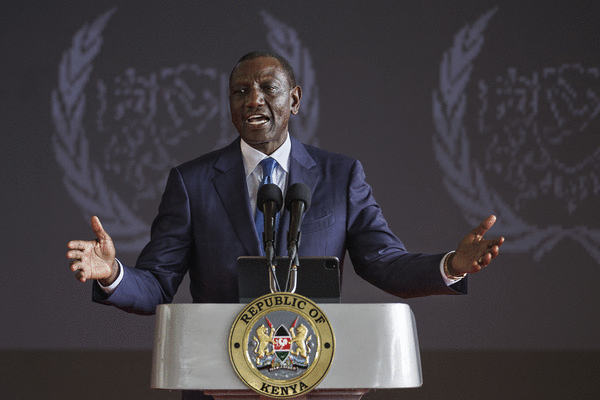
Kenyan President William Ruto used his brief moments on the world’s stage on Wednesday to revisit his East African nation’s successes and challenges in Haiti, and to call for support on authorizing the next succession mission to the multinational security support force his country fielded in the Caribbean country.
Ruto told world leaders gathered at the United Nations General Assembly that they did not show up for Haiti, telling them that when Kenya answered the call two years ago for help dismantling criminal gangs, it was under the belief that “we were joining a genuinely multinational effort.
“We welcomed and fully embraced resolution 2699 by which the United Nations Security Council authorized the [mission] with Kenya as the lead nation, drawing on our decades of peace support operations,” he said. “We stepped forward, stepped up and deployed our officers to confront the rampant menace of gang violence in Port-au-Prince and its environments.”
But over the last 15 months, as the mission operated in a volatile environment and under enormous constraints, “It has been underfunded, under equipped and operated below 40%” of its authorized personnel.
“For far too long, the people of Haiti called out to the world. Too often their pleas were met with silence, hesitation or half measures,” he said. “Haiti became a tragic reminder of what happens when the international community looks away, prevaricates or offers half-hearted support.”
Ruto then pushed for support or a new “Gang Suppression Force,” which the U.S. is pushing the U.N. Security Council to adopt by Sept. 30, ahead of the end of the current mandate for the Kenya-led force. That mandate expires on Oct. 2.
“From this podium, I wish to assure all partners and actors that with the right personnel, adequate resources, appropriate equipment and necessary logistics, Haiti security can be restored,” Ruto said. “Gangs can be neutralized and the safety of streets, schools, hospitals and homes secured. The continued harassment, abductions and criminal acts undermining the lives of Haitians are unacceptable, unjustifiable, and must be stopped by this organization, the United Nations.”
The crisis in Haiti has become a major focus during this week’s U.N. meeting. U.N. Secretary General António Guterres and U.N. General Assembly President Annalena Baerbock spoke about the country’s escalating gang violence and deepening humanitarian crisis during opening remarks on Tuesday.
The country, however, did not make it into the address of President Donald Trump, who used his time on the podium to tout his mass deportation domestic agenda, telling leaders “Your countries are going to tell” due to immigration countries and the U.N. that it has failed to live up to expectations.
Even still, State Department officials have been holding meetings and pushing Security Council members to support a resolution on the new mission, going as far as calling countries up, sources say, even as some raise objections to the name and express concerns about where all the money will come from.
In the 15 months since the Kenyan mission has arrived in Haiti, gangs have expanded their territory of control as they launched attacks on not just the region that includes Port-au-Prince but rural communities north. In addition to driving record hunger and displacements, gang-related violence has also been blamed for more than 8,000 deaths.
Even still, Ruto told leaders that he’s been proud to lead the response in Haiti, “not because it has been easy, but because solidarity is the essence of the United Nations.”
He offered the mission’s successes and the challenges as both a cautionary tale and a living lesson about the strengths and weaknesses of the current global security governance architecture.
“Our police officers have valiantly shouldered responsibilities without the full logistical support that would accompany any mission sanctioned by the United Nations,” he said. “Despite these challenges and against all odds, the MSS has delivered results many thought were impossible.”
“The police headquarters and the police training center, once overrun by gangs, are now secure with the academy resuming the training of new police officers, over 700 of whom graduated a few months ago,” he noted. “Schools that have been shattered by violence have been opened with children back in class, learning and progressing roads once man or blocked by gangs have now free flowing traffic. Cases of kidnapping and extortion have reduced sharply.”
©2025 Miami Herald. Visit at miamiherald.com. Distributed by Tribune Content Agency, LLC.





Comments