Baltimore's Key Bridge rebuild: Test piles to be driven into riverbed in next few days
Published in News & Features
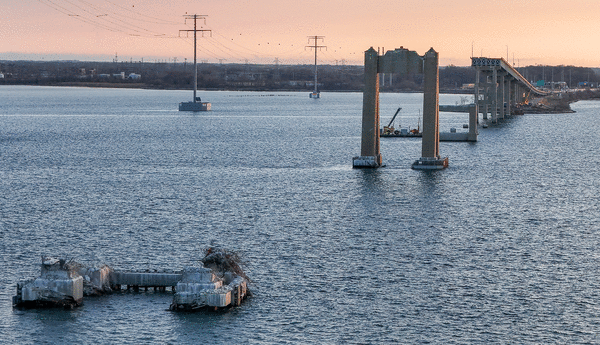
BALTIMORE — A major test program for the reconstruction of the Francis Scott Key Bridge is expected to begin in the next few days, weather permitting, the Maryland Transportation Authority announced Wednesday.
Starting on or around Saturday, crews will drive 12 test piles — strong posts driven deep into the ground to support and stabilize a bridge — into the Patapsco River over the next six to eight weeks, the authority said. Each pile will take about two hours to hammer into place, producing a sound that will resemble a large bell from a distance, transportation officials said.
Construction will occur Monday through Saturday during daylight hours, typically within a 12-hour work window, according to the MDTA.
Officials said the testing is necessary to confirm that the soil conditions are suitable for future pile installation.
Six test piles, each more than 220 feet long and eight feet in diameter, have already arrived in Baltimore by barge. Made from American steel, they will help engineers fine-tune the design for the bridge’s new foundations, the MDTA said.
“The Test Pile Program marks another major milestone in the Key Bridge Rebuild project,” MDTA Executive Director Bruce Gartner said in a statement. “Some of the test piles will be evaluated for the potential to be incorporated into the permanent foundations for the new bridge.”
The process will begin with a crane and tripping barge lifting the piles into position. They are then set into a template, stabilized with a vibratory hammer and driven into the riverbed with a hydraulic hammer, transportation officials said.
A load frame will later be placed on the piles to exert vertical and horizontal pressure, while sensors collect real-time data to confirm the accuracy of design models.
Noise and vibration monitors have already been installed around the project area and nearby neighborhoods. The devices have been gathering baseline data ahead of demolition and construction, and will continue to track conditions throughout the test pile program to ensure activity remains within acceptable limits, according to the MDTA.
The entire replacement bridge is expected to cost between $1.7 billion and $1.9 billion. Congress approved full federal funding in December, though President Donald Trump has threatened this.
Last week, the Trump administration criticized Maryland for what it called “unconstitutional DEI practices” in selecting contractors for the Key Bridge rebuild and voiced concerns about the project’s cost and schedule.
In response, Gov. Wes Moore issued a written statement that did not address the contracting practices directly but reaffirmed his administration’s commitment to cooperating on the efficient construction of the new bridge.
“We will continue to work with the Trump Administration to find ways to reduce costs and rebuild faster,” Moore said in a statement. “We anticipate the price estimation process to be finalized in the coming months and we will provide regular updates from the Maryland Department of Transportation about the project’s status.”
The rebuild follows the collapse of the Key Bridge on March 26, 2024, when the container ship Dali lost power and slammed into one of the bridge’s main support piers. The 112,000-ton vessel triggered the immediate failure of the structure, sending several vehicles and a crew of highway workers into the river.
Six construction workers were killed in the collapse, and maritime traffic to the Port of Baltimore was disrupted for weeks.
_____
©2025 The Baltimore Sun. Visit at baltimoresun.com. Distributed by Tribune Content Agency, LLC.






Comments