Sacramento is betting on tiny homes to address homeless crisis. Will it work?
Published in News & Features
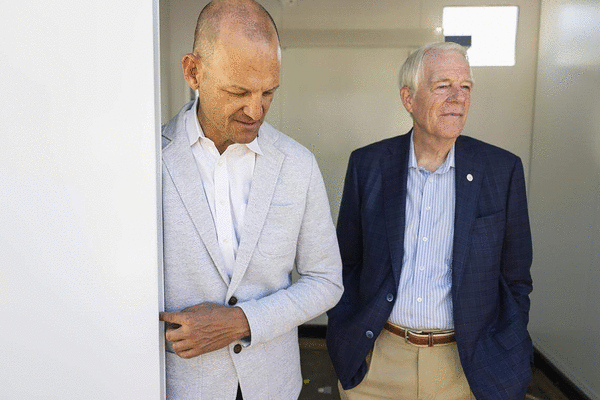
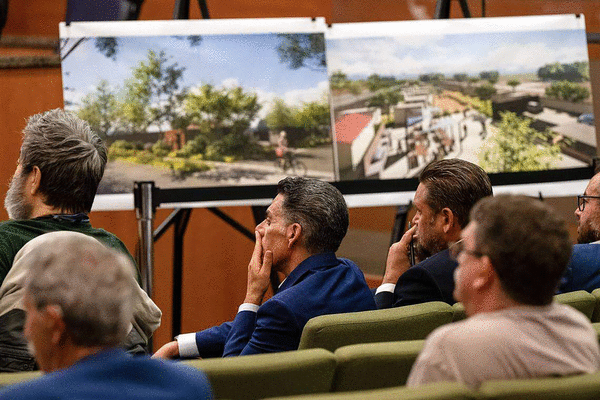



SACRAMENTO, Calif. – Last month, Sacramento Mayor Kevin McCarty stood at the Roseville Road Campus — a shelter tucked along the edge of Del Paso Park — and declared the future of the city’s homeless strategy.
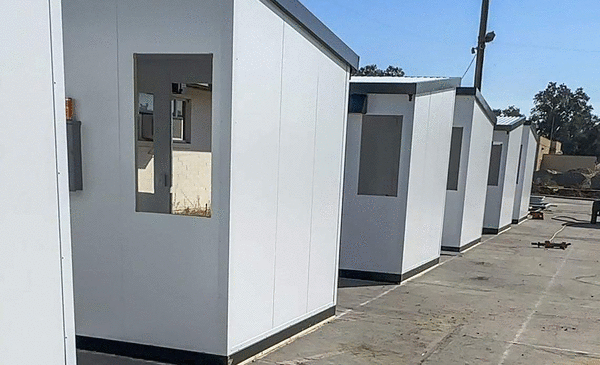
The shelter, which opened in January 2024, will soon expand by 135 new tiny homes. For years, Sacramento had sparsely used the structures to house homeless people and relied mostly on congregate shelters and its motel shelter program. Only about 13% of the city’s current shelter beds come from tiny homes.
But under McCarty, who campaigned on a promise to change the course of homelessness, the miniature dwellings will be a key piece to addressing the issue. As of this week, the city has 300 more units planned. About half of those will be located in what the city is calling interim housing micro-communities.
“This is kind of the future of where we’re heading with our homeless response,” McCarty said, following the Aug. 28 Roseville Road announcement.
Tiny home communities for homeless people have existed on a small scale for decades. In recent years, the model has gained momentum with cities across the country embracing the idea for its lower cost, quicker construction and potential to offer residents more autonomy compared to traditional shelters.
A 2022 survey in Portland, where some of the nation’s longest-running villages are located, found that homeless people were largely satisfied with tiny homes. Participants also reported improved outcomes in health care access, housing transitions and long-term stability, said Todd Ferry, an architect and Portland State University researcher who authored the survey.
“They’re not perfect, but they tend to have really good outcomes,” Ferry said.
Sacramento is banking on the model as a cheaper and faster path to results. The strategy is shaped, in part, by the city’s structural budget deficit and shrinking state homeless funding.
Some homeless advocates worry the approach could undermine itself. The city plans to charge residents a monthly fee of about 30% of their income at its new tiny homes villages, an unusually steep fee for non-permanent housing.
The success of Sacramento’s plan may ultimately hinge on whether future residents are given real authority in shaping their communities. Experts, like Ferry, say the strongest outcomes come from those built on resident input and shared governance.
“If the goal is to find a cheap place to put people that can be hosed down and is the bare minimum, then I think that you’ll see different outcomes than if it’s designed for dignity, healing and humanity,” Ferry said.
History of tiny homes
Tiny homes have existed for generations. The structures have differing definitions, but generally are regarded as miniature dwellings that range anywhere from 100 to 600 square feet.
One of their earliest uses followed the 1906 San Francisco earthquake, considered the biggest natural disaster in American history at the time. Ferry said the U.S. Army Corps of Engineers created hundreds of “earthquake shacks,” or tiny homes, of about 140 square feet for people.
A century later, a handful of cities began using the concept as homeless shelters.
Lisa Alexander, a professor at Boston College Law School, said the approach reflected a need to find alternatives when permanent housing is becoming scarce and expensive. Momentum for the structures grew during the COVID-19 pandemic, when cities sought socially distant shelters that were more cost-efficient and could be assembled quickly.
The number of tiny home villages for homeless people in the U.S. have nearly quadrupled since 2019, going from 34 to 123, according to data from Missouri State University.
“Cities began to recognize that creating small, tiny homes might be an alternative to people being on the street in a cold environment,” said Alexander, who has studied tiny homes for years.
Sacramento’s experience with tiny homes began in 2020 when it launched Emergency Bridge Housing at Grove Avenue for transitional-age youth. Four years later, the Roseville Road campus followed and mixed tiny homes with trailers. The shelter has previously faced criticism for a lack of electricity and pedestrian safety.
Together, the two shelters offer 111 tiny homes units.
The city’s new plan would nearly triple that amount. Each micro-community of 40 units is expected to be built in about a year, said City spokesperson Julie Hall on Thursday.
Cost-efficient shelter
Cost is central to why many cities are choosing to build more tiny homes.
Permanent supportive housing, or affordable housing to address homelessness, in the Sacramento region has recently ranged from $200,000 to $600,000 per one unit. Those costs can reach $1 million in other parts of the state like the Bay Area.
By contrast, Sacramento estimates tiny homes at the micro-communities will cost $85,000 per unit.
“Permanent supportive housing can take a long time to develop, it can be expensive, there can be delays,” Alexander said.
A decrease of 40% in state funding for homeless services and the city’s budget deficit has already led the officials to rework its contracts with homeless service providers. The new deals have scaled back at congregate shelters to focus on building more tiny homes and opening safe ground sites.
As of this year, the city spends about $28 million annually to fund its shelters. That money supports 18 sites with 1,375 shelter beds. Under a plan unveiled this month, which included the micro-communities, the city would add eight more sites and nearly double its beds in the coming years.
“By focusing on the cost, being cost-effective, we can serve more people,” McCarty said on Tuesday following the meeting.
Elizabeth Funk, chief executive of DignityMoves, a San Francisco based nonprofit developer of tiny home communities, argues the structures are a way to expand the definition of permanent housing. Funk said that for too long state and federal governments have graded homelessness responses by getting people in permanent housing, instead of inside shelter.
Tiny homes, when built properly, are stable places for people to stay “indefinitely,” she added.
“What attributes of traditional permanent housing are we so obsessed with and what could we bring over into this new form of housing, this interim housing?” Funk asked.
How will tiny homes work for Sacramento?
Tiny homes of all shapes, designs and lengths of stay can now be found across the country.
In a DignityMoves development near Southern California, residents have rooms with private desks and a communal computer lab. On the outskirts of Austin, residents share a community that has vegetable gardens and an outdoor amphitheater for movie screenings. And a Portland veterans-only village offers a putting green, chicken coop and food pantry.
Sacramento, in its latest projections, is expected to partially model itself after some of these communities. The micro-communities would offer 40 units of 120 square feet with communal bathrooms, cooking areas, laundry, garden and gathering spaces.
Villages of no more than 40 tiny homes are typically recommended for the best outcomes, Ferry said.
“We’re looking for people that just have no place that they can afford to live, and they want to live in their own community,” Pedro said at Tuesday’s council meeting.
But, unlike most tiny home villages, Sacramento will charge its residents a monthly fee based on income. The housing will be designated for seniors who are to referred into the program by the Department of Community Response.
Pedro, following Tuesday’s meeting, said he was not aware of any city in America that charged a percentage of someone’s income for interim housing. The state of Hawaii began moving toward a similar fee in 2023. It is not uncommon for some shelters to charge a daily fee of $1 to $5.
The proposed percentage fee has particularly baffled homeless advocates, who argue that charging goes against the historical definition of shelters — often the last line of support.
“To charge them at that rate seems unfathomable to me,” said Donald Whitehead, executive director of National Coalition for the Homeless.
Among Whitehead’s worries is that people will not be able to save up enough money to transition away from the interim housing. He suggested the city put that money into a savings account for residents to use when they leave the units.
City leaders, including McCarty and Pedro, have argued in favor of the fees by saying it will foster self-independence, create a sustainable housing model and comparable to other housing programs. They also note that people will not be required to leave if they continue to pay the fee after the initial grace period of 90 days.
“We want people to be involved,” Pedro said. “This is it. It creates buy-in if you’re willing to give your 30% of your income, like most of us do.”
Ferry said charging fees was not a common approach used by tiny homes villages in Portland. But buy-in was earned in other ways, from providing input on certain amenities to electing a community council. He highlighted an example in which residents of a tiny home village advocated for an outdoor grill.
“Maybe the villagers don’t get to decide everything, but when they do have a voice, that makes a huge, huge difference,” Ferry said.
Pedro said the city has already started such discussions but holding “listening sessions” with potential micro-community residents about rules and expectations for how the sites could operate. Those sessions included roughly 50% of seniors living in the city’s shelters, according to Pedro.
“Building on that input, the city has established a collaborative approach where both residents and staff play a role in shaping the community,” Hall said. “The goal is to create inclusive, safe spaces that support the long-term success of the program.”
Ferry particularly cautioned against cities that view tiny home villages as merely a cost-effective solution. Instead, they should be intentional about building communities that are “inviting,” help heal and transition people to permanent housing.
“In other words, there’s such an amazing opportunity to create the kind of communities that anybody would want,” Ferry said.
____
©2025 The Sacramento Bee. Visit at sacbee.com. Distributed by Tribune Content Agency, LLC.






Comments