Kevin Baxter: 'They chose to cheat.' Why Manchester City needs to face heavy punishment for violations.
Published in Soccer
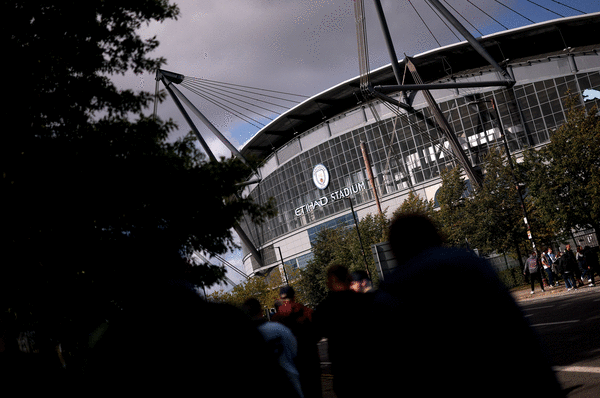
LOS ANGELES — When rumors first began circulating that Manchester City had committed egregious violations of the Premier League's financial fair play rules, Pep Guardiola, City's then manager, said he went to the team's owners and asked for an explanation.
At the same time, he issued a threat.
"I said to them: 'If you lie to me, the day after I am not here. I will be out and I will not be your friend anymore,'" he said.
Four years later, Guardiola is gone, having resigned last spring with a year left on his contract, and City's lies have been exposed, with a multi-year investigation finding the club guilty of "sham payments" and inflating revenue figures by nearly $1.2 billion, the Premier League said in a statement Tuesday, confirming reporting from the Athletic last week.
The league's independent commission investigated 115 charges against City between 2009-2018 and found the club guilty of "clearly intend[ing] to circumvent financial regulations."
That's what we know. What we don't know is what the penalties will be or when they will be announced. But given the gravity of the accusations — failure to provide accurate financial information, failure to provide accurate details for player and manager payments, failure to comply with UEFA's Financial Fair Play guidelines, and breaching the Premier League's Profitability and Sustainability Rules, or PSR — the sanctions are likely to be the stiffest in the history of the sport.
City has until Friday to appeal the findings of the commission and has said it will do so. In a statement the club declared its innocence and said it was "disappointed and surprised by the opinion of the Premier League commission" and said "the opinion contains clear material errors, of law, principle and fact."
Basically, the Premier League found that City violated rules requiring it to provide "accurate financial information that gives a true and fair view of the club's financial position." The rules were the closest thing the freest-spending league in the world's freest-spending sport had to a salary cap in that it limited clubs to losses of $140 million over a rolling three-year period, measures designed to ensure clubs spend only what they earn from deals that are shown to be at legitimate market value.
Violating or abandoning those rules would bring anarchy, guaranteeing that modest, well-run clubs would never be able to compete with profligate billionaires. (The Premier League replaced the PSR with a new set of financial rules this season.)
And the league's investigation determined that's exactly what happened. City has won eight Premier League titles, four FA Cups, seven League Cups and one Champions League since 2008, when it was bought by enormously deep-pocketed owners from the United Arab Emirates, who have been basically cooking the books by inflating sponsorship revenues and hiding payments to managers and players.
Heavy fines will certainly be part of the package, but Sheikh Mansour funds his ownership of Manchester City primarily through his private equity vehicle, the Abu Dhabi United Group, which is backed by the immense oil wealth of the ruling Al Nahyan royal family of Abu Dhabi — wealth estimated to be in the hundreds of billions of dollars. It would be impossible to fine the club enough to make a dent in that. (In 2020, City was fined $11.6 million — less than half of Kevin De Bruyne's salary that season — for violating UEFA's Financial Fair Play regulations. It was a hand slap that told the powerful club that rules were for lesser clubs.)
But City has some hardware it could trade. Eight of the trophies the club won under Mansour came during the years under investigation, so handing them over to the teams that finished behind City while following the rules seems like a logical solution.
"They chose to cheat. And they deserve to be punished. Where we finish with that is obviously difficult," former Manchester United legend Roy Keane said on ITV last week. "But they were cheating. And found guilty of it. They have to take their medicine now."
There is precedent for that. Juventus was stripped of two Serie A titles — from 2004-'05 and 2005-'06 — in the wake of the Calciopoli match-fixing scandal. The team was also relegated to Serie B for the 2006-'07 season.
However, relegating City to the second-tier Championship League would be a punishment that could hurt the rest of the league. The EPL is the fourth-most profitable league in the world with annual revenues of nearly $9 billion, according to Deloitte, much of it driven by its unrivaled international television reach. City is a big part of that draw, so sending it down a level and promoting Swansea or West Ham would have a significant financial impact on the rest of the league.
What is likely is point deductions, enforced looking forward, not backward. Having City start each of the next five seasons in a 30- to 40-point hole would allow it to compete every weekend, but would make it almost impossible for the club to win a league title or qualify for a European tournament, depriving it not only of revenue — City banked nearly $155 million when it won the Champions League in 2023 — but of prestige, which is what Mansour values most.
Guardiola, by the way, moderated his stance on City's conduct before he left so he and the club's management are apparently still friends.
"I trust them," he said in May before leaving as the second-most-decorated manager in English soccer history. "I spoke with them and trust how they behave and how they did. What happened, happened."
Now what happened must be punished. Severely. Because if clubs like Manchester City are allowed to play by their own set of rules, the level playing field will always be tilted in their favor.
____
©2026 Los Angeles Times. Visit latimes.com. Distributed by Tribune Content Agency, LLC.


Comments