Jonathan Tannenwald: This summer created World Cup fans, but that's not the same as soccer fans. MLS must bridge the gap.
Published in Soccer
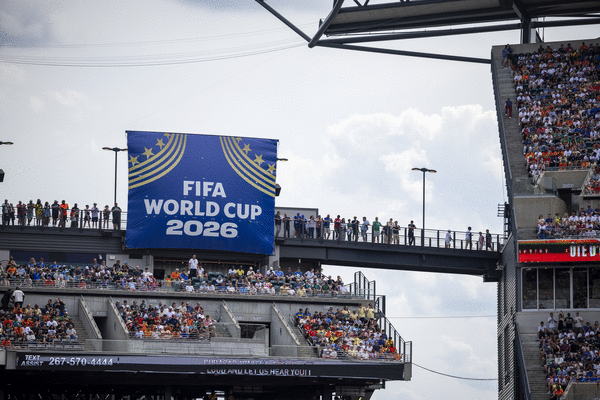
PHILADELPHIA — After Sunday’s World Cup final, the walk out of the Meadowlands passed by deconstructed pieces of the stage where Spain lifted the trophy.
Like the quick transformation from Philadelphia Stadium back to Lincoln Financial Field, it was a sharp reminder of the end of an unprecedented spectacle.
This World Cup made a huge impact on a country where soccer wasn’t always welcome, but is now. Look no further than the massive television audiences, not just for the U.S and Mexico, but across the tournament.
A stunning 63 of the 104 games drew audiences of more than 10 million viewers across Fox’s English and Telemundo’s Spanish coverage. Thirty-one topped 15 million, 18 topped 20 million, 11 topped 25 million and five topped 30 million — capped off by 46.7 million for Mexico-England, 50.1 million for U.S.-Belgium and 66.4 million for the Spain-Argentina title game.
Yes, that many people watched a game that had just one goal in 140 minutes of game clock, including stoppage time.
But while the World Cup is over, is soccer? Even the critics might finally admit it isn’t. So let’s ask some better questions.
What kind of soccer will Americans now want to watch? Will they treat the sport like track and field at the Olympics, only tuning in every four years? Or will they be interested more often, wanting to see the world’s biggest sports tapestry unfold every week?
If it’s the latter, the line of suitors is already long. The English Premier League, Europe’s UEFA Champions League and Spain’s La Liga are among the front-runners, along with their respective broadcast partners at NBC, CBS and ESPN.
They are the most likely to profit from the World Cup’s halo, while showcasing the sport’s biggest stars. But they can’t be alone. The pressure is rising fast on America’s domestic men’s game, Major League Soccer above all.
No, it doesn’t have the sport’s biggest names, and for some people that will always be what matters. What about an audience that MLS has long failed to properly pursue: People who want to watch the sport in person, and forge a connection with a local team?
You can’t go to Liverpool, Manchester, London, Madrid and so on every weekend. Once a season, sure, and a Saturday morning at a soccer bar is a fun time. But whether in Chester or the rest of the country, experiencing soccer in person is still unmatched.
This is not meant to cheerlead for the Union. They have to earn fans’ trust, and there’s a history of that not happening. These pages have long chronicled it, especially when it comes to Subaru Park’s woefully limited public transit access.
But soccer also faces a burden that other American sports don’t. Why be a Flyers fan, with no titles in a half-century? Or a Phillies or Eagles fan during the team’s fallow years of the past? Why bother with the eternal angst the Sixers inflict on a basketball city without equal?
We all know the answer, from Northeast Philly lifers to the thousands of newcomers who’ve made Center City a destination. It’s about feeling those teams are yours. Through good times and bad, nothing fuels emotions like that sense of deep connection.
Emotion trumps data
For most of its 30-year history, MLS has shied away from doing the work needed to forge those bonds. Instead, it has chased sugar highs from signing big names.
That path has been profitable, to be sure, and the list is long: David Beckham, Thierry Henry, Didier Drogba, Javier Hernández, Lionel Messi, Son Heung-Min and now Antoine Griezmann and Robert Lewandowski.
But the foundations are still missing in too many cities leaguewide, with Philadelphia high up that list. New York, Chicago, Boston and Houston are also perennially on it.
This came to a head when commissioner Don Garber met the press at the U.S.-Australia game in Seattle last month. Behind him, a scene unfurled that American soccer fans dreamed of for decades: A thunderous home crowd in a city that not only loves the sport, but loves this country’s game specifically.
How can the league build connections like that elsewhere?
“Part of it is time and part of that is tactical; part of it is actually doing the work,” Garber said to start. He referenced how MLS “got FIFA’s permission to do Fan Fests in every market,” which sounds nice until you realize the need to ask is yet more of FIFA’s greed.
“We want to bring everybody together,” Garber said. “But we want to know, if people are going to support a World Cup match, what can we do to talk to them and give them exciting news and information and connections to become a fan of Sporting Kansas City or the Seattle Sounders? Some of that is just the data and intelligence that we’re going to gather, and be able to do that.”
He sounded good until the words data and intelligence. Because the problem here isn’t a rational one, it’s an emotional one.
For many years, the response from fans to MLS has been: I don’t care, because your product isn’t as good as others.
A league now in its fourth decade should be mature enough to shoot right back: So what? That isn’t the point.
There’s nothing stopping any soccer fan from watching European games on a Saturday morning and their local team on a Saturday night. Nor do some of the English Premier League’s loyalists understand England’s thriving lower leagues, where crowds can be bigger than Europe’s other top flights.
Why would a Londoner pick Charlton over giant Arsenal? Why bother in Bolton when Manchester is a stone’s throw away? It isn’t just because they dream of winning promotion. To those fans, the teams are theirs in a way the giants will never be.
MLS, meanwhile, has often been too timid to make the case.
This was put to Garber.
“I will say to everybody who has said to me from the day I took this job: If you don’t believe, that’s OK,” he answered. “Right now, soccer is the third most popular sport in our country. We’ve got to make MLS a bigger part of that pie, but the market’s there and it’s up to us to convert it. If we don’t convert it, shame on us.”
That’s more like it. Because though Garber’s legacy is unquestionable ahead of his retirement next year, the league missed a big opportunity after the last World Cup. Now it risks another one.
‘Not just about’ the stars
The second the 2022 tournament ended, North America’s hosting in 2026 was on the clock. MLS could easily have boasted its players featured this year — not just for the United States, but many countries. So what if they would be in Europe later? They were in the league now, and worth watching.
This summer, MLS was almost invisible during the tournament. Of course it was right to not have games, but the lack of publicity on TV was shocking. Especially on World Cup broadcaster Fox, which airs MLS games throughout the year.
And where, yet again, was the marketing heft from Apple? The world’s most famous tech brand was also pretty quiet, instead of trumpeting to new soccer fans that it has every MLS game.
If casual newcomers didn’t know what they were missing, devotees were all too aware, and rightly angry.
Rank the domestic leagues of the world by how many players they sent to this World Cup, and MLS had the second-most of any outside Europe’s traditional big five: England, Spain, Germany, Italy and France. Saudi Arabia took No. 6 — by just two players — thanks to the exorbitant, oil-and-gas fueled salaries paid by clubs with sovereign wealth backing.
Along with that, this reporter counted a total of 115 players spanning 24 World Cup teams who play or have played in the U.S. or Canada, whether in the pros, college or high school.
Those are marketable numbers if the league wants. But how many people know about them?
When MLS hosted the media at its new Manhattan offices last Thursday, Garber was grilled again, and seemed to get it right again.
“It’s not just about those Designated Players, the big names,” he said. “It’s about Alex Freeman, who started as a youth player, played in an academy, played in MLS Next Pro, and now is playing overseas after he was a starter for Orlando City.”
As that famous poet Batman might say: Right again, commissioner.
Yes, MLS is absolutely right about Freeman, the U.S. team’s breakout name of this World Cup who moved from Orlando to Spain’s Villarreal last winter. But the league has also been too afraid to admit it’s a launchpad to Europe, even though doing so would likely bring more global eyeballs. Tracking future stars in soccer has become as profitable as doing so in basketball and football.
It certainly is in Philadelphia. The Union’s academy can boast alumni in the soccer world just like Roman Catholic High rightly does in the NBA, and Penn State does in the NFL.
The Union’s game on Wednesday against Red Bull New York at Subaru Park (7:30 p.m. ET, Apple TV) will be a prime example. At least five young candidates for the 2030 U.S. World Cup team will be on the field: the Union’s Cavan Sullivan, Frankie Westfield and Malik Jakupović, and the visitors’ Julian Hall and Adri Mehmeti.
Soccer fans know those names are worth watching, but the new World Cup fans in town don’t yet. The burden is on MLS to make the point, and there’s no better time than right now.
____
©2026 The Philadelphia Inquirer. Visit inquirer.com. Distributed by Tribune Content Agency, LLC.





Comments