Storybook ending eludes Lionel Messi at what could be his final World Cup
Published in Soccer
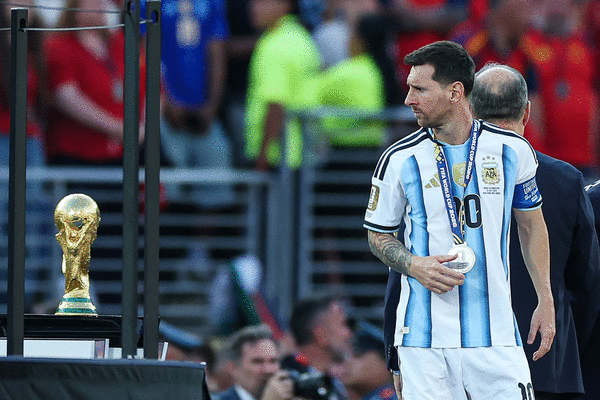
NEW YORK — The storybook ending eluded Lionel Messi.
Soccer’s biggest superstar, still playing at an otherworldly level at age 39, sat on the grass at MetLife Stadium, his thousand-yard stare saying more than words ever could.
Spain, in well-earned exuberance, celebrated nearby.
It wasn’t until the on-field medal ceremony that Messi’s pained expression turned to tears. A second World Cup championship was not to be.
Not on this Sunday afternoon in East Rutherford, N.J., where Spain’s smothering defense stifled Messi-led, defending-champion Argentina and keyed a 1-0 victory in extra time to clinch the World Cup crown.
“I feel sad,” Messi said afterward. “But I am aware that we played our hearts out.”
Competing at his sixth and potentially final World Cup, Messi had delivered his usual rarefied excellence throughout the tournament — even at an age in which most soccer greats are well into retirement.
Messi totaled eight goals and four assists, many of them timely as Argentina eked out instant-classic victories over Cape Verde, Egypt and England en route to Sunday’s final.
But Messi’s magic ran out against a historically stingy Spain team that allowed just one goal in eight World Cup games.
Spain limited Messi to one shot in Sunday’s final, and none in regulation.
A sellout crowd decidedly in Argentina’s favor kept waiting — and waiting and waiting — for Messi to save the day.
But Spain was too young. Too active on defense. Too much to overcome. A 90th-minute red card resulted in the ejection of Enzo Fernández, forcing Argentina to play a man down for all of extra time. That preceded Ferran Torres’ game-winning goal in the 106th minute.
Clinging to that lead, Spain deflected Messi’s cross in the 114th minute, then watched moments later as he sent another ball just above the goal.
In the end, Spain’s immovable object thwarted Messi’s unstoppable force.
“When you have Messi on the other side, well, you are nervous,” Torres said. “At the end of the day, we always depended on us. We always come up with our football, and we showed it again.”
Now, questions about Messi’s future with Argentina will dominate the discussion.
Messi will be 42 at the start of the 2030 World Cup and turns 43 during it. Spain, Portugal and Morocco are co-hosting that tournament, though one game will take place in Argentina.
The ageless Messi has a history of teasing retirement, only to return — and flourish — on the international stage. He had signaled Sunday’s final would be his last World Cup appearance without actually saying it.
In a social media post last week, Messi referred to his “Last Tango.” In another, he offered a big-picture reflection on his experiences playing for Argentina.
“The nicest thing about all these years was never just the titles, but all the way,” Messi wrote on Instagram. “Sharing the day to day with this group, competing together, getting up in the difficult moments and enjoying every step.”
But consider that a decade ago, at the very same MetLife Stadium, a deflated Messi declared his retirement from Argentina, bewildered that a major international championship had eluded him.
Argentina lost the 2016 Copa America final to Chile that night, with Messi — already considered the world’s greatest player — uncharacteristically missing a kick during the penalty shootout.
It was the fourth loss in a major final — three at Copa America, plus the 2014 World Cup — that Messi had suffered with Argentina.
“I tried my hardest,” Messi said at the time. “It’s been four finals, and I was not able to win. I tried everything possible. It hurts me more than anyone, but it is evident that this is not for me. I want more than anyone to win a title with the national team, but unfortunately, it did not happen.”
Messi reversed that decision a few weeks later, and wisely so.
In the 10 years that followed, Messi earned his long-awaited first World Cup championship in 2022. He led Argentina to back-to-back Copa America titles in 2021 and 2024, too.
Some suspected Messi’s 2023 departure for Inter Miami and the MLS meant the beginning of the end for a player who starred for Barcelona and Paris Saint-Germain.
That hasn’t been the case.
Messi’s eight goals at this year’s World Cup were the second-most of any player — earning him the Silver Boot — behind only France’s Kylian Mbappé, the Golden Boot winner.
Earlier this summer, Messi became the World Cup’s all-time-leading scorer, though Mbappe has since surpassed him with 22 goals.
Messi now boasts 21 goals in 33 career World Cup games. He was named the second-best player in this year’s tournament, finishing behind only Spain’s Rodri for the Golden Ball trophy.
Argentina was trying to become the first team since Brazil (1958 and 1962) to repeat as World Cup champions. Messi aimed to join the short list of players to win multiple World Cup titles — an exclusive club headlined by Pelé, the only three-time champion.
Instead, Messi fell to 1-2 in World Cup finals. Sunday was the first game in this tournament in which failed to record a goal or an assist.
The day ended in tears.
If this was indeed Messi’s final World Cup chapter, the sobering finish did not match the incredible journey.
“We lost the game, and we accept that,” Messi said. “That doesn’t mean that we will forget everything we’ve done so far, so I’d like to thank my people, my players and the country. I can tell them that we played our hearts out.”
____
©2026 New York Daily News. Visit nydailynews.com. Distributed by Tribune Content Agency, LLC.





Comments