Ben Sills: Trump, Messi, Thatcher -- and the most lucrative World Cup ever
Published in Soccer
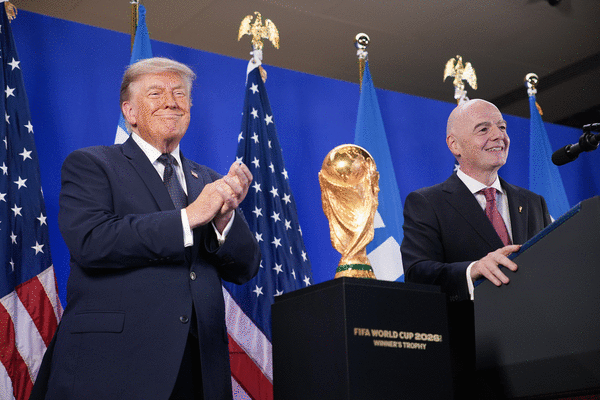
The moment when the political sideshow of the 2026 World Cup moved to center stage came at the end of the second semifinal.
As the beaten England players wandered around the pitch in Atlanta trying to come to terms with how the game had gotten away from them, Argentina’s Giovani Lo Celso and Lisandro Martinez grabbed a banner from the crowd and unfurled it with their celebrating teammates. “The Malvinas Are Argentine,” it declared in Spanish.
For context, the Islas Malvinas — the Falkland Islands — are not actually controlled by Argentina, a source of frustration to many in the country. But the dispute over the British Overseas Territory in the Southern Atlantic is now a prominent narrative in the most political — and lucrative — of World Cups as it reaches its climax on Sunday night when Leo Messi’s Argentina takes on Spain in the final in New Jersey.
Donald Trump will attend as host, and he faces a potentially awkward encounter with Spanish Prime Minister Pedro Sánchez, who has been a regular punching bag for the U.S. president since his return to office last year.
Then there’s FIFA President Gianni Infantino, who has cozied up to Trump and whose organization controversially reversed the suspension of an American player earlier in the tournament. Infantino may be confronting Aleksander Ceferin, the UEFA chairman who is his main rival for control of the billions of dollar generated by the planet’s richest sport each year.
But it may be the UK that has the most to worry about, with England at risk of having insult added to the injury of losing last Wednesday’s semifinal, 2-1.
Argentina has long disputed the UK’s hold over the archipelago of 4,000 people that lies about 300 miles off its coast. It argues it rightfully inherited the islands from Spain two centuries ago. Britain, meanwhile, first laid claim to the territory in 1765 as the country was building its empire. The UK maintains that a 2013 referendum in which residents voted to remain a British Overseas Territory settled the issue.
In 1982 (another World Cup year that began with Argentina as champions), the country’s military leader, General Leopoldo Galtieri, dispatched his forces to seize control of the Falklands. In response, UK Prime Minister Margaret Thatcher sent her navy some 8,000 miles across the Atlantic and after several weeks of fighting, the Argentines surrendered.
For most people, the case has been consigned to jingoist history since it served as a backdrop to a controversial Argentina victory over England at the 1986 World Cup.
Before Argentina’s quarterfinal victory over Switzerland, Foreign Minister Pablo Quirno penned a newspaper column reiterating his nation’s claims to the islands. Before the England game, Vice President Victoria Villarruel called on the team to defeat the “usurping pirates.” “Against the English, it’s always something more,” she wrote on X.
The debate has been revived by two issues that appeal to the U.S. president: Oil and retribution. Argentina’s interest in the issue has been stoked by a potential oil project off the Falklands coast that it says is violating UN resolutions by advancing without its involvement.
In April, UK diplomats were spooked by the leak of a Pentagon memo suggesting the Trump administration might review its stance on the Falklands’ status to punish the UK for not offering more support for the war on Iran.
Trump also has a track record for questioning the sovereignty of Atlantic islands with complicated histories, as residents of Greenland can testify. He also has a penchant for granting favors to his favorites like Argentine President Javier Milei.
FIFA has taken no action against the Argentine players for their banner. The organization didn’t respond to a request for comment submitted to the press office through its website.
The World Cup has had a political dimension since it first started in Uruguay in 1930. In theory, players are banned from making political statements at FIFA matches, under article 14 of its disciplinary code, which says that “provoking spectators” merits a minimum two-match suspension.
During the 2018 World Cup, two Swiss players of Kosovan descent were fined for making an Albanian eagle gestures with their hands after scoring against Serbia. The decision was reached within three days, meaning that the issue was resolved before the Swiss team’s next match.
In this World Cup, FIFA’s disciplinary procedures have buckled under pressure from the organizer’s commercial and political interests.
Cristiano Ronaldo, the aging Portuguese captain who remains the game’s most bankable star, saw a suspension reduced, allowing him to play in his team’s first game. It overturned the ban on the U.S. team’s star striker following a red card to allow him to play in their knockout tie against Belgium, following an appeal from Trump himself.
Then there’s Messi. The Argentine legend brings an authentic glory that plenty of politicians want to be reflected in. And Messi sometimes is happy to oblige. When he lifted the World Cup in 2022, he was wearing ceremonial Arab robes provided at the last minute by the Qatari hosts.
He’s also become an important piece in Infantino’s struggle to strengthen FIFA’s grip on the global game and all its wealth in the face of a challenge from UEFA and the European clubs, especially since his lucrative move to play for Inter Miami in 2023. It was the first time the world’s best player had joined a club outside of UEFA’s structure.
Victory for Messi’s Argentina on Sunday would give FIFA a narrative that would help to consolidate the tournament in the U.S. and drive more of football’s revenue away from UEFA’s reach. A Spanish win, meanwhile, would be a boon to UEFA.
A Spanish triumph might also irritate Trump, who has repeatedly clashed with Sánchez over U.S. demands for defense spending. The Spanish premier has also portrayed himself as a counterpoint to the anti-immigrant policies that Trump and many of his allies have made their signature issue.
This month, at the NATO summit in Ankara, Trump ordered Treasury Secretary Scott Bessent to shut down all U.S. trade with Spain. (It wasn’t clear how Bessent could do this and the White House quickly walked back the idea).
Someone who won’t be present on Sunday night, though, is Argentina’s Milei, a libertarian whose politics appeal to many of Trump’s most high-profile backers and who has a personal rapport with the U.S. president.
Milei, the first foreign leader to meet with Trump following his 2024 election victory, has decided he’ll be more comfortable watching from his residence in Buenos Aires. “I sweat like a condemned man,” he explained in an interview on a local radio station.
———
— With assistance from Travis Waldron.
©2026 Bloomberg L.P. Visit bloomberg.com. Distributed by Tribune Content Agency, LLC.




Comments