Heavy NYC rain to improve smoky air ahead of World Cup final
Published in Soccer
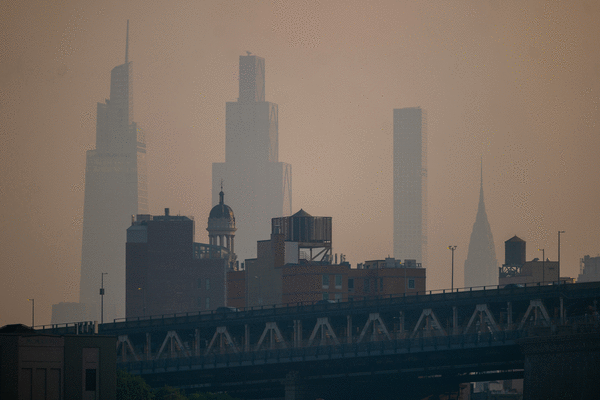
Heavy rains forecast to douse the New York and Washington, D.C., areas will improve air quality worsened by Canadian wildfires ahead of Sunday’s World Cup final.
By contrast, Chicago faces worsening conditions Saturday night as air patterns send more smoke down from across the northern border. Air quality is still “very unhealthy” in parts of Pennsylvania and Virginia as of Saturday morning, according to the National Weather Service.
New York City will see rain and thunderstorms Saturday afternoon and evening, which could offer some relief to the worst of the smoke on Sunday when Spain and Argentina meet in the World Cup final at MetLife Stadium in New Jersey.
“Tomorrow’s theme is really pretty poor in the upper Midwest again, as the east and northeast start to improve,” said Brian Hurley, a senior branch forecaster for the U.S. Weather Prediction Center. Air quality concerns for the World Cup game on Sunday should be “much better, but not fully gone.”
Temperatures in Chicago will reach 90 degrees Saturday afternoon, but a passing cold front will bring thunderstorms that could be severe in northern Illinois, according to the NWS. The air quality will be unhealthy for sensitive groups on Sunday in Chicago.
Longer term, the smoke will likely fluctuate across the Midwest, Northeast and southern Canada for weeks to come as hundreds of forest fires rage unchecked. President Donald Trump alleged the U.S.’s northern neighbor is “responsible for the fact that they are not properly maintaining their Forests.”
Trump said he planned to speak to Canadian Prime Minister Mark Carney “to find out what they are going to do about it,” while also threatening to increase tariffs on Canada in response to the trans-border smoke. Canada’s boreal forest is particularly vulnerable to rising temperatures driven by climate change.
Ontario has 191 active wildfires, seven more than on Friday, and 73 are not under control, provincial Premier Doug Ford told reporters Saturday. Even so, air quality is expected to improve in much of the province on Sunday.
Ford responded to criticism from US officials over the wildfires, saying it’s a “shame” that the Trump administration and some members of Congress are blaming Canada.
“You don’t get on and start threatening and criticizing because, guess what? One day it’s going to be your turn and we’re going to be down there without hesitation to support our neighbors,” Ford said. He cited Canadian efforts to help California fight wildfires last year.
Saturday’s thunderstorms are forecast to hit New York City and northern New Jersey in the afternoon and evening. The biggest concern will be damaging winds of more than 60 miles per hour, Hurley said. The area is under flood watches as it braces for as much as four inches of rain in some pockets.
“Tomorrow will bring severe storms to New York City,” Mayor Zohran Mamdani said Friday in a post on X. “Thunderstorms are expected to bring damaging winds strong enough to down trees and power lines, along with heavy rainfall that could cause flash flooding.”
Across the U.S., wildfires in the Pacific Northwest are causing air quality issues in Oregon and Idaho, with the potential for smoky air to dip into northern California, Hurley said. Conditions southwest of the Blue Mountains in Oregon were considered “unhealthy” as of Saturday morning.
The U.S. was battered by multiple weather extremes this week, with more than half of the population breathing in smoky air, enduring high heat or contending with catastrophic flooding on Friday.
As the climate warms, the chances of more intense storms, droughts and fires have been rising. A hotter world, driven by human-caused warming, has led to the atmosphere holding more moisture, prompting catastrophic flooding. It’s also contributed to significant levels of evaporation that’s ushered in years-long droughts, including in the U.S. Southwest earlier this century.
Some scientists say this is just the beginning of even more severe weather during both summer and winter that will threaten commerce and populations globally.
———
— With assistance from Vivien Ngo, Tom Fevrier, Anand Mammen Katakam and Nojoud Al Mallees.
©2026 Bloomberg L.P. Visit bloomberg.com. Distributed by Tribune Content Agency, LLC.





Comments