Yuen: Soccer's biggest barrier isn't talent. It's money.
Published in Soccer
The World Cup reminds us Americans that soccer, “the beautiful game,” transcends language, geography and how much money your parents make.
Sometimes that’s tough to reconcile if your Minnesota summers are like mine, ferrying kids to soccer games across the metro or beyond. You pay the hotel bill for that out-of-town tournament and take off work when a local game is scheduled on a Wednesday morning. Being a club soccer parent often signals that you are part of a privileged class.
That’s because much of the U.S.’s youth sports ecosystem is driven by a hyper-organized, pay-to-play ethos, where many parents fret they’ll miss the train if their kid isn’t training competitively by second grade. I’ve seen otherwise levelheaded adults, myself included, shell out thousands of dollars a year on their kids’ club fees and travel costs and get swept up in the race to raise an “elite” athlete.
Look a little harder, though, and there are exceptions to this model, outliers that — by design and circumstance — lack parental interference or barriers to entry.
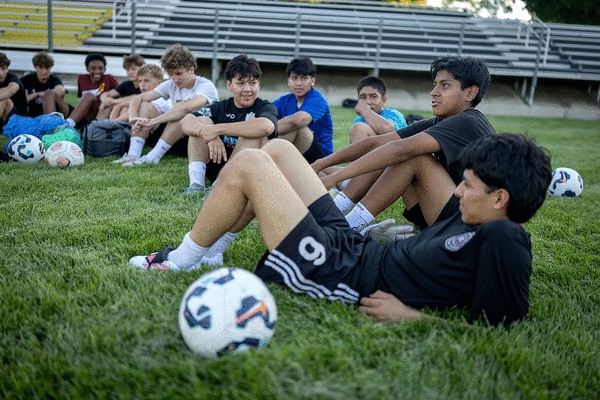
On a recent night, I stopped by the Futsal Society’s first summer league game at DeLaSalle High School and spotted teens from all over the world, suited up in team jerseys and cleats. Alson Tshikondo impressed peers with his speed — they called him “Mbappé,” after the French superstar. The 18-year-old has kicked the ball his entire life but has yet to break into the exclusive realm of American club soccer.
“You need money, and I’m broke,” said Tshikondo, who’s from Zambia. “Many people are talented, but they have no money.”
Here, though, Alson and the other players compete for trophies, just like more organized teams. They get touches on the ball, even in winter. And before high schools form teams in August, a coach runs clinics and drills that chase away pre-tryout jitters.
The biggest difference here is that everything is free.
The origins of the Futsal Society started a decade ago when a group of 20-something friends began renting out a rec-center gym in Minneapolis’ Whittier neighborhood, hoping to stay in shape and play a compact, indoor version of the game they loved.
High school kids from the neighborhood, many of them from refugee families, started to pop their heads in the gym. Within weeks, there were lines out the door.
“At first you’re bitter because as an old guy, you’re like, ‘It’s my one time to play,’ ” recalled Sean Oyaas, one of Futsal Society’s founders. “And then you start looking at the magic of it.”
Oyaas said he and his buddies saw how these casual games stood in contrast to the “incredibly restrictive” travel soccer culture they grew up immersed in. They recognized that the club scene was largely walled off from kids of lesser means.
One teen who grew the futsal program by word of mouth was Bishar Mohamed, a Somali immigrant from Ethiopia. A teacher’s aide at his middle school, Caleb Crossley, invited Bishar to play after they connected over soccer. The two debated endlessly over who was the true GOAT of the game (Messi or Ronaldo).
But when Crossley asked Bishar which team he played on, he was shocked to learn the teen didn’t have one.
“How do you love this more than me — and I love it a lot — and you don’t have a coach, you don’t have a team?” Crossley remembers thinking. “I idolized my coach. They were my teacher, my mentor. I attribute so much of my development as a person, so many values and lessons, to being on a team."
Those early days were not without drama, though. Kids lost tempers, fights escalated.
Crossley recalled: “I was the ref, league commissioner, and bouncer.”
He helped establish a positive culture where respect, hard work and fun were the guiding principles. Crossley, now executive director, said the past few years have been fistfight-free.
Many of the players I spoke to said they learned to regulate their emotions by playing futsal, along with patience, positivity and fairness. Crossley has walked some players to the nearby Minneapolis Community and Technical College to enroll. Bishar, who spent much of his teen years DoorDashing and caring for his younger siblings, is now a 24-year-old father of two who runs his own trucking business.
In 2023, the Futsal Society set up a coffee shop on a tucked-away street near Loring Park. At Fawkes Alley Coffee, every latte and Americano funds the mission of making a more democratic youth soccer world. You can also order a Somali tea, a recipe passed down from Mohamed’s mother. The coffee shop hires players as baristas, who receive mentorship and workforce development training.
Futsal Society is now a nonprofit that has served more than 1,300 kids, hailing from 48 countries and 68 high schools. More than half of the players are first-generation immigrants. Alumni return to the program as refs or volunteer coaches.
One of those alumni, coach Shuaib Mohamed, 23, knows firsthand how the game connects these kids. “Soccer was like a home, our way of searching for happiness,” he said.
After arriving here with his family as a refugee, Shuaib connected with kids from other countries who shared a fluency in the language of soccer. While he played for his high school team, he didn’t pass the cut by the time he tried out as an older teen for a Minneapolis club. Now he’s mentoring promising athletes who play in Somali recreational leagues, encouraging them to join clubs early if they want a chance to play in college. Some clubs offer financial assistance.
In 1994, the last time the United States hosted the men’s World Cup, it launched soccer mania, inspiring a massive surge of American kids picking up the sport. In 2026, the tournament asks us to reflect who we will be included, and who will be left out, if our youth sports model continues to require privilege to play.
On that evening at DeLaSalle, there was another vision of youth soccer. As the sun set over the field, boys of every background hustled and worked the ball. They cheered each goal and laughed over the ones they missed. Wealth didn’t matter. That’s when soccer is most beautiful — when it belongs to everyone.
________
©2026 The Minnesota Star Tribune. Visit at startribune.com. Distributed by Tribune Content Agency, LLC.





Comments