World Cup is dream for Seattle player on Palestinian women's soccer team
Published in Soccer


SEATTLE — Imagine competing in a soccer tournament like the FIFA Men’s World Cup that’s been playing out in Seattle and across North America this summer.
The badge on your jersey. The ball at your feet. The smell of the grass. The roar of the crowd. For most young soccer players, it’s just a dream.
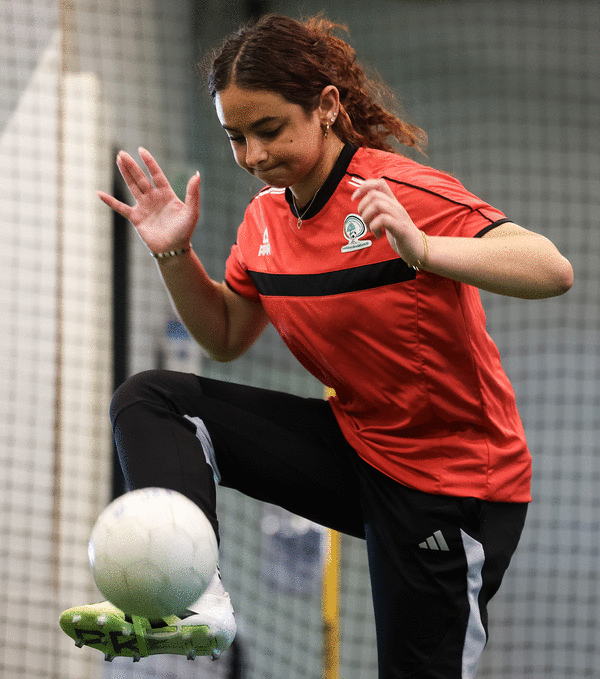
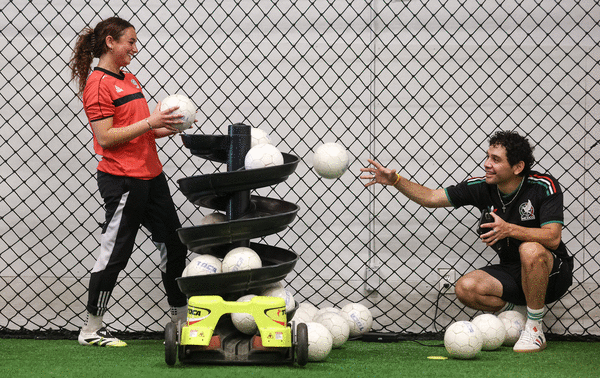
But for Zjada Baydass, it’s a real goal with serious stakes. The 22-year-old from Issaquah plays for the Palestinian women’s national team. She also coaches soccer and organizes pickup games in the Seattle area.
“I’m not stopping until we get to the World Cup,” Baydass said last month during a break from her job in Tukwila. “Because that’ll be history.”
Baydass isn’t a household name. She doesn’t play professionally yet. But she might have the most remarkable story in Seattle-area soccer, considering how she learned the sport and whom she represents when she takes the field.
Raised here and in the United Arab Emirates by a Lebanese-Palestinian father and an American mother, Baydass didn’t start playing soccer with local youth clubs until she was 13 and never even joined her high school’s team.
She fell in love with soccer for a simple reason: It meant spending time with her dad.
“He would come to the fields with me. He was the one I would train with. He saw potential in me that I didn’t see in myself,” said Baydass, who improved so much, so quickly that the Palestinian Football Association took notice.
“We didn’t even know there was a national team” until a family friend mentioned it and put her on the association’s radar, Baydass said.
Baydass was 18 when the association called and invited her to a youth national team tournament. She and her parents were blown away.
Initially, “My dad thought it was like a prank,” Baydass said, laughing.
Then reality set in and Baydass began grinding. The tournament was postponed due to pandemic travel restrictions, so she had time to prepare.
“My training changed significantly,” said Baydass, a midfielder who models her play on Kevin De Bruyne, a Belgium men’s national team superstar known for his incisive attacking passes. “Once we realized I had the opportunity to go play overseas … that became my main focus.”
That work paid off in 2023, when Baydass traveled to Ramallah for the tournament and played with the Palestinian youth team. She had never played soccer at such a high level before and, although she grew up hearing her grandparents talk about their homeland, she had never been there.
“It was the first time that anyone on my dad’s side of the family had returned to Palestine since 1948,” Baydass said. “It completely redefined my perspective on everything that I do and everything that I’m a part of.”
The team practiced in a refugee camp near Israeli settlements. Baydass heard gunshots and tear gas filled the air, she recalled. As she got to know her new teammates, she was struck by their resilience and devotion to the game.
“The pride, passion and dedication they have for soccer that I’ve never seen here in the United States,” she said. “It’s a completely different level of love for the game because it’s all they have. Soccer is an escape from reality.”
In 2024, Baydass moved up to the women’s national team and competed in the West Asian Football Federation’s major tournament. The squad notched wins against Syria and Iraq, opening up a chance to qualify for the 2027 FIFA Women’s World Cup, before being knocked out by Jordan.
Held in Saudi Arabia just months into the Gaza war, the tournament unfolded while players’ emotions were still raw. The experience helped Baydass come to view playing for the national team as a way to humanize Palestinians for the rest of the world, she said.
“I want them to see that we’re the same as anyone else,” Baydass said.
Baydass has struggled with serious injuries since then. She snapped a bone in her foot soon after the 2024 tournament, sidelining her for a year, and then broke her kneecap this January, soon after returning to play.
The injuries have kept Baydass off the field for a while and postponed her plans to play professionally overseas, but she has stayed in touch with the Palestinian team and has kept busy in Seattle.
She graduated from the University of Washington in December with an environmental studies degree and interned with The Nature Project, a nonprofit that connects teenagers with outdoors experiences and athlete mentors to benefit their mental health and broaden their horizons.
“She just has a spark,” said Jane Bierman Seibel, executive director of The Nature Project. “Her drive and passion is sports but she integrates that into other parts of her life, into her friendships and communities.”
Baydass has organized local soccer tournaments to raise money for Palestinian kids and, through a national street soccer group, she coordinates hard-court pickup games at Judkins Park in the Central District. She sees soccer as a way to bring Seattleites of different backgrounds together.
“I just love being around the game, because soccer is a universal language,” she said. “Everyone can just come together and play.”
Baydass recently started a coaching job at Elite 90, a huge new indoor soccer complex near Southcenter mall. The complex is screening World Cup games this summer, giving her glimpses of what she wants to achieve.
“It just kind of reinforces how badly I want it,” she said about her drive to succeed on the world stage. “I feel like we can get there some day.”
©2026 The Seattle Times. Visit seattletimes.com. Distributed by Tribune Content Agency, LLC.






Comments