Mike Vorel: VAR changes are the worst thing about the best World Cup
Published in Soccer
SEATTLE — On the internet, they call it “the rule of cool.”
The concept is simple. In sports, if a play is cool enough — a poster dunk, a buzzer-beating 3-pointer, a one-handed catch straddling the sideline, a bicycle kick pummeled between the posts — its coolness should outweigh everything else. Like whether the tip of a football technically touched the ground. Or whether the left guard held a jersey for a fraction too long. Or whether the goal scorer’s pinkie toe sat microscopically offside.
If it’s cool enough, it stands, reviews be damned.
Sports, after all, are supposed to be fun. We watch to be mesmerized by elite athletes, to feel closer to our communities and the colors we wear. Not to be bombarded by yellow flags and red cards and miles of red tape.
The rule of cool, of course, is more of a joke than a serious suggestion. Sports require both rules and referees. We all know that. Fairness cannot be compromised. You have to get it right.
But in an otherwise incredible FIFA Men’s World Cup, nothing has been less cool than the video assistant referee.
Or VAR, as it’s known to millions of soccer/football/futbòl fans forced to reckon with its incessant replays.
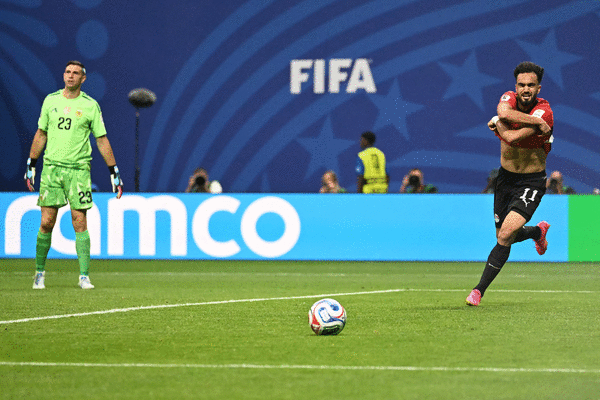
Case in point: Tuesday’s round of 16 slugfest between Argentina (the reigning World Cup champion) and Egypt (which had never won a World Cup match before this tournament). In the 58th minute, Egypt clung to an improbable 1-0 lead, when Egyptian defender Marwan Attia dispossessed Argentina’s Lisandro Martínez. Pinned into his corner, Attia passed to teammate Haissem Hassan, who made mincemeat of Argentina’s midfield. The 174-pound Hassan darted through and around Argentine defenders before successfully locating captain Mo Salah. Salah sent a pass sashaying into the box, where attacker Mostafa Ziko fashioned an emphatic finish.
It was a breathtaking 16-second stampede, an undeterred underdog trampling the status quo. It was a defunct McDonald’s supersized serving of uncut adrenaline, as Ziko tore off his jersey and leapt into a teammate’s arms. It was the very best of what the World Cup can be.
Until, of course, it wasn’t.
Though no foul was called on the field, VAR initiated a review. French referee François Letexier concluded that Attia had stepped on Martinez’s foot, thus negating the entire 16-second frenzy that followed. It didn’t matter that Attia’s foul occurred on the opposite end of the pitch, and Argentina had myriad opportunities to regain possession. It didn’t matter that Egypt was creeping closer to a signature upset in World Cup history, toppling a perennial power and arguably the game’s greatest player (Lionel Messi).
It didn’t matter that, according to ESPN soccer commentator Ian Darke, “The goal would have stood for 150 years prior to VAR.”
Imagine if Marshawn Lynch’s “Beast Quake” run — all 67 yards, 16 seconds and nine broken tackles — was erased by a holding penalty that wasn’t called in real time by the referees on the field. From iconic to forgotten, just that fast.
To its credit, Egypt added a second goal in the 67th minute before Argentina resurrected itself with three consecutive strikes in a 3-2 win. Though Egypt’s players and staff appealed for a pair of fouls that preceded Argentina’s 92nd-minute winner, no video review was initiated.
Which may be why, in the aftermath, a distraught Zico declared: “It’s clear that this tournament has been fixed.”
I don’t believe the World Cup has been fixed.
I do believe VAR’s misstep was more egregious than Attia’s.
“This was (the) goal of the tournament,” former goalkeeper and current analyst Kasper Schmeichel agreed on Fox. “For me it’s an absolute disgrace how this has been brought back. I obviously don’t know the rules of football, then. Because if there’s a foul directly leading to a goal, then yeah. But (Hassan) runs the length of the pitch. It’s not even him that gets the assist. I can’t, for the life of me, understand how that’s been allowed to be brought all the way back to the corner. I’m absolutely shocked.”
Added former U.S. men’s national team coach Bob Bradley: “When we’re using cameras to re-referee plays that happened five, six, 10 seconds before, something is lost.”
When it comes to our coolest World Cup goals? Boy, we’ve lost a lot. We lost an incredible Croatian equalizer in the 103rd minute of a loss to Portugal, because a microchip inside the ball detected that a Croatian player’s hair had touched it, triggering an offside. We lost a 90th-minute Colombian winner against that same Portugal side, because a literal toe tipped offside. We lost a 93rd-minute Iran winner against Egypt, which would have sent Iran into the knockout rounds for the first time in its nation’s history, for the same reason.
As X user Diego Lopez joked in a post with 52,000 likes, as of Thursday: “I don’t understand why so many Americans are confused about how offsides works in soccer. It’s easy, if anything exciting happens, that’s offsides.”
Are these the right calls? Technically.
Are they the cool calls? Not a chance.
Besides, even with the benefit of video review, the referees don’t always get it right. ESPN analyst and former referee Andy Davies has reviewed every VAR intervention across the World Cup. And in 13 of 31 cases (41.9%!), including the red card issued to U.S. striker Folarin Balogun against Bosnia-Herzegovina, he determined the referee still got it wrong.
Look, I’m not here with sweeping solutions for a 160-year-old sport. I don’t have all the answers, same as the flawed video assistant referee.
The fact is, VAR is a tool that’s often used incorrectly and inconsistently — which comes at a cost.
As ESPN American football analyst Bill Barnwell asked on social media: “If replay only makes it marginally more likely that the right call is being made on the field, is that really worth the trade off of stopping games for minutes on end, often amidst or after their most dramatic and important moments, for replay review?”
I didn’t come to watch a grizzled referee rewind a slow-motion replay on a sideline monitor, while both teams sip water and wait to play again.
I came to watch the World Cup, which has been incredible — but could be cooler.
©2026 The Seattle Times. Visit seattletimes.com. Distributed by Tribune Content Agency, LLC.






Comments