Marcus Hayes: Philadelphia was the star in its World Cup debut
Published in Soccer
PHILADELPHIA — It took 96 years, but the most sacred version of the beautiful game came to Philadelphia.
Both the city and the match met the moment.
Extra public transportation, hydration stations and modest traffic framed an evening of graceful and powerful football, the kind every other nation reveres except ours.
Amid the spectacle of team jerseys, flags and team benches covered by vibrant roofs identifying the sides in national colors, the grass was the star. The stadium’s normal turf is a ragged Bermuda thatched with 5% plastic to withstand the cleated NFL rhinoceroses who usually play there. For the World Cup, it was transformed into a flawless pitch, golf-course quality ryegrass and bluegrass, the sort of surface you could imagine Jason Kelce lying on his back and making snow angels.
Viewed through an international lens, even a soccer game this insignificant still was the most significant sporting event in the history of the city. A town that has seen two World Series titles and a Stanley Cup won within its borders has never hosted anything that riveted folks on six of the continents.
What comes close? Maybe Rocky Marciano, when he knocked out Jersey Joe Walcott in 1952, and won the heavyweight championship. Maybe not.
More moments will come, since the group-stage match between Ivory Coast and Ecuador is just the first of five such games. On July 4, Philadelphia will host a Round of 16 elimination game, and then that will become the most significant sporting event in the history of the city.
The difference was deserving of the night’s significance. At the top of the box, Amad Diallo, who plays for Manchester United, redirected a simple cross from Wilfried Singo with his left foot in the 90th and final minute of regular play. Given 8 minutes of stoppage time, Ecuador could not break through.
Three crucial points to Les Elephants, following the 1-0 final.
After three days of pre-tournament watch parties and fan fests (the Cup began in Mexico City on Thursday), Philly’s hot, sticky, 90-degree moment finally arrived.
The city, four weeks removed from the PGA Championship at Aronimink and four weeks from hosting the Major League Baseball All-Star Game at Citizens Bank Park, finally seemed to grasp the magnitude of the world’s biggest single-sport sporting event landing at its doorstep.
The catalyst: How about the 4-1 thunderbolt win the United States laid on Paraguay in Los Angeles on Friday night.
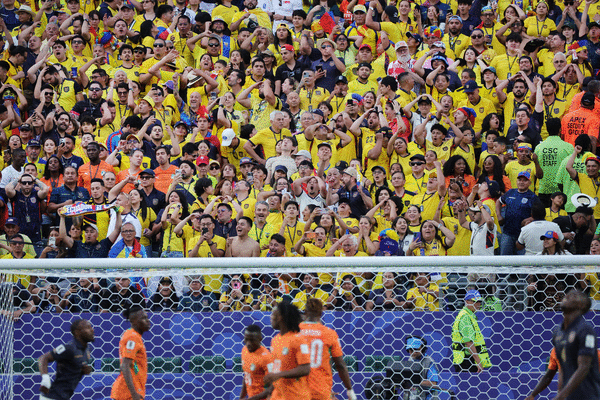
Ecuador hit the crossbar twice in a first half and nearly scored on a blast from Gonzalo Plata just before the water break in the second half. Ivory Coast hit the crossbar 6 minutes into the second half. All of those shots drew gasps, but gasps of different timbre; either delight denied or disaster averted, because the gasps were almost completely Ecuadorean.
Ecuador is nearly 3,000 miles from Philadelphia, but, for two hours, the stadium served as an Ecuadorian colony, its fans wearing yellow, accounting for 90% of the 68,247 fans in the seats. If they’d issued 60,000 pairs of goggles, they’d have had 60,000 Minions.
Little wonder. About half of the approximately 850,000 people in the United States who claim a connection with Ecuador live in either New York or New Jersey. Most estimates of Ivorians in the U.S. don’t even reach 10,000.
After the 5 p.m. SEPTA Broad Street Line express was taken out of service at Race-Vine because a door wouldn’t close, the 5:15 local train was inundated with Ecuador enthusiasts when it hit the City Hall stop.
The cars were full to bursting by the time they hit Walnut-Locust, yellow jerseys shoulder to shoulder and chest to chest, men and women alike. As the train pulled out a song arose, full throat and deafening in the hot, cramped subway car:
“¡Vamos, vamos ecuatorianos, esta noche tenemos que ganar!”
Or:
“Let’s go, let’s go, Ecuadorians, tonight we have to win!”
As the throng exited up the stairs of NRG Station, their hearts and voices swelled again. The song rang out again and again during the match.
Unfortunately, the Ecuadorians were not singing on the subway ride home.
Only the Olympics does a better job than FIFA capitalizing on nationalistic spectacle, and Sunday night was no exception. The stunning FIFA World Cup 2026 emblem tapestry laid on the ground covered the midfield circle. Replicas of the flags of Ecuador and the Ivory Coast took up most of the rest of the pitch in front of the goals, crescents cut in the extra fabric to frame the FIFA logo tapestry at midfield. The teams stood on their respective sides of the circle, facing the south stands, as the anthems played.
The match occurred where the Eagles play, at Lincoln Financial Field, which must be referred to as Philadelphia Stadium during World Cup games. FIFA has a strict policy that prohibits references to sponsors who don’t give FIFA money.
That said, Sunday’s affair was nothing like an Eagles game. It was far more elegant.
When Ivory Coast dawdled, La Tri — a nickname for Ecuador’s fans, who wear the tricolor yellow, blue and red of the flag — booed and whistled. It was not unlike the response of Eagles fans whenever the Cowboys score.
Fans of the American version of football might balk at the contention that soccer is a bigger deal, and lovers of the Olympics might contend that the ever-shifting collection of summer and competitions matters more. They are wrong.
The World Cup is a different animal than the Olympic Games, concentrated and egalitarian. You don’t have to own a horse or skis to prepare to compete in the World Cup, just a ball.
The only thing in America that reflects a World Cup is an NFL season. Consider the first 17 games, the regular season, the group stage. Consider the playoffs the knockout Round of 16.
The NFL season in its entirety and intensity is the one comparison that might allow most Americans to understand the depth of investment and emotion other nations harbor for soccer.
And, when you factor in the fact that virtually every man, woman and child in many of these countries have played the sport, then you can better comprehend why soccer is, for so many people on earth, as much religion as it is diversion, and how sacred evenings like Sunday can be or anyone connected with the Ivory Coast or Ecuador.
The best news: Philadelphia gets to do this five more times.
©2026 The Philadelphia Inquirer, LLC. Visit at inquirer.com. Distributed by Tribune Content Agency, LLC.



Comments