How do wildfires impact fish mercury levels in Minnesota lakes?
Published in Outdoors
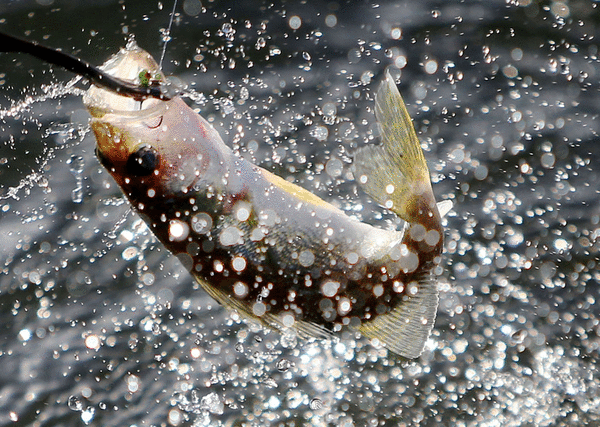
MINNEAPOLIS — Cooking up a shore lunch of freshly-caught walleye, bass or northern pike is a Minnesota tradition.
But because harmful mercury can be found in higher quantities in fish caught in northeastern Minnesota, the state’s Department of Health now has a special consumption limit.
This year, the state advised that kids and others in sensitive groups should only eat one serving a month of many types of fish caught in Cook, Lake and St. Louis counties. Limits for the general population are higher, but still more restrictive than for fish caught in the rest of the state.
Minnesota Star Tribune reader Chuck Cathcart became very aware of mercury contamination when his son, now a fish biologist, researched the issue in college.
Cathcart wondered about the disparity between fish in northeastern Minnesota and the rest of the state. He reached out to Curious Minnesota, the Strib’s audience-powered reporting project, and asked: Could wildfire smoke be a major contributor?
As fires in Canada and Minnesota become more prevalent, scientists are just beginning to study their impact on Minnesota’s aquatic ecosystems.
“We have very limited knowledge of how wildfires, both direct burns and smoke deposition, impact lakes,” said Christopher Filstrup, a limnologist at the Natural Resources Research Institute. “And so, I think that’s what we’re trying to do in our lab, is fill that knowledge gap.”
Looking into what fires leave behind
Filstrup led the largest lake-wildfire study of its kind in North America following the 2021 Greenwood fire, which burned over 26,000 acres of northeastern Minnesota. Within six months of the fire, his team tested the water of 15 lakes that were among the burned acreage of the fire and 15 lakes that were not.
While smoke’s impact is less clear, the burned vegetation and dried out soil that fires leave behind do increase lakes’ mercury levels, Filstrup said.
“We know that when you have watersheds that are burned, you are likely to see more total mercury and also methylmercury [the organic form of the chemical] coming off of the terrestrial land and soils and being transported into lakes,” Filstrup said.
But so far, his team has not found significantly higher mercury contamination in fish in burned watersheds compared to those that did not burn. This could be due to how long it takes for fish to be impacted, he said. The lakes they studied also have other variables that could shape results.
In any case, there are some other likely factors already impacting the disparity in mercury levels around the state: Fish in northeastern Minnesota may accumulate more mercury because they grow more slowly due to the cold water, according to the state Department of Health.
Wetland environments with connected lakes like the Boundary Waters also tend to foster higher mercury levels. In addition, zebra mussels disrupt the food chain, leading to higher accumulation rates.
How does mercury get into fish?
Mercury is a naturally occurring element that takes on many forms. The elemental metallic form, also known as quicksilver, is found in old thermometers and fluorescent light bulbs. The inorganic form is what’s found in the Earth’s crust.
There are many sources that deposit mercury into water systems. It can come from contaminated water runoff from power plants and landfills. Mercury can also be deposited into water directly from the atmosphere. Vegetation absorbs and stores mercury naturally.
Bacteria in the soil or water react with inorganic mercury and transform it into a highly toxic organic compound called methylmercury. This process may happen more frequently due to the effects of wildfires, since burned plants add organic carbon to the water, Filstrup hypothesizes.
“Not only do you get more mercury coming into those lakes,” Filstrup said, “But when you’re seeing water quality changes after wildfires, are those [changes] also increasing the amount of mercury that gets methylated?”
Methylmercury is absorbed by biological tissues at a high rate and is known to affect the central nervous system.
As fish keep eating and growing, they retain and accumulate methylmercury. First, the toxin crosses through the membrane of phytoplankton, such as blue-green algae. Then, zooplankton, like the water flea, consume phytoplankton. Fish then consume zooplankton as part of their diet.
The state health department recommends eating smaller fish, and here’s why: The more fish eat over time, the more mercury they accumulate, so smaller fish of the same species contain less than larger ones. This is often referred to as bioaccumulation.
The type of fish matters too: Predator fish consume other fish, and in just one meal, a predator fish consumes all of the mercury that their prey accumulated over an entire lifetime. The higher a fish is on the food chain, the higher its mercury concentration will be. This is called biomagnification.
Studies will continue
In the future, Filstrup’s team hopes to sample more lakes in general, including lakes that are more similar. They also plan to look at lakes over a longer time period.
As they do, they are researching the fires’ other potential impacts. For example, sustained smoke might influence light availability, affecting phytoplankton and aquatic plants.
On a larger scale, the smoke could deposit ash and nutrients into the lake, which is what Filstrup’s team is starting to explore now.
“The more and more we’re starting to see sustained wildfire and smoke over the ecosystem, it’s likely to have a bigger impact on a whole host of things,” Filstrup said.
____
©2026 The Minnesota Star Tribune. Visit at startribune.com. Distributed by Tribune Content Agency, LLC.






Comments