La Velle E. Neal III: 'Best rivalry in sports' resumes as US, Canada chase Olympic gold in women's hockey
Published in Olympics
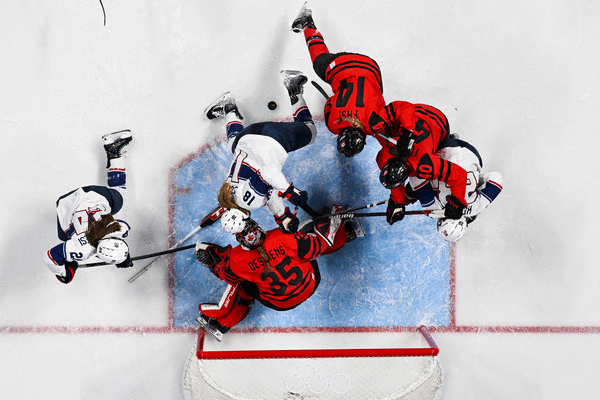
Kelly Pannek was introduced to the USA-Canada rivalry on April 7, 2017, in Plymouth, Mich., in the gold medal game of the IIHF Women’s World Championship. Just 21 years old then, she looked over at the Canada bench and felt a surge of determination.
She knew the Canadian players. She had played with some of them in the past. But this time, they were in those maple leaf sweaters.
“All those veteran players,” said Pannek, a Minnesota native and Frost forward. “It was like, we do not care if we are friends with those people on the other side. We are going to make sure that our team is winning. And that was the standard for our program.
“It still is.”
Team USA won that game 3-2 in overtime to take the gold medal. That time.
It’s a rivalry based on proximity. The North American neighbors have been battling since 1987, when Canada won 2-1 in the inaugural meeting. In their most recent matchup, the U.S. won 4-1 on Dec. 13 in the Rivalry Series between the teams. In between, there have been 191 U.S.-Canada games.
Some blowouts. Some with fisticuffs. All of them gritty.
Canada leads the all-time series 106-86-1. Team USA has won the last six encounters, is the defending gold medalist from the 2025 World Championship and swept all four games of the recently completed Rivalry Series, outscoring Canada 24-7 in those contests.
“I still think it’s the best rivalry in sports,” said Frost defender and Roseville, Minn., native Lee Stecklein, who is playing in her fourth Olympics. “It’s not going away, I don’t think, anytime soon.”
Their next meeting should be the first of two big ones between the adversaries. On Feb. 10, they will face off in the preliminary round of the Olympics in Milan. Both are undefeated in group play so far, as expected. The next matchup would be the gold medal game, if everything breaks right.
Since women’s hockey debuted at the 1998 Nagano Games, there has been only one time that the U.S. and Canada did not meet in the gold medal game. That was 2006, when Canada beat Sweden for gold in Turin, Italy. It’s not the Olympics unless there’s a collision between these two countries with gold on the line.
The last three Olympic meetings between the U.S. and Canada for gold:
It is a growing rivalry as women’s hockey thrives. Players from around the world come to the United States to play college hockey. Now the Professional Women’s Hockey League is in its third year. There is now an established outlet — after other attempts to sustain leagues sputtered — for players to continue their careers. And there are 39 PWHL players — 23 from Canada, 16 from the United States — on the two rosters. They are improving their games in the league, thus raising the level of the U.S.-Canada rivalry.
The two best hockey playing countries in the world are the United States and Canada. Consequently, they bump heads with each other at these competitions. In addition to the Olympics, the teams have met in the final of the World Championship 23 of 24 times.
“Even as we have our league and you play with Canadians a lot of times ... when you get out there and you’re wearing those [USA and Canada] jerseys, there’s just something different,” Stecklein said.
It is a rivalry that has been built on knuckle sandwiches. They have usually occurred during games leading into the Olympics — no one wants to hurt their team by landing in the penalty box with gold on the line. There were fights in 2009 leading into the 2010 Games. But the most memorable battle occurred on Oct. 12, 2013, in Burlington, Vt.
Team USA was down 3-0 in the third period but scored two goals to tighten the game. Late in the period, Jocelyne Lamoureux rushed the net and ended up knocking over the Canadian goaltender. Canada didn’t like that. Soon, a multiplayer brawl broke out that included Lamoureux’s twin sister, Monique.
Kendall Coyne Schofield, a self-proclaimed “lover, not a fighter,” looked on from the bench as all 10 skaters on the ice were handed fighting majors. Coyne Schofield, the Frost’s captain, is now headed to her fourth Olympics with the U.S.
If you want something more recent, there is photographic proof of current Team USA forward and Minnesota Gophers star Abbey Murphy mixing it up with Canada’s Jamie Lee Rattray at the 2021 World Championship.
“People see that she doesn’t care,” Pannek said of Murphy. “She’s not gonna take anything from you. She’s gonna play hard, play physical, but she’s also gonna play really skilled, right?”
It is a rivalry in which the sting of losing to each other in a tournament is more painful, emotionally draining and devastating.
“You go there to win a gold medal,” Coyne Schofield said. “That’s the goal when you get on the plane.”
Added Stecklein: “When you play a bracket sport like at the Olympics, it feels like you’re losing the gold medal instead of winning a silver.”
Team USA has plenty of veterans, led by forward Hilary Knight, playing in her fifth and final Olympics. Seven Frost players help form the spine of the team, from Stecklein, one of the best stay-at-home defenders in the game, to Coyne Schofield, one of the fastest skaters in the world.
There are also seven college players on the U.S. team who are expected to go in the first round of the PWHL draft, four from the University of Wisconsin. They showed they belong by making an impact during the Rivalry Series. Murphy had a hat trick in a 4-1 win over Canada on Nov. 6, with all three of her goals assisted by former Gophers teammate and current Frost forward Taylor Heise.
The sweep of Canada in the Rivalry Series shows Team USA’s mix of players is working. There are veterans and young talents, speed and skill. But that guarantees nothing. Because one of hockey’s best rivalries resumes on Feb. 10, with an Olympic gold medal on the line.
Past performances matter in handicapping horse racing, but not U.S.-Canada hockey.
“They have so much experience and pride on their side,” Pannek said. “So you know that they’re gonna find a response. And we’re gonna respond to that, and it’s just the way it always is.
“And, if we know anything, we know that it’s probably gonna be a 3-2 game in overtime, right? That’s historically what those games come down to.”
____
©2026 The Minnesota Star Tribune. Visit startribune.com. Distributed by Tribune Content Agency, LLC




Comments