Commentary: Demolition derby: The problem with the Kentucky Derby is Churchill Downs
Published in Horse Racing
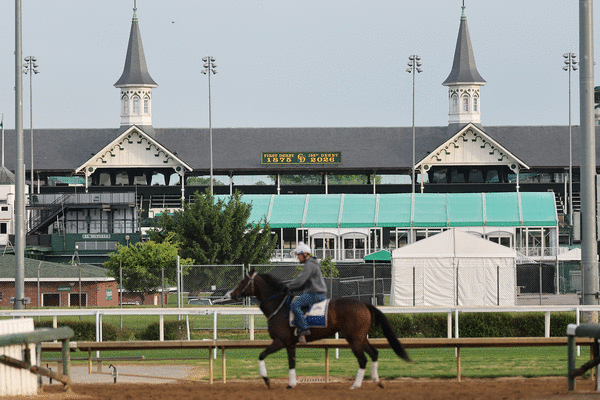
The only bet I would make during Kentucky Derby week is one I’d hope to lose. I’d wager a horse will die.
Because Churchill Downs, the most iconic track in the world, owned by the wealthiest racing company in the country, is one of the deadliest.
Look beyond the women wearing gaudy, oversized hats, men in outlandish suits and beautiful thoroughbreds, and you will see the report recently released by racing’s federal oversight body, the Horseracing Integrity and Safety Authority (HISA), revealing that Churchill Downs is one of the most dangerous tracks in America., with the third most deaths in 2025.
This is why no one should watch or bet on the Kentucky Derby and why Churchill Downs Inc. must own up to its failures and take meaningful action to stop the carnage.
In 2025, 19 horses died at Churchill Downs or its training track. That’s a staggering number, particularly as there were only 70 racing days at Churchill last year. And even one dead horse there, or anywhere else, is unacceptable.
One horse, Sorcerer’s Silver, fractured a leg on Kentucky Derby day, and survived. But just days earlier, Valley of Fire was euthanized after breaking both front legs during training.
In 2023, 12 horses died in the weeks surrounding the derby, including a young thoroughbred named Lost in Limbo, who broke loose just moments before the race. Perhaps he was sore, or maybe he panicked or simply didn’t want to feel the whip. But he was forced into the starting gate and run to his grave.
The horrific breakdown was edited out of Churchill Downs’ replay video, but PETA was there in person to capture the shocking footage. One week after Lost in Limbo was killed, Churchill Downs succumbed to the public outcry about the rash of deaths and suspended racing. The investigation that followed concluded that there was no single cause for all the dead horses—there were many. And the deaths continued.
This creates an existential crisis for horse racing, and nearly everyone in the industry, except Churchill executives, gets it.
Racing experts point to the drastic decline in the total amount of money bet on racing in the U.S., which has dropped, in real value, by 57% since 2003. Among the many issues facing the industry? Horse fatalities.
Churchill Downs Inc. reported a profit of $383 million in 2025 with a revenue of $2.93 billion. If the company can’t divert a sizable chunk of this massive income toward keeping its athletes alive and if it’s willing to accept its rock bottom reputation as one of the nation’s deadliest tracks, then racing will surely continue on its own death spiral.
While this situation has been a long time coming, it accelerated after the 2008 Kentucky Derby, when, seconds after crossing the finish line in second place, a filly called Eight Belles crashed to the dirt, shattering both front ankles. Bettors were cashing in their tickets—more than $10 on a $2 bet on Eight Belles to place—while she was being euthanized.
Since then, PETA has heard every week from people involved in racing—the jockeys and hot walkers, the grooms, the bettors, the trainers and the owners—and every one of them is concerned about abuse and death. Imagine how desperate these people must be to come to racing’s loudest critic and ask for our help.
When the only sure bet during Kentucky Derby week is that a horse will die, the entire racing industry must come together and demand better of Churchill Downs and of itself. As for the rest of us, we should skip the Kentucky Derby, forget about betting on it and ask friends and family to do the same.
____
Kathy Guillermo is a senior vice president at People for the Ethical Treatment of Animals (PETA), 501 Front St., Norfolk, VA 23510; PETA.org.
___
©2026 Tribune Content Agency, LLC.




Comments