Adam Minter: The PGA Tour should welcome prodigal son Jon Rahm home
Published in Golf
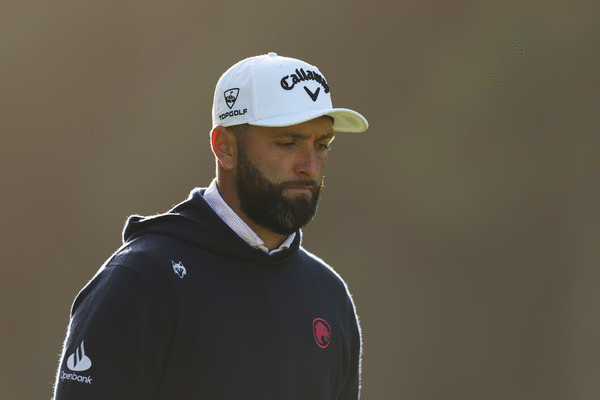
Three years ago, Jon Rahm was on top of the golf world. He had two major championships, a stint as the No. 1-ranked player in the world and star power. LIV, the Saudi-backed upstart challenging the PGA Tour, noticed. It needed a superstar to boost its credibility, and Rahm was the obvious prize. For a deal reportedly worth over $300 million, LIV lured him away.
It didn’t last. Saudi backing for LIV is drying up, the league is in bankruptcy, and on Wednesday Rahm’s lawyer announced he’s walking.
That leaves the PGA Tour with a decision that should be easy because one of the world’s best golfers is suddenly available. But there’s a hitch. The Tour’s one-time return window is closed, and it has no plans to reopen it.
That’s a mistake, especially if Rahm wants to return to the Tour. With LIV no longer a serious threat, keeping Rahm off the Tour would only weaken it and risk a return to the bad habits that left its best players open to leaving in the first place.
For decades, the PGA Tour could take the world’s best golfers for granted. It had the prestige, the tournaments and, most importantly, no serious rival. But it was far from perfect. Players had no guaranteed salaries, faced a relentless tournament schedule and had little leverage to demand better terms.
LIV, which debuted in 2022, exploited the weaknesses. Saudi money brought bigger purses, lucrative guarantees, a lighter schedule and equity in the teams around which it built its tournaments. Suddenly golfers had an alternative, and some of the biggest names took it.
The PGA Tour was forced to compete. Purses grew, more money flowed to the biggest stars, and — eventually — players received equity in the Tour’s commercial arm.
Nonetheless, the Tour wasn’t exactly grateful for the lesson, and the bitterness ran thick. Commissioner Jay Monahan accused LIV players of “turning their backs on the PGA TOUR” for “financial-based reasons” and disrespecting loyal players and fans. LIV players were suspended, and those who resigned were barred from competing as nonmembers. There was no set path back.
The Returning Member Program, established in early 2026, offered a cold welcome. Marking the announcement, PGA Tour CEO Brian Rolapp wrote that returnees would be held “accountable for substantial compensation earned elsewhere.”
Brooks Koepka, a five-time major champion and one of four players who qualified for the program, accepted the terms for returning. Rolapp estimated coming back could cost Koepka as much as $85 million in future earnings — plus a $5 million charitable contribution. It was, Rolapp noted, “one of the largest financial repercussions in professional sports history.”
If the point was to deter future defectors, the Tour can rest assured that the message was sent. But the organization also announced that the program was created for fans interested in seeing “the best golfers competing together more often.” Punishing players is a strange way to accomplish that goal.
Others decided not to apply, including Rahm. At the time, he was still under contract with LIV and, publicly at least, noncommittal about a return to the PGA Tour. Given Koepka’s terms, why rush? The program expired in February.
To be fair, deterrence has value, and the Tour isn’t wrong to demand something in return from the prodigal athletes. Golfers who stayed passed up big LIV guarantees. It would be unfair if defectors could simply resume after filling their pockets with LIV’s once-abundant cash.
But there’s a difference between being fair and being punitive, especially when punishment weakens the Tour itself. What, precisely, has been accomplished if terms are so heavy-handed that players don’t want to come back at all? How does that ensure fans get to see the best golfers compete?
These questions ultimately lead to one main one: What should returning players have to give up? For starters, they shouldn’t recover status or benefits they left for LIV’s riches, and they should have to earn their way into tournaments under the same rules as everyone else. But there’s no reason to impose financial penalties so steep that returning becomes — for some players, at least — a humiliation that’s more trouble than it’s worth.
For now, Rahm hasn’t said he wants to return. In early September, he told the BBC “we’ll see what happens” when asked if he would go back to the PGA Tour, noting that he remains under contract with LIV Golf. Soon, he won’t be.
Rahm is unlikely to be the Tour’s last test. Other players could soon be available too, including Bryson DeChambeau. He has roughly three million YouTube subscribers who watch his videos, regardless of what competition he affiliates with. DeChambeau is one of golf’s biggest online personalities. The Tour has few players who can equal his reach with digitally minded sports fans, and it should covet the chance to be associated with a player who is.
This move wouldn’t just be about the present. The PGA Tour’s next challenger may look nothing like LIV. Should another rival step forward in the future, it would be great for the Tour to seem like the best place to be. It can start by showing the public it has learned not to take players for granted.
———
This column reflects the personal views of the author and does not necessarily reflect the opinion of the editorial board or Bloomberg LP and its owners.
Adam Minter is a Bloomberg Opinion columnist covering the business of sports. He is the author, most recently, of “Secondhand: Travels in the New Global Garage Sale."
©2026 Bloomberg L.P. Visit bloomberg.com/opinion. Distributed by Tribune Content Agency, LLC.




Comments