Brad Biggs: Ben Johnson wants a physical identity for the Bears. After 4 games, that is emerging.
Published in Football
CHICAGO — The symmetry of a 16-game season has been gone for a while, but in the NFL they still talk about the “first quarter” of the season as a period for self-discovery.
Chicago Bears coach Ben Johnson said in training camp — and again last month — that it would take four games to determine the identity of this team, even as it attempted to do many of the same things that worked well in 2025 with a lot of the same personnel.
It sounds like pigskin cliche, but you’ll hear it from every team in the league and it’s more nuanced than you might imagine. Teams break camp with an idea of how things will shake out, but they never really know.
“It’s the old quarter-pole of the season, if you will,” a general manager for another team said. “And it’s a combination of a lot of things. You are starting the season and you haven’t played a full game and some of your starters have barely played in preseason. You don’t have the feedback in camp to self-correct.
“I don’t know if people talked as much about this 20 years ago or longer, when they were doing full two-a-days in pads. So maybe the rules we’ve been under for a long time now have exacerbated things a little bit.”
The GM then went into the weeds a little and talked about how changing out one player — such as a starting wide receiver — can introduce a handful of questions even when most of the offensive personnel remains in place.
“You add one player to the mix and there is a domino effect,” he said. “Who is the third-down target now? Do they need to get the ball in his hands and get him going early? When are we going to take our shots? How is the defense going to roll coverage in the secondary? How are teams going to treat us?
“It’s a little bit of knowing who you are and what you can be. And also what others think of you in a sense of: How are they treating you? What are they scared of? What’s the scouting report on us every week?”
The GM shifted the conversation to the Bears, noting that the trade of DJ Moore created certain unknowns for the coaching staff that couldn’t be figured out until games that count were played.
“Are defenses vising (tight end Colston) Loveland now in the red zone?” he said. “Are they funneling it to him? There is always a cause and effect, and defenses are going to focus on taking something away, usually your biggest threat, and then go from there.
“What are they focusing on and what does that open up? When you have 11-on-11 and all of the variables, there is such a trickle-down effect. One player can change the dynamic, and it’s an evolution a little bit and it’s an exploration of finding who you are and what you do well. That is the minutiae behind it.”
So now that we’re at “the old quarter-pole,” what’s the identity of this Bears team, which takes a 3-1 record into Lambeau Field on Sunday to face the Green Bay Packers?
Unlike last year, when the running game didn’t get sorted out until after a Week 5 bye, this team is a wagon running the football. The Bears are averaging 196.3 rushing yards per game, easily tops in the league. They’ve been successful with both D’Andre Swift and Kyle Monangai, and now we’ll see how they fare without Monangai, who is out for Week 5 with a toe injury.
The running game is the foundation of Johnson’s offense. It travels and it works with Caleb Williams, Tyson Bagent or Case Keenum at quarterback, especially the last two because it takes pressure off of them to make a lot of plays.
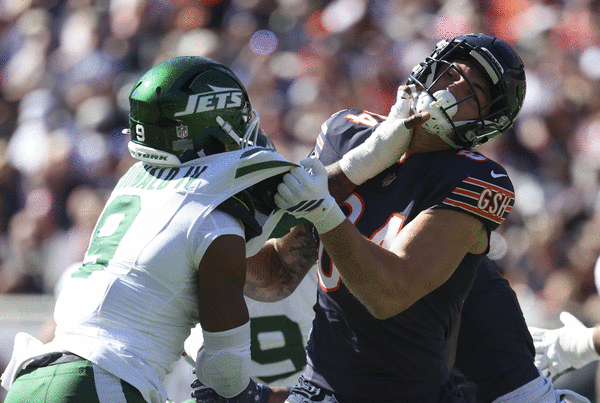
It also allows the Bears to control and dominate tempo. They dictated everything about last week’s 23-12 victory over the New York Jets with their running game. They ran the ball 54 times. That’s a statistic you usually see associated only with a service academy offense. You don’t see that very often in an NFL game.
It’s the way the Bears did it, too, behind their impressive offensive line. There were five runs of more than 10 yards by running backs, but none went for more than 19. It was just, “We’re going to wear you out and run the ball downhill.” That allows the quarterback to throw off play action, and Bagent was 11 of 16 on play-action throws because they mirror the running game.
Some of their offensive identity still has to be sorted out with Williams set to miss his third game because of a hamstring injury. When he returns, Johnson and his staff can dial in on that.
The tough part when you’re analyzing the passing game is the Bears have so many options, obviously a good problem to have. In the first couple of weeks, Kalif Raymond was the go-to target, which no one in the world predicted. Loveland was a ghost.
Last Sunday, Loveland and wide receiver Rome Odunze got going, with Johnson likely making a concerted effort to have them as the primary reads for passing downs early in the game. That’s important because even though the Bears can win games without those two, over the course of the season they cannot achieve their best without them. So the ball has to be force-fed to certain players on occasion, and that’s all part of creating what you want to be on offense.
On defense, coordinator Dennis Allen’s unit has been super stingy since a rocky start in the 59-37 road win against the Carolina Panthers. The Bears have allowed only two touchdowns and a total of 28 points over the last three games. The last time they allowed 28 points or fewer over three consecutive games was Weeks 4-7 (a bye week was mixed in) in 2012.
The Bears have been outstanding on third down, ranking No. 2 in the league at 23.7%, and they rank third in total defense (282.3 yards per game), in part because the offense has run 298 plays to only 192 for the opponents. That’s a huge difference.
The defensive line has been steady with tackle Grady Jarrett, who wasn’t healthy last year, being disruptive in the middle. Ends Montez Sweat, Dayo Odeyingbo and Austin Booker have taken turns making plays.
Objectively the defense has thrived the last three weeks against lower-level competition. So it’s still to be determined what this defense is and what Allen wants it to be. In the first couple of weeks, he was very man-coverage heavy. The last two weeks were much more balanced between zone and man. He has been very calculated when he has called pressures.
The Bears also have tackled very well since Week 1, and amid the abyss of statistics and analytics, that’s overlooked way too often. Good tackling wins games. Just look at the mess the Dallas Cowboys have on defense right now and their abysmal performance Thursday night in a loss to the previously winless Tampa Bay Buccaneers.
“We’re a physical unit, fast unit, disruptive, and as long as we control what we can, I think we can play with anybody,” Jarrett said. “We’ve got to get out of our own way on some of the mistakes that we make, whether it’s misfitting in the run game sometimes or allowing a big play here or there. But we’re only going to be better and everyone on the defense is hungry for that.”
How it looks in the second half of the season will be telling. The Panthers game didn’t go well, but the Bears recovered from that mess immediately.
“Defense has really executed the last three games,” said a pro scout who has watched the Bears. “I still think it’s too early because you’ve got to see them play the Lions, someone like that that can press them a little bit.”
Even with some stuff to unravel, such as the passing game when Williams returns and how the defense fares against better offenses, the results have been positive. Johnson talks almost weekly about how the team’s physicality shows up on tape. It shows up in other ways too. The Jets, in a bid to buy more recovery time, held a walk-through Wednesday, three days after they were whipped at Soldier Field.
That’s the kind of thing Johnson wants to hang his hat on when establishing an identity.
©2026 Chicago Tribune. Visit chicagotribune.com. Distributed by Tribune Content Agency, LLC.



Comments