Mike Vorel: An open letter to the Khosla family, the Seahawks' next owners
Published in Football
SEATTLE — To the Khosla family:
First, let me say, welcome to Seattle. I hear you bought the Seahawks. Congratulations! That might not mean much, coming from a columnist who still drives a rusted 2003 Honda CR-V that whimpers while it miraculously limps along. I can’t even count to $9.612 billion, what the Seahawks cost to buy, more than 20 times what it once took to build Lumen Field.
But hear me out. I know it takes money to make money. I also know this team is so much more than the money you stand to make. It’s more than an appreciating asset or a status symbol. It’s more than a valuation, or an invitation to an exclusive club bankrolled by billionaires. It’s more than two Lombardi Trophies and a streak of 190 (and counting) consecutive sellouts. It’s more than a big blue flag flying above the field.
I hope you understand what you bought and why it matters to millions in the Pacific Northwest.
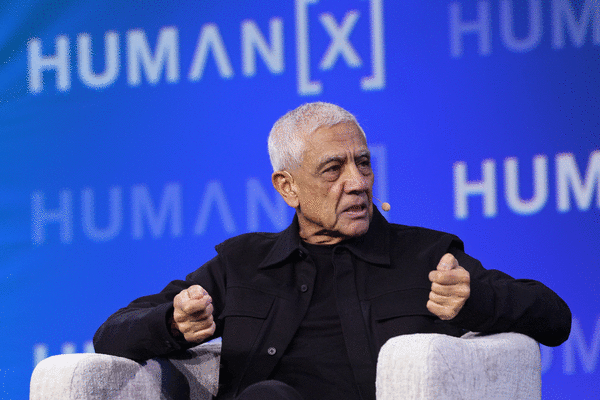
On Wednesday, after the NFL unanimously approved your purchase, you sounded appropriately appreciative of the opportunity. Draped in black, standing beside wife Neeru and son Neal, Vinod Khosla said of your broad benchmarks: “Keep winning, take a long-term approach, and learn a lot. We don’t know enough.”
Maybe I can help in that department.
When it comes to the Seahawks, here are some things you need to know.
You need to know this team has been built with 416 wins and 376 losses spread across a half-century of drizzly Sundays, with nine head coaches and more than 1,200 players, with 52,800 cubic yards of hardened concrete that formed a football fortress where the Kingdome once stood.
You need to know that its successor, Lumen Field — with its imposing white arches, relentless decibels and infamous north end zone — can’t be replaced by a soulless stadium in the suburbs. So don’t get any ideas.
You need to know, contrary to national knowledge, the Seahawks did not pop out of Puget Sound in 2012. You need to know about Steve Largent, who never needed gloves, and Cortez Kennedy’s defensive dominance in 1992. You need to know that, before the Legion of Boom, the Seahawks stacked four pick-sixes in a 45-0 fileting of the Kansas City Chiefs in 1984. You need to know that’s just the beginning.
Because it hasn’t always been easy for the Seahawks or their fans. They once went 10 years between playoff appearances, with seasons as unforgiving as the Kingdome AstroTurf. Three decades ago, then-owner Ken Behring attempted to relocate the team to southern California, before finally selling to Paul Allen instead. Their first Super Bowl appearance, in 2006, was doomed in part by dubious refereeing. They also endured the most crushing interception the sport has ever seen, denying Pete Carroll and his Legion of Boom back-to-back Super Bowl victories.
Seahawks fans have been hardened by that heartbreak. The decades in darkness afforded them an edge. The 12s earned a game ball after forcing 11 false starts in an overtime win over the Giants in 2005. In Seattle, that number represents a shared belonging. And in a stadium that volleys decibels between its arches, they became the NFL’s most daunting and deafening force.
On that note: you need to know about the Beast Quake, in which Marshawn Lynch personally steamrollered the New Orleans Saints. You need to know what it felt like, as a city’s collective catharsis spiked on the Richter scale.
You need to know about the people that built this place. Like Jim Zorn and Kenny Easley and Mike Holmgren, who should be in the Hall of Fame. Like Walter Jones and Steve Hutchinson, who snowplowed holes the size of houses for Shaun Alexander to expose. Like Carroll, with his Nike Air Monarchs and inexhaustible enthusiasm. Like Richard Sherman, who “a sorry receiver like Crabtree” couldn’t overcome. Like Russell Wilson, whose fluttering moon balls fell like rain.
Like Paul Allen, who saved NFL football in this city. Like Jody Allen, who quietly led the Seahawks to their second Super Bowl victory. You need to know the weight of what you’re inheriting. Because the Seahawks are not a piggy bank to break. They’re a Pacific Northwest institution to protect.
You need to know what Behring didn’t: the Seahawks, like Mt. Rainier, are unmovable.
That institution was made from too many moments to cram inside a column (though I obviously tried). Most recently, Mike Macdonald dunked on the Seahawks’ doubters. Jaxon Smith-Njigba also ascended to superstardom, and Ernest Jones IV used a four-letter word we can’t print to protect his quarterback. General manager John Schneider built a second Super Bowl roster from rubble.
Which is all to say: this franchise doesn’t need to be fixed. Macdonald and Schneider, etc., need to be empowered, however possible. Their blue-collar football factory needs to be invested in, supported and maximized.
Like you said, you have a lot to learn. You’re outsiders to Seattle. So was I. But that doesn’t mean you can’t carve an indelible legacy. I moved here from the Midwest in 2018. I met my wife here, bought a house here and found a home here. This city will love you if you let it, and if you love it back.
You have a lot to learn about the Seahawks. That’s a good thing. Because growth comes in knowing you can never know enough.
© 2026 The Seattle Times. Visit www.seattletimes.com. Distributed by Tribune Content Agency, LLC.




Comments