Chip Scoggins: This is why Larry Fitzgerald Jr. was just inducted into the Pro Football Hall of Fame
Published in Football
MINNEAPOLIS — A group of NFL players from various teams huddled at the end of an exhausting workout for a final message. They had come to Minneapolis to train alongside Larry Fitzgerald Jr. It was the morning of July 3.
Good work, Fitzgerald told them. See everyone tomorrow morning.
“They’re like, ‘Wait a minute. That’s July Fourth,’ ” recalled Bill Welle, the trainer who led the workout.
Sure is, Fitzgerald noted. Work doesn’t stop just because it’s a holiday.
The group gathered for another intense early-morning session on July 4. Fireworks and the lake could wait.
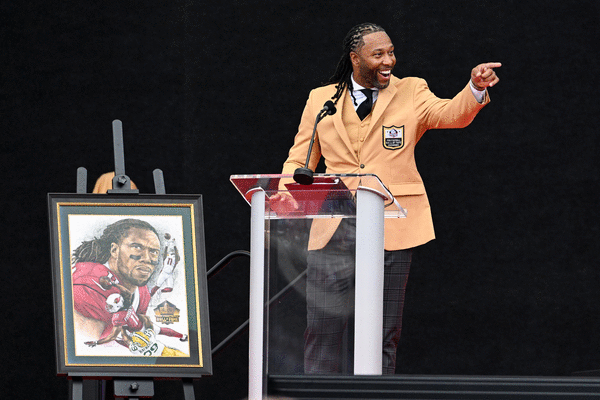
Fitzgerald, the pride of Minneapolis and Academy of Holy Angels, was enshrined into the Pro Football Hall of Fame on Saturday. He officially joined a select club of the greatest players in NFL history.
To understand how he reached that pinnacle, one must travel back to steamy summer mornings on the Gophers campus when Fitzgerald trained as if he were an undrafted rookie trying to make an NFL squad, even though he already had become a superstar receiver in his 17-year career with the Arizona Cardinals.
Those workouts, which I termed “Camp Fitz,” became popular among NFL players who wanted final conditioning before heading off to training camp with their respective teams. What started with a handful of players blossomed into an annual gathering of 30 to 40 at all positions, not just receivers.
Those sessions became more than workouts. They were tutorials. Fitzgerald invited retired receivers to visit to share their expertise. Hall of Famers Jerry Rice, Cris Carter and Michael Irvin showed up over the years. He brought in Andre Rison and former NFL coaches.
Fitzgerald had a list of questions for all of them.
“He’s an information guy,” Carter told me recently.
Fitzgerald was obsessive about training and developing as a player. He was never satisfied. He always felt like he could put in more work, learn something new, improve a skill that would make him 1% percent better.
When Fitzgerald learned that Rice ate grapes every morning for breakfast, he incorporated grapes into his diet.
Fitzgerald once missed a workout while attending a charity function out of town. He called Welle, his personal trainer, after he landed back in Minneapolis and asked if there was a park near his house. There was, but Welle was watching his kids. Fitzgerald told him to be there in two hours. Welle, with kids in tow, put him through a workout.
Fitzgerald gave Carter a request every year. Critique his game film and write down four or five things that he needed to improve on that offseason.
“There’s a reason why those guys have those gold jackets,” said Carter, who earned his Hall of Fame jacket in 2013. “They’re not like the other guys.”
Rice is recognized as the GOAT at the receiver position. His offseason training as a player became the stuff of lore. He accepted Fitzgerald’s invitation to share his knowledge and take part in a workout at age 46.
“That was crazy, man,” Rice told me back in 2016. “I was really impressed with his workout.”
The idea for Camp Fitz originated when Fitzgerald was a high school student and Vikings ball boy. Carter, who was being trained by Welle at the time, invited Fitzgerald to Florida to join them.
As a young pro, Fitzgerald asked Welle to do something similar with him in Minneapolis. Fitzgerald rented the Gophers football practice field and invited a handful of local players, including former Gophers tight end Matt Spaeth, who was just starting his career with the Pittsburgh Steelers.
Word spread quickly across the NFL. The group multiplied.
Welle led four workouts each week with each day focused on a different area. The sessions started with a hard workout, followed by route-running drills, then a weightlifting session.
“The best workouts I’ve done were with Larry,” said Eric Decker, the former Gophers and NFL receiver. “It was organized. It was hard. He brought in [my] idols. To be able to surround yourself with guys like that, it was kind of like a childhood dream, but also the best way to prepare for a season.”
Fitzgerald often asked Welle to script workouts to address perceived deficiencies in his game. He didn’t like it when Welle scaled back the work to give players a lighter day.
“Bill would be like, ‘OK, this is what we’re going to do,’ and everybody would be breathing a sigh of relief,” Spaeth said. “Larry would be like, ‘No, no no. That’s not what we’re doing. We’re doing this.’ Everybody would be like, ‘Uggghhhh!’”
They dug into the grind because of their admiration for Fitzgerald. If he was eager to do it, they knew they needed it as well.
The gab sessions were just as meaningful. Fitzgerald treated the group to dinners, outings to Twins games and boating on the lake.
Fitzgerald’s inquisitive nature about playing receiver never rested. He asked peers how they ran routes, how they trained, how they set up cornerbacks, what they ate.
He already was an established superstar when Antonio Brown emerged as a Pro Bowl receiver in Pittsburgh and teammate of Spaeth.
Said Spaeth: “Larry was always asking me about Antonio. ‘Does he do this? Does he do that?’ ”
Fitzgerald learned to be a tactician from Carter, his mentor whom he refers to as “Uncle Cris.” Their desire to master the craft was a valve that never shut off.
When Carter went to a grocery store and neared the end of an aisle while pushing a cart, he pretended he was running a route as he made the turn to go down the next aisle. He mimicked the footsteps he used getting out of his break.
“We’re always trying to improve,” Carter said.
In summer 2016, after he had already been selected to the Pro Bowl nine times, Fitzgerald told me, “You’re always battling yourself.” He began bringing a trainer with him when he traveled in the offseason. He ran sprints in the rain at a public park in Sandwich, England, and trained at a rugby facility in London.
He and Welle would head to Flagstaff, Ariz., three weeks before training camp for two-a-day workouts at 7,000-foot elevation. He was meticulous about his sleep, his diet and recovery after games.
Fitzgerald missed only nine games in 17 seasons.
“Larry is the epitome of the NFL and what it stands for,” Rice told me in 2016. “I think that’s what the NFL should be about — not getting complacent.”
Welle put Fitzgerald’s athletic traits among the top five of everyone he has trained in his long career. Pure athleticism alone didn’t bring him to the stage in Canton, Ohio, to receive football’s highest honor.
Fitzgerald got there because of all those exhausting summer mornings when he could have slept in. He was out there battling himself, refusing to be satisfied with being a star player. He never lost that fire to be just a little bit better today than yesterday, even on a holiday.
©2026 The Minnesota Star Tribune. Visit startribune.com. Distributed by Tribune Content Agency, LLC






Comments