Mike Vorel: New Seahawks owners may want to replace Lumen Field, following NFL trend
Published in Football
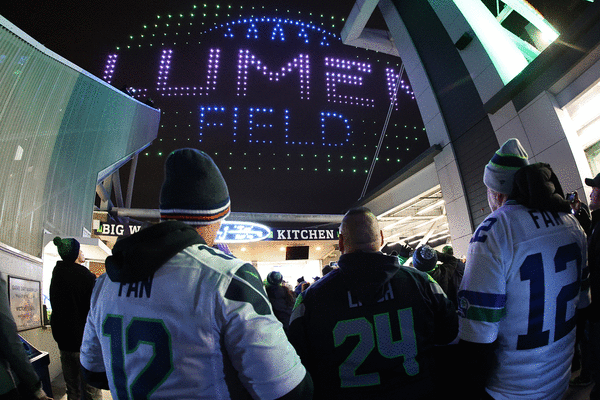
SEATTLE — The Seattle Seahawks don’t need a new stadium.
If you’ve attended a game at Lumen Field, where the 12 flag reliably rises over nearly 70,000 fans; where sound bounces between its iconic, steel-tied arches; where the Seahawks have won 66% of their regular-season games and 85.7% of their playoff games, surfing the cresting decibels with punishing aplomb; where the Sounders set CONCACAF Champions League and Leagues Cup attendance records in transcendent tournament finals; where the 2026 FIFA men's World Cup will set down for six matches this summer …
Then you already know that.
The Seahawks’ next owner(s), whoever they are, probably know it, too.
Why, then, did a report from ESPN’s Seth Wickersham last week include the following as one reason the franchise’s impending sale has received softer-than-expected interest from billionaire buyers?
“The Seahawks might also need a new stadium in coming years. While a new venue could open up additional revenue in the long term, the politics and cost could be a fight in the short term.”
That was a revelatory wrinkle for many Seahawks fans — considering Lumen Field only opened in 2002, is regarded as one of the NFL’s most ferocious home fields and has received multiple renovations to hide its gray hairs. Though the franchise’s lease runs through 2031, the team has three 10-year options beyond that time to extend it.
Visually, aesthetically, experientially, Lumen Field is a first-team All-Pro playing in its prime.
But …
“A lot of the stadiums that are Lumen Field’s peers are reaching the end of their timeline,” Wickersham told The Seattle Times on Monday. “You can argue the merits of that, whether stadiums should last longer than 20-some years. I think there’s a compelling argument, personally, that they should last longer.
“But you look at Denver. They’re starting again. Cleveland’s another one. If you’re a new owner coming in, you’re going to pay probably a record amount of money, and the thing that a new stadium does for them is it opens up all kinds of potentially new revenue streams.”
That’s all this is. Cathedrals are paved over and replaced with roads in the race for revenue. NFL owners want stadiums packed with suites that cater to corporate partners with capacious pockets. They want retractable roofs, which allow for concerts and Super Bowls and ticketed spectacles. They want to surround their stadiums with entertainment districts designed to swallow money, while dangling sportsbooks and sugary drinks and jalapeño poppers.
All of which is understandable. These billionaire businesspeople didn’t become billionaire businesspeople by prioritizing sentimentality or Costco pizza prices. The NFL is — above all else — a booming business. That revenue pays for facilities, players, coaches, scouting and analytics departments, sports medicine staffs, hot tubs and cold tubs and hyperbaric chambers. It pays for all the invisible inches that decide Sundays. It pays for Super Bowls and superyachts, like the one Dallas Cowboys owner Jerry Jones parked outside Elliott Bay Marina in 2020.
So, the Washington Commanders are leaving Northwest Stadium, which opened in 1997. And the Tennessee Titans are leaving Nissan Stadium, which opened in 1999. And the Cleveland Browns are leaving Huntington Bank Field, which opened in 1999. And the Denver Broncos are leaving Empower Field at Mile High, which opened in 2001.
Because the revenue race has winners and losers, but no finish line.
The Seahawks’ next owner(s), whoever they are, won’t need a new stadium.
But they may want one.
“They’re looking at, can we ever host a Super Bowl? Can we host Final Fours? That would be part of the thinking,” Wickersham said of the calculus involved in a Seahawks bid. “The NFL, with everything, they want to go bigger than before. I don’t know where that ends. Nobody does. But everything they want to be bigger and more spectacular.
“It’s one of the reasons why Stan Kroenke won the battle for Los Angeles. Stan wanted to build something that was bigger than just a football stadium. He wanted it to be a cultural gathering place, and that appealed to owners. It had the wow factor. The wow factor isn’t cheap.”
In Kroenke’s case, the wow factor exceeded $6 billion, which the Rams owner paid for privately to fund SoFi Stadium. But most NFL stadiums are made possible, in part, by taxpayers footing prolific bills.
By your willingness to pay for the construction of a country club that then demands membership dues.
But that’s a thorny agenda item for would-be bidders.
“You’re talking about an entire multiyear process of huge expenditures and political wars. I think that’s part of it,” Wickersham said. “You’re not just buying a team. You’re buying the idea that you might need a new stadium, or at a minimum have to figure out a way to make significant renovations to increase revenue. It’s distasteful to a lot of fans, and I don’t blame those fans for feeling that way.”
Neither do I. Because this franchise’s identity is pridefully tethered to the impact its fans have underneath those arches. Because Lumen Field is already undergoing a $19.4 million renovation to prepare for the World Cup. Because this stadium, this boisterous noise box, is not a problem to be solved or a piggy bank to be broken. Because Lumen Field is fine. Better than fine, in fact.
Someone will buy the Seahawks. Two groups — Boston Celtics alternate governors Aditya Mittal and Wyc Grousbeck, and San Francisco 49ers minority stakeholder Vinod Khosla — are reportedly preparing bids. And though the franchise may not fetch $10 billion, it’ll blow past the NFL-record $6.05 billion Washington garnered in 2023.
The Seahawks’ next owner(s) — whoever they are — will inherit a championship roster, a reigning NFL executive of the year, a wunderkind coach, a reliably rabid fanbase and a 190-game sellout streak inside a stadium that doesn’t need to be replaced.
____
© 2026 The Seattle Times. Visit www.seattletimes.com. Distributed by Tribune Content Agency, LLC.





Comments