Mike Preston: Ravens' incomplete draft will need time to develop
Published in Football
BALTIMORE — As one of the few media members who has covered every Baltimore Ravens draft, it’s amusing to watch or hear the grades that are immediately filed.
It actually takes three to four years to determine final grades, unless a team has an unusually high number of first-round picks.
ESPN draft analyst Mel Kiper Jr. almost always gives the Ravens an A, and that’s usually followed by others based on the Ravens’ track record of having won two Super Bowl titles in 30 years, or having three former players — Jonathan Ogden, Ray Lewis and Ed Reed — in the Pro Football Hall of Fame.
But it’s easily going to take at least three or four years to determine the final grade for the 2026 draft class.
Only one pick, Penn State offensive lineman Vega Ioane, appears to be a slam dunk, while the rest of this group has to prove itself. It’s strange because the Ravens had a higher pick in just about every round compared to late-round picks in recent years.
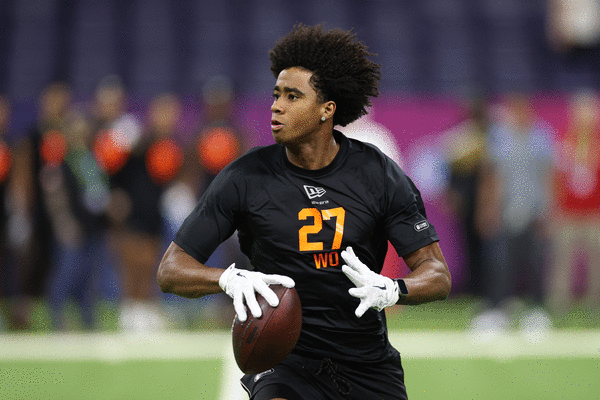
The Ravens, though, apparently weren’t very high on centers in this class and didn’t take a tight end until they traded up to select SMU’s Mathew Hibner in the fourth round (No. 133 overall), giving up the No. 154 pick and a 2027 sixth-rounder. But they did take Missouri outside linebacker Zion Young in the second round, and then Southern California wide receiver Ja’Kobi Lane in the third and Indiana wide receiver Elijah Sarratt in the fourth.
The Ravens haven’t had much success with big receivers in the past, but we’ll get to those later.
As far as Ioane, he is generally rated the best guard coming out of college by almost everybody. He is tough and physical, and when general manager Eric DeCosta compared him to former defensive tackle and Ring of Honor member Haloti Ngata, that made him an enforcer.
Ngata was the protector of the Ravens’ defense, built in the same manner as former defensive linemen Sam Adams and Tony Siragusa. If you cheap-shot a Raven, particularly middle linebacker Ray Lewis, it was nap time, because Ngata would put you out.
The Ravens need that kind of protector on the offensive side of the ball. They had that type of player in 2000, when tight end Shannon Sharpe would win the war of words, but they haven’t had that physical presence since the late Orlando Brown Sr.
But the rest of this class could take a year or two to develop. Young is a physical specimen at 6-5 and 267 pounds. His forte is holding the edge with strong arms and hands, which puts him in the same class as former Ravens outside linebacker Jarret Johnson.
It was a solid, perhaps good move because Young complements both pass-rushing specialists, Trey Hendrickson and Mike Green.
As far as the receivers, the Ravens went out and got two big ones in the 6-4, 200-pound Lane and the 6-2, 200-pound Sarratt. It’s easy to get excited about both, with Lane recording 49 receptions for 745 yards and four touchdowns last season.
Sarratt was just as imposing with 65 catches for 830 yards and 15 touchdowns at Indiana. But here’s the problem: Both are known for acrobatic, one-handed catches because of long wing spans, but neither is exceptionally fast, and both are expected to struggle with strong, aggressive press cornerbacks at the line of scrimmage.
Sarratt likes to make catches in the red zone with back-shoulder throws, but when was the last time quarterback Lamar Jackson made a back-shoulder throw?
Well? Give up?
Never.
Plus, the Ravens don’t have history on their side. In case you’ve forgotten, the Ravens have drafted Travis Taylor, Mark Clayton, Breshard Perriman, Marquise “Hollywood” Brown and Rashod Bateman in the first round without much success. Only Zay Flowers, taken in 2023, has made major contributions.
But maybe that’s why the Ravens selected Sarratt and Lane. No one knows what to expect from Bateman in his fifth season. He is an enigma, like third-year receiver Devontez Walker. Now you see him, now you don’t.
Poof. Gone.
The Ravens did get a tight end, thank goodness. Apparently, Ravens coach Jesse Minter knew Hibner from the four years he spent at Michigan. Again, it’s better to go with the known than the unknown. Hibner had 31 catches for 436 yards and four touchdowns last season.
He ran the 40-yard dash in 4.57 seconds, but again, there is nothing to rave about. It all goes back to the time factor again. Odgen played left guard for his first season, and Lewis didn’t emerge until his third season when he ran down Eric Metcalf after a long run in San Diego against the Chargers.
Right now, the Ravens have an incomplete draft. They don’t have a starting center. Right now, the top player at that position is Corey Bullock, who has yet to start a game. Danny Pinter is No. 2, and he has started only 10 games throughout his six-year career. The Ravens had a similar situation in 1999 and ended up starting Everett Lindsay at right tackle, followed by Kipp Vickers and Ethan Brooks the next two years.
The rest of the players, such as Duke cornerback Chandler Rivers, Alabama tight end Joshua Cuevas and Clemson running back Adam Randall, as well as Michigan State punter Ryan Eckley, are basically projects, even though Eckley has a legitimate shot to make the team. Both Michigan defensive tackle Rayshaun Benny and Northwestern guard Evan Beerntsen are long shots at best. Both were taken in the seventh round as compensatory picks.
Maybe one or two might slip into the lineup, but as you watched Minter speaking next to DeCosta, he looked like a first-year coach who was exhausted. Or maybe he’s intimidated by DeCosta, who has been with the Ravens since the team moved here from Cleveland for the start of the 1996 season.
You can chalk this all up as a learning experience for Minter. He’ll get better, and he’ll know what he wants as the season progresses. Until then, the standard remains.
It usually takes at least three or four years for a draft class to pan out. Unfortunately, this group might take even longer.
____
©2026 Baltimore Sun. Visit baltimoresun.com. Distributed by Tribune Content Agency, LLC.






Comments