Jets select Texas Tech edge rusher David Bailey with No. 2, Oregon TE Kenyon Sadiq at No. 16
Published in Football
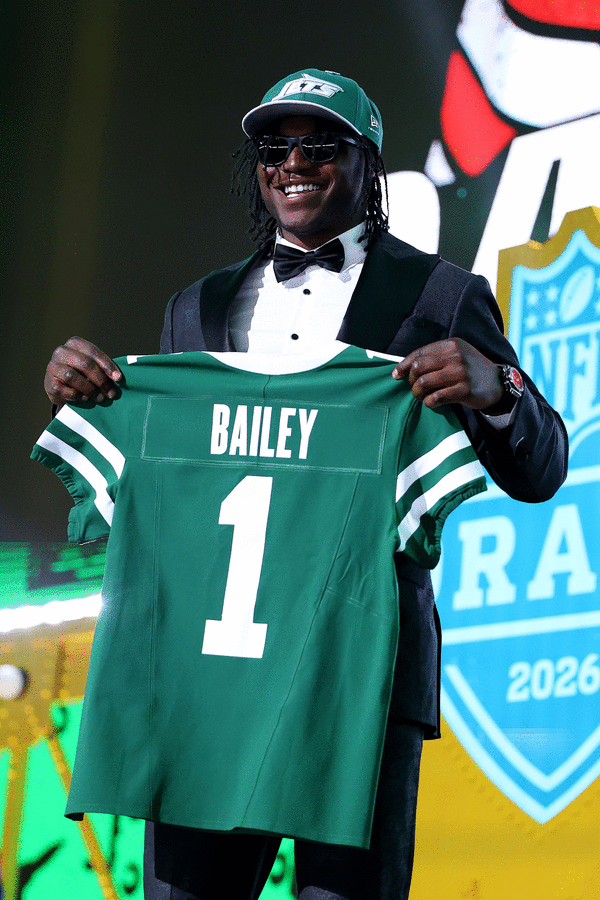
NEW YORK — With their first pick in the 2026 NFL draft, the Jets selected what could be their future defensive cornerstone.
At No. 2 overall, the Jets select Texas Tech edge rusher David Bailey.
He became the highest-drafted defensive player in Jets history.
“I had a great interaction with them at the combine,” Bailey said on Thursday after he was drafted. “Obviously, they canceled the 30 visit, but other than that, I had great Facetimes.
With their second selection in the first round and at No. 16 overall, the Jets added an offensive playmaker in Oregon tight end Kenyon Sadiq.
After selecting a tackle in back-to-back drafts (Olu Fashanu and Armand Membou), Gang Green chose Bailey, 22, who was the most productive pass rusher in the nation and arguably the best one available. He led the FBS in sacks (14.5) while also finishing with 19.5 tackles for loss. After the Jets traded Jermaine Johnson to the Titans for T’Vondre Sweat, adding a pass rusher was a must for a Jets defense that finished with the second fewest sacks last year (26).
The Jets had dinner with Bailey and also attended his pro day last month. At the NFL Combine in February, he ran a 4.5 40-yard dash, which was the second-fastest among defensive ends and edge rushers behind only Ohio State’s Arvell Reese’s 4.46.
“The first thing that jumps out is my pass-rushing ability,” Bailey said. “I’m explosive, I have an elite first step, but I’m also a versatile football player.
“I played in different schemes throughout my collegiate career. I played off-ball linebacker, I played in the box. I have the ability to adapt to a lot of schemes.”
There was some thought that the Jets might draft Reese instead after they canceled Bailey’s top 30 visit earlier this month. But Jets general manager Darren Mougey downplayed the decision earlier this week and didn’t detail why the visit was canceled.
“I didn’t know if it was an unusual thing to do, but I was still confident because of the interactions that I had with them at the combine,” Bailey said. “We also had a dinner back in Lubbock after my Pro Day. So I still felt good about the conversations. I know they for whatever reason they had their reasons [to cancel] the visit], but I was just trusting my agent and trusting the process.”
The Jets desperately need Bailey to produce immediately after having one of the worst defenses in the league last year on their way to finishing 3-14. They finished 25th in yards and 31st in points allowed last year.
Gang Green also became the first team in NFL history to go the entire season without registering an interception. In addition, the team was also the first in league history to lose its final five games by 23 points or more. In the midst of that, the Jets fired defensive coordinator Steve Wilks after just 14 games.
Bailey is a 6-3, 250-pound pass rusher who uses his excellent first step and someone who uses his acceleration to win matchups against offensive linemen at the line of scrimmage. He also has an amazing bend that helps him get around blockers, along with a variety of pass-rush moves. At Texas Tech, Bailey played both as a stand-up edge rusher and as a hand-in-the-ground player.
The Jets finished 25th in yards and 31st in points allowed last year. They also became the first team in NFL history to go the entire season without registering an interception. In addition, they were also the first team in league history to lose their final five games by 23 points or more. In the midst of that, the Jets fired defensive coordinator Steve Wilks after just 14 games.
After making several staff changes, Jets head coach Aaron Glenn will be the team’s defensive playcaller moving forward. He is also expected to use a hybrid defensive system incorporating both 3-4 and 4-3 elements. Bailey will join fellow defensive players Joseph Ossai and Kingsley Enagbare, who were both signed this offseason.
Bailey will also team up with Will McDonald, who led the Jets in sacks last season (eight). One concern about Bailey’s game is his run defense. But he says it’s an area he knows he needs to continue improving.
“I can always improve,” Bailey said. “Even as a pass rusher, I can always improve, but I know I have the ability to play the run.
“There’s obviously clips that you play where you question it, but there’s also clips that show up on tape where you are like ‘Yeah, he can play the run.’ Obviously, that comes down to certain positions I’m in. I feel confident they will put me in the best position to succeed, whether that will be staying on the edge or dropping back. There’s always things to work on.”
The pick of Sadiq was a bit of a surprise because the Jets drafted a tight end last year. They selected Mason Taylor in the second round and he was first on the team in receptions (44) and second in receiving yards (369).
Although it wasn’t an immediate need like at wide receiver, Sadiq, 21, should help a Jets offense that finished dead last in passing yards last season. He isn’t just a tight end — Sadiq is an offensive weapon. At Oregon, Sadiq was one of the most physical and versatile blockers in the nation.
Last year for the Ducks, Sadiq recorded 51 catches for 560 yards and eight touchdowns in his lone season as their starting tight end. The 6-3, 241-pounder ran a 4.39 40-yard dash at the NFL combine in February and registered a 43.5-inch vertical. He was named a second-team All-American and the Big Ten Conference Tight End of the Year last season.
One of the most impressive aspects of Sadiq’s game is his ability to create mismatches in the passing game. His speed consistently gives both linebackers and safeties trouble. The Jets desperately needed to add another offensive weapon alongside Garrett Wilson, who led the team in receiving yards last year despite missing 10 games (knee).
©2026 New York Daily News. Visit at nydailynews.com. Distributed by Tribune Content Agency, LLC.






Comments