Mike Vorel: Seahawks will beat Rams in NFC Championship Game, and here's why
Published in Football
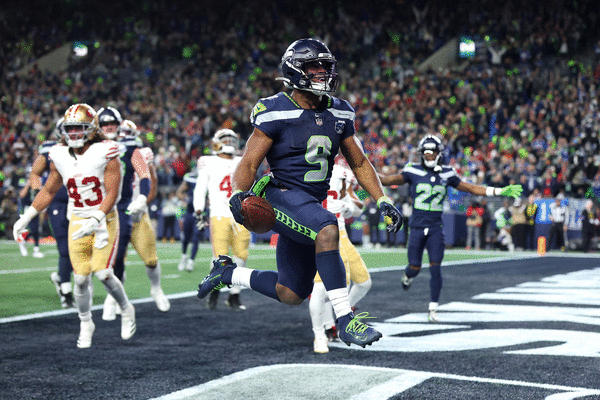
SEATTLE — After witnessing the Los Angeles Rams squeak by the Chicago Bears last weekend at a frigid Soldier Field, venerable Los Angeles Times sports columnist Bill Plaschke boldly declared:
"The Los Angeles Rams are going to win the Super Bowl."
Period. No conditions. No debate. It’s been written here before and, after Sunday, it literally bears writing again.
The Rams are going to win the Super Bowl.
It’s a take so nice he wrote it twice.
It also isn’t true.
Because winning the Super Bowl first requires the Rams to beat the Seahawks, in Seattle, on Sunday afternoon. It demands they reverse a monthlong trend and stone a Seahawks team that’s only getting better. It asks that they overcome the most complete outfit in the NFL, plus a rabid home-field advantage and a resounding history.
The Rams are a war ship sailing into a storm.
The Seahawks are the rocks.
They’ll win because they’ve effectively nullified their fatal flaw. Seattle’s 28 turnovers in the regular season were second-most in the NFL, and quarterback Sam Darnold’s 20 giveaways also led the league. But in recent weeks, both have benefited from a revelatory running game.
Specifically, the Seahawks have averaged 172.3 ground yards and 5.2 yards per carry, with eight rushing touchdowns, in their past four games. (That includes 171 rushing yards, 6.8 yards per carry and two touchdowns in the 38-37 overtime win over the Rams on Dec. 18.)
Since Darnold delivered four picks in a 21-19 loss to the Rams in Inglewood, Calif., on Nov. 16, Seattle’s offensive identity has dramatically shifted. With a running game that can wear down defenses and consistently grind clock, the Seahawks are winning without needing Darnold to put the ball in harm’s way.
They’ll win again if Darnold manages to sidestep disaster Sunday.
Admittedly, that’s an agonizing, prickly “if.” But remember that in their first two meetings, the Rams won an unbalanced turnover battle 7-1. That margin generally yields dual beatdowns. Instead, Seattle and LA were essentially equal — with the Rams outgaining (830-829) and outscoring (58-57) Seattle in the regular-season split.
It took a tidal wave of turnovers to keep it that close.
But given the running game, dominant defense and superior special teams, the Seahawks don’t need Darnold to juggle chain saws to filet LA.
By the way: though the Seahawks are getting better, the Rams are squeaking by. Their defense has surrendered an average of 370.5 yards and 27.8 points in their past six games, which would rank 29th and 28th — respectively — in an entire season. They barely beat Carolina (an 8-9 NFC South “champ”) and Chicago (which won seven games after trailing in the final two minutes) to begin postseason play.
As for the Rams win that prompted Plaschke’s proclamation? LA was outgained 417 to 340 by the defensively flawed Bears, who sacked Matthew Stafford four times and allowed the Rams to convert just 5 of 16 third downs. Stafford completed 47.6% of his passes, and a miscommunication between quarterback Caleb Williams and wide receiver DJ Moore likely saved the Rams’ season.
Because LA needed overtime to outlast Chicago, 14 Rams logged 60 or more snaps last Sunday. Though the Rams also received one fewer day of rest and are required to travel for the third consecutive week, not a single Seahawk played more than 59 snaps against San Francisco. These things matter at the end of marathons.
Yes, the Rams deserve credit for braving the elements and beating the Bears.
But while the Seahawks are rolling, the Rams are limping into Lumen Field.
Speaking of which: the Seahawks will win because history says so. Seattle previously earned the NFC’s No. 1 seed and home-field advantage in 2005, 2013 and 2014, and each season ended at the Super Bowl. Since the 1970 merger, the No. 1 scoring offense (Rams in 2025) and No. 1 scoring defense (Seahawks) have met twice in a conference championship game, with the dominant defense advancing on each occasion.
The Seahawks will also win because general manager John Schneider said so. When he hired coach Mike Macdonald less than two years ago, Schneider — who was named NFL Executive of the Year by the Pro Football Writers of America this week — kept coming back to the same question.
“Who’s going to change the marketplace?” Schneider said on Feb. 1, 2024. “The product is the product. He’s done it. You’ve seen it.”
In a copycat league, Schneider didn’t hire a coach to be Sean McVay or Kyle Shanahan.
He hired a coach to beat them both.
Macdonald’s defense just manhandled San Francisco, limiting the 49ers to nine total points and zero touchdowns in back-to-back shellackings. Against an offensive innovator (McVay), an assumed MVP (Stafford) and a prolific receiver (Puka Nacua) who decimated his defense barely a month ago, Macdonald enters Sunday with a point to prove.
If you believe in Macdonald’s ability to maximize his chess moves, and address his mistakes, then the Rams really haven’t seen anything yet.
Not that he’d say so.
“Well, they’re a really good team,” Macdonald said Wednesday, when asked why the Rams and Seahawks are so evenly matched. “They play hard. They play together. They got really talented players. They got a great scheme. It’s a great matchup. It’s right where we should be at this point in the year.”
The point here is not to rip Plaschke (one of our country’s finest columnists) or the Rams (a proven, persevering juggernaut fit for Sunday’s stage).
But on Sunday, in Seattle, what will stop the Seahawks?
Nothing and nobody.
____
© 2026 The Seattle Times. Visit www.seattletimes.com. Distributed by Tribune Content Agency, LLC.





Comments