Mike Sielski: Let us raise a glass to the Tush Push. It's dead, and the Eagles have to find an alternative.
Published in Football
LANDOVER, Md. — We are football followers, Eagles followers, so … no lies between us.
The Tush Push had its moments. Yes, it did. You remember the first touchdown of Super Bowl LIX, the ease with which Jalen Hurts slipped through the Kansas City Chiefs’ defensive line and into the end zone? The Tush Push was the first sign of the rout to come. And the fourth-and-1 from the Eagles’ 26-yard line against the Miami Dolphins two years ago? In a one-score game? That was the Tush Push at its best. And the NFC championship game in February. The two Hurts TDs from the Washington 1-yard line. The Frankie Luvu leaps. The high comedy.
The Tush Push took a lot of close games and put them away. Yes, indeed. It won more games for the Eagles than it lost, as much as any strategy or ploy. Did it tick off an NFL coach or three? No doubt. I think the league actually kind of got used to it, thank God. Did it cause controversy and enrage owners and get people in the media saying silly things about “nonfootball plays?” Hell, yes. Was it as much a fad, a passing fancy, as the run-and-shoot and the wildcat and an RPO-based offense? Abso-freaking-lutely. But the Tush Push stood against that dark tide, and it helped make the Eagles of Philadelphia a great team. A championship team.
———
Here at Northwest Stadium, just 35 miles from the city that was the setting for David Simon’s magisterial series "The Wire," it is only fitting that, as if attending a barstool wake among Baltimore po-leece, we eulogize the Tush Push. The play that once gave the Eagles a physical, psychological and strategic edge over every opponent they encountered is, by all available indications, dead.
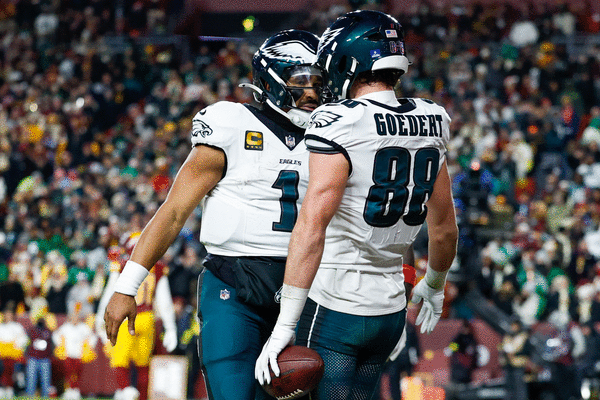
Three times during their 29-18 victory Saturday over the Commanders, the Eagles tried to run their unique and once-unstoppable version of the quarterback sneak. Three times, it failed. Once, tackle Fred Johnson committed a false-start penalty. Once, Hurts gained no yardage. Once, guard Landon Dickerson committed another false-start infraction. And with his offense facing a (relatively long) fourth-and-1 on its first possession, coach Nick Sirianni had the Eagles punt from their own 41 instead of attempting the play.
This was the flat line across the echocardiogram screen. In 2023, the Eagles led the NFL in fourth-down conversion percentage, at 67.9%. Last season, they were third, but their efficiency rate (71%) was higher. This season, they entered Saturday at 61.1%, seventh-best in the league — good, but not dominant, not close.
“Team adjust; we’ve got to continue to adjust,” Sirianni said. “Credit to them. They did a really good job of stopping us there. … We have to get this play working the way it’s been in the past, which we’ll work our butts off to do. But we were really able to overcome.”
They were. They got Hurts’ 15-yard touchdown pass to Dallas Goedert late in the third quarter — a nifty bit of improvisation after Dickerson’s penalty and a holding call against Johnson had pushed them back from the Commanders’ 1. They got Saquon Barkley gaining 132 yards and running like all the members of Washington’s defense had insulted his mother. And they got the benefit of playing a bad team that started its backup quarterback (Marcus Mariota) and had to turn to its third-stringer (Josh Johnson).
But the demise of the Tush Push is real, and it has to be a worry as the Eagles look ahead to the postseason. Hurts has made it clear that he had grown tired of running it anyway, and the league officials had raised their level of scrutiny of it, calling more penalties against the Eagles this season. It has gone from an automatic first down to an unreliable chore. They will have to find a new way to remain aggressive, and to succeed, in fourth-and-short situations.
“The play might not even be around next year, to be honest, the way they’re officiating it,” tackle Jordan Mailata said. “Last week, it was that our shoulders have to be parallel to the line of scrimmage. They can’t be angled in. Great. They’re officiating us a little harder. If this is the last year that we can run it, we’ll just run it till we can’t run it anymore.
“The history that we have with that, we’re pretty successful, so when we lean on that play, you expect us to convert. One-yard line — we just didn’t do it. I was pretty happy that Dallas and Jalen could bail us out on that one, but sometimes, that’s just how it goes. Teams this year have done a great job of stopping that play, so we’ve got to do a better job of executing it and go from there.”
Understand: The Eagles brought these challenges upon themselves, in the best way possible. They pioneered the Tush Push, then perfected it, then used so frequently in the course of winning a Super Bowl that they mounted a campaign against it. Teams are better prepared for it now, and the officials are eyeballing the Eagles every time they line up to run it. And yet, like mourners over a casket, they spoke Saturday as if they haven’t reconciled themselves to the hard, heartbreaking truth. “It’s in a good place,” Hurts said, and center Cam Jurgens insisted, “It’s still our bread and butter. It might get a little dry at times, but bread and butter is bread and butter.” But these words seemed the bittersweet valediction for a play that will send an opposing defense to its knees no more.
The Tush Push worked, and now its prime has passed. Raise your glass. It was called. It served. It is counted.
©2025 The Philadelphia Inquirer, LLC. Visit at inquirer.com. Distributed by Tribune Content Agency, LLC.



Comments