Mark Zeigler: Gonzaga and others keep adding players via court injunctions, but does that make it fair?
Published in Basketball
SAN DIEGO — San Diego State’s basketball team spent all week trying to get better on the court.
Gonzaga got better in court.
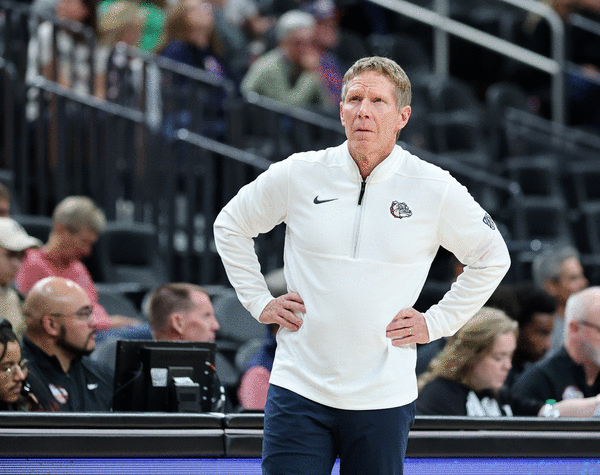
Coach Mark Few and about half his team filed into Department 13 of the Spokane County Superior Court on Thursday. They sat on wooden benches while a judge approved an injunction for 6-foot-10 forward Chauncey Wiggins that grants him a fifth year of eligibility for the Bulldogs until the case can go to trial.
The judge held an expedited hearing for Wiggins, then went through his court calendar to find a trial date. Sorry, the earliest was May 10, conveniently a month after the college basketball season ends.
The judge: Dean Chuang, proud alumnus of Gonzaga University School of Law.
Wiggins exhaled and smiled.
“I transferred here for a reason, and that’s to win,” he told a Spokane TV station, referring to his teammates in the gallery. “This just shows the off the court chemistry that we have.”
Pun intended?
This is what college sports have come to. This is what supposed institutions of higher learning have stooped to. This is what the judicial system has descended to.
Wiggins was a coveted four-star prospect from the high school class of 2022 who played three years at Clemson and last season at Florida State, where he started 30 times and averaged 13.3 points per game.
The Seminoles’ season ended with a loss in the ACC Tournament, and Wiggins, having played four years, figured his college basketball career had, too. But then the NCAA passed legislation in June allowing current or future athletes five years to play five, and members of the Class of 2022 started filing lawsuits requesting that they get a fifth year, too.
Wiggins initially was part of a case in Georgia, receiving an injunction to play in August before the NCAA appealed and got it overturned in September. Then he and several others across the country withdrew from that case and tried to join another in Texas, where an injunction still stands. The judge shook his head, noting they’d “already gone through the process … from another state.”
That was Oct. 29. Two weeks later, Wiggins was in yet another state asking for the same thing, in Department 13 of Spokane County Superior Court two miles from Gonzaga’s campus, with his Gonzaga coach and teammates — bona fide celebrities in town — sitting expectantly in the gallery, with a Gonzaga alum in the black robe.
“It is interesting that he lost a court case in two other places and wins it in Spokane,” said SDSU coach Brian Dutcher, who declined to defy NCAA rules and wade into the fifth-year market but will have to face several teams that did. “I think we’re seeing that all over the country. Good for him. Another year of basketball.
“The rich get richer.”
It was not Few’s first trip to the courthouse. A year earlier, he was down the hall in Department 8, where talented 6-7 guard Tyon Grant-Foster had filed a lawsuit requesting a seventh year of college eligibility after the NCAA had denied it.
The NCAA filed a motion that the case was a national issue and thus should be heard in federal court. The U.S. Eastern District of Washington is on the other side of the Spokane River, and Judge Thomas Rice kicked it back to superior court.
Rice is a Gonzaga undergrad and law school alum.
The presiding Spokane County Superior Court judge in Department 8 was Marla Polin, and she granted Grant-Foster an injunction allowing him to play immediately (the Zags had a home exhibition game a few hours later).
Where did she attend law school?
Do you need to ask?
And it’s not the first player on Few’s absolutely loaded roster with eligibility via injunction. He has two more: Florida transfer Xaivian Lee from a California court and Dayton transfer Javon Bennett from an Ohio court. He also has a 6-10 Spanish forward, Izan Almansa, who spent a year in the G League, which may have precluded him from playing in the SEC, Big Ten, Big 12, ACC or any other conference that instituted bans against players who signed an NBA or G League contract.
That left Wiggins as the lone Zags player still seeking eligibility.
“When we get Chauncey, like, look out,” Few said Nov. 2 after the Zags’ season-opening victory. “Because he’s a heck of a player and he’ll really help us, too. Another wonderful addition to our program.”
The Gonzaga lineup that an Aztecs team with little frontcourt size could see twice during the Pac-12 season: 6-5, 6-7, 6-10, 6-10 and 7-2, with another 6-10 stud off the bench.
“I mean, that’s just the way it is,” Aztecs forward Tae Simmons said. “People are coming from the G League and that weird kind of stuff. To me, it doesn’t matter. It’s just the way college is going now. People refuse to say it’s a professional sport, but there are so many signs saying these days that it actually is becoming very, very professional.
“If you just complain, no one’s going to care because that’s just the way the tides have shifted.”
Wiggins and Gonzaga are not alone. Hundreds of other athletes have filed similar lawsuits across the country, and the NCAA is fastidiously fighting them one by one. It won a huge victory last week in the Tenth Circuit Court of Appeals, invalidating a blanket federal injunction from a lower court that would have granted fifth-year eligibility to basically the entire high school Class of 2022.
The NCAA’s success at the superior court level has amounted to an endless game of Whac-A-Mole. Some players are still sitting. Some, like UC San Diego’s Treysen Eaglestaff, are playing.
Few, who was recently inducted into the Naismith Hall of Fame, remains unabashed in his justification for actively circumventing a rule passed unanimously by the Division I Cabinet, a 40-person body of athletic directors, conference commissioners and other college sports stakeholders.
“You know, the NCAA screwed up on this deal,” Few said. “They did. … You’ve just got to be fair and let these ’22s in. If you’re on the right side of it, I think you always feel good about it. And I feel great about it.”
It started with the agents, realizing their clients stood to make exponentially more money in college instead of $60,000 in the G League or on a foreign pro club — and that universities are willing to operate their athletic departments in the red in the name of almighty victory.
But it also takes the universities themselves.
The Division I Cabinet’s decision to exclude Class of 2022 athletes who had exhausted their four years of eligibility was explained thusly: the NCAA had fulfilled its promise to them when they enrolled in college, and granting them a fifth year of eligibility would unnecessarily limit opportunities for other players who had patiently waited their turn.
And then it takes judges unwilling to recuse themselves from cases for potential conflicts of interest, real or perceived.
“With these fifth-year guys in the courts getting that extra year, I don’t have control over that stuff,” said Dutcher, whose team beat New Mexico State, 73-61, on Sunday afternoon at Frontwave Arena in Oceanside. “All I control is the performance of my team and how we play. These things that are decided in the courtroom, there’s little I can do about it.”
Or maybe there is. Maybe you fight fire with fire. File a lawsuit claiming that opposing teams’ defiance of NCAA rules is creating a competitive imbalance and potentially damaging the multimillion-dollar investment in your own program that dutifully followed them.
That the losers in this should not be the schools who actually respected and followed the rules.
That Judge Chuang’s injunction may apply in Spokane County but not in, say, San Diego County. Or in Clark County, Nev., where the Pac-12 and three other conference basketball tournaments are held.
Or in Detroit, site of the 2027 Final Four.
You know, all in the name of court chemistry.
____
©2026 The San Diego Union-Tribune. Visit sandiegouniontribune.com. Distributed by Tribune Content Agency, LLC.





Comments