WNBA fans rally around Babe's Sports Bar in Chicago for Finals game after rescheduling uproar: 'It's just bad business'
Published in Basketball
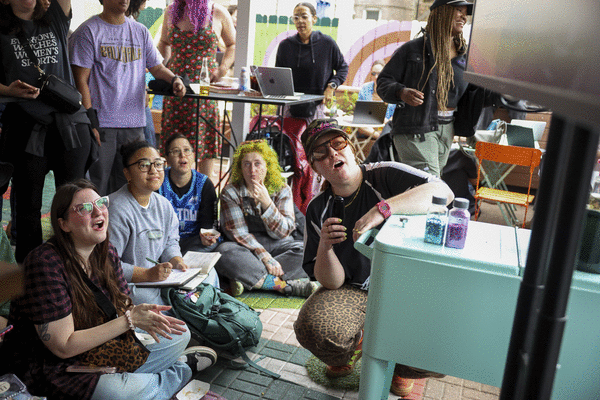
CHICAGO — Hours before tipoff of Game 6 of the WNBA Finals on Thursday, a temporary sign was hoisted above the front door of Babe’s Sports Bar on Armitage Avenue.
“Babe’s Cafe. Fueled by caffeine. And rage.”
The sign signaled a quick pivot for the Logan Square establishment, which opened at 9 a.m. — seven hours earlier than usual for a weekday — to accommodate the 11:30 a.m. start for the matchup between the Atlanta Dream and Golden State Valkyries.
The game time was switched from its scheduled 7 p.m. CT tipoff to allow a move from the Dream’s home court — Gateway Center Arena, which has a seating capacity of 3,500 — to State Farm Arena, which seats roughly 17,000 fans. In order to play at the larger stadium, the game needed to be moved up because the NBA’s Atlanta Hawks — State Farm Arena’s primary tenant — had a game scheduled for the same time Thursday.
The decision to make the Finals game a matinee drew criticism from women’s sports fans in Chicago and beyond.
Babe’s owner Nora McConnell-Johnson first learned about the changed start time Monday in a Slack group chat with other owners of women’s sports bars across the country. The decision was a blow for McConnell-Johnson, who said four of her top-10 sales days in the past year corresponded with WNBA Finals games.
The schedule for this series, which included multiple weekend matinees and Game 7 landing on Halloween night Saturday — already diminished the earning opportunities typically provided. Moving the opening tipoff of a potential elimination game to before Babe’s typical open only exacerbated the issue.
“Luckily we’re financially stable, so I don’t feel as panicked as I did last year when I didn’t know what the structure of things would look like,” McConnell-Johnson said. “But it definitely has made it clear that these Finals will not be the sort of tentpole sales events that they have been in the past.”
McConnell-Johnson’s immediate reaction was simple: We have to open.
Her staff agreed. Every bartender available volunteered to pick up an additional shift Thursday morning. McConnell-Johnson contacted Meagan Shamberger and the Babe’s street team — which serves up hot dogs during Chicago Sky away games and other events — to wrangle a pair of Blackstone grills into the back of a few pickup trucks. Shamberger and the rest of the team spent the morning slinging bacon and pancakes in exchange for donations to the bar. The night before, the staff handcrafted aprons, placards and the sign for the front door.
The swift change garnered immediate turnout. Lauren Simington arrived at Babe’s around 9 a.m. with her laptop in tow, setting up at the bar to knock out a few hours of work before watching the game. Emmicia Swartz arrived around the same time, setting up her workspace at a low-top table in the back of the bar while rocking a red cardigan to show her support of the Dream. Within a half-hour of opening, half of the bar was filled with fans, most of whom worked remotely while awaiting tipoff.
“The timing is terrible, but I was going to watch it no matter what time it was on,” Simington said. “It was unfortunate timing but it wasn’t a deterrent for me.”
Jackie Schmitz isn’t even a sports fan, but she loves to work in vibrant spaces during the day — and she wanted to support a local business. Schmitz learned of the scheduling controversy through a post made Monday night on the Babe’s Instagram page. That post earned nearly 3,000 likes and more than 400 shares, boosting a strong turnout by Thursday morning. Some patrons stopped by before work to grab a coffee for the road.
As a small business owner, McConnell-Johnson wanted to be pragmatic. And her pivot worked. The bar was packed Thursday morning, filling up to standing room only by the 11:30 a.m. tipoff. Fans bought beer and coffee and bloody marys. The event — despite its last-minute nature — ultimately felt like a success. But as a fan of women’s sports, McConnell-Johnson still felt the league failed its fans with its decision.
“It just feels like yet another disrespect in the world of women’s sports,” McConnell-Johnson said. “We already had to build our own bar to be able to watch the games we wanted to watch. And now we can’t even watch when we want to because they’re changing the schedule on us? It just feels like yet again an indignity of being a women’s sports fan.”
An undercurrent of frustration permeated the entire event. It was the center of focus for Stephanie Zing and Elisa Mary Sanchez as they set up at a table nearly two hours before tip.
“Who’s in charge?” Sanchez said with a laugh. “It sounds like it’s a man who’s in charge.”
Added Zing: “They had time. It was just the bad planning. And the thing is, (State Farm Arena is) sold out. The money was there. They just didn’t care. They just put it to the side.”
The fans assembled at Babe’s on Thursday morning offered varied solutions for the scheduling conflict. Move Game 6 back a day. Play it at Mercedes-Benz Stadium. Move the Hawks game to the morning — or to a different arena. Cancel the NBA game entirely.
The WNBA, NBA and all three teams involved considered many of those options. The NBA game could not start earlier Thursday because the Hawks played a game Wednesday night, and per the collective bargaining agreement between the league and players union, teams can’t play a day game following a night game in a back-to-back. Pushing back the date of the Hawks game created a challenge the NBA felt was logistically unfeasible.
But these reasons didn’t offer much reassurance to WNBA fans who have tired of watching games in small arenas or on subpar broadcasts. At times, they feel the league is growing too quickly for its leadership to keep up — and the fans who are propelling that rapid growth aren’t afraid to demand more.
“It’s disappointing, but I think it’s fun to see everyone rally around the game,” Swartz said. “At some point we have to go all in on supporting the league and the women who are part of it, who are going above and beyond, not just in the season but with how they advocate for women’s sports at all levels. It would just be great to see other people advocate for them in that way.”
Despite the frustration that drove much of Thursday’s crowd, the event was largely a celebration of a league experiencing seismic growth. The Dream — who won 80-69 to force a winner-take-all Game 7 — sold out State Farm Arena despite the early tipoff. And women’s sports bars like Babe’s, Level Sporting Club in Wrigleyville and Whiskey Girl Tavern saw major traffic throughout the morning.
McConnell-Johnson hopes her bar’s success will further prove the popularity of the WNBA — and the opportunities lost by not providing ideal access to the league’s biggest games.
“Women’s sports is good business,” McConnell-Johnson said. “And I think this is a move that shows that the decision-makers still have not fully registered that and have not figured out how to align themselves with that. … You guys are leaving money on the table. It’s embarrassing and it’s just bad business.”
____
©2026 Chicago Tribune. Visit chicagotribune.com. Distributed by Tribune Content Agency, LLC.





Comments