David Murphy: The Jaylen Brown analytics argument was misplaced. He powered a Sixers comeback and showed why.
Published in Basketball
PHILADELPHIA — One problem with analytics, or the application of them, is that they treat things that cannot be quantified as things that do not exist. That’s not a criticism of the science. More so, it’s a criticism of the manner in which the science is frequently applied. Any time there is gap between a player’s perceived performance and analytical measures of that performance, we tend to treat the gap itself as evidence of absence rather than what it actually is: An absence of evidence.
That assumption is often the correct one. But there are cases where the gap is less a measure of what a player is missing, and more so a measure of what the analytics are missing. It is here where Jaylen Brown abides.
At some point during the Sixers’ furious rally from a 29-point deficit in their home opener Thursday night, Tyrese Maxey turned to Brown and told him to get ready to do his thing. Maxey, the seasoned yet still upwardly mobile guard who is quickly establishing himself the star of stars, had tasked himself with the priority of slowing down Cavaliers veteran and former teammate James Harden, who’d spent much of the first half orchestrating a devastating middle pick-and-roll game. Maxey was going to spend his energy pressing Harden on the defensive end, be it at half court, three-quarter court, or even full court.
“I told him, ‘Look, I’m going to guard James, but third, fourth quarter, I’m going to need you to score the ball,’ ” Maxey said.
Brown himself had his hands full. Against a Cavaliers team with an oversized back court and a versatile pair of bigs in Jarrett Allen and Evan Mobley, the Sixers were leaning heavily on the 6-foot-6, 223-pound Brown to play sideline-to-sideline and baseline to three-point line in the manner befitting his linebacker proportions. A 29-point deficit does not allow much room for gimme possessions. Every shot must be contested, every potential rebounder boxed out, every loose ball chased down and corralled. Brown’s physicality and versatility make him a lynchpin in such endeavors. They do not allow for strategic breathers.
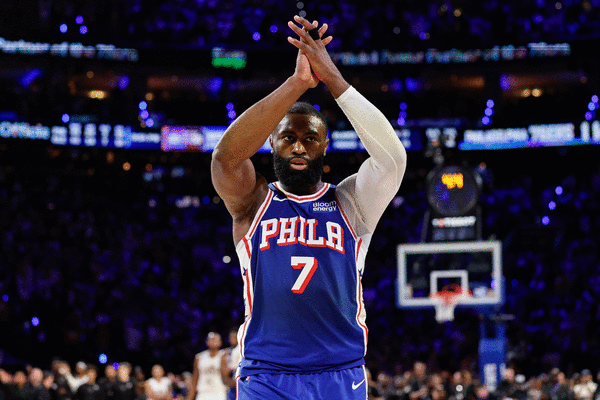
Brown has made those off-ball tasks his baseline in his first two games as a Sixer. If he did not have the name, and the max contract, and the NBA Finals MVP; if he had not scored 19 points in the Sixers’ season-opening win over the Knicks and then followed it up with 21 in Thursday’s 114-106 win over the Cavs, we would be talking about him as the kind of player who is undervalued. We would be talking about all of the little things that Brown did that made the Sixers look like a team that plays the kind of basketball that winners play. We would be talking about the way he tied up Allen for a jump ball on one second-half possession, and about the loose ball he saved by leaping across the baseline on another, and about his steal off of Jaylon Tyson. We would be talking about how every winning team has a player like Jaylen Brown.
Except, Brown also happens to be the kind of player that Maxey can turn to when the dial on the heat is turned all the way to the right. He is a player who can get to the bucket, through all kinds of traffic, as defenders and teammates are wearing down.
“His stamina, his strength, his mentality, it’s great for our ballclub,” LeBron James said. “It sets a tone.”
Brown did what he was asked on Thursday night. After a rough first half where he shot 2 for 8 from the field and turned the ball over three times, the final two quarters revealed Brown as the real bully. With 6 minutes, 8 seconds left in the fourth, after his baseline save of a loose ball on the other end of the court, Brown hit a 20-footer to put the Sixers up 98-95. The next time down the court, he made a driving layup. The next time down the court, he hit a 10-foot pull-up to put the Sixers up 102-95. All of this came with Joel Embiid on the bench.
“Physically, making those plays, we desperately need that,” Sixers coach Nick Nurse said. “Just get the ball, use your physicality to get to your spot and score. Crashing into some people. Rebounds at the other end, coming away with the ball — we need the physicality. He’s a very physical player.”
That’s the kind of stuff that the analytics don’t capture. It’s why the debate raged all summer about Brown’s true place in the NBA’s hierarchy. Again, not a knock on analytics. They say what they say. Facts and figures are useful. But they fail to capture the totality of certain players more than others. Grind is a difficult thing to quantify. But it is an immensely valuable thing. It is the kind of thing that can force multiply a player who is “only” very good into one who is actually pretty great.
The Sixers would not be where they are if Brown was not who he was in the fourth quarter on Thursday. The rally would have met the fate of so many like it: too little, too late, the gas tank on E well before the finish line. He is a close combat player. It may not be pretty in the classical sense. It may not be as efficient as the algorithms prefer. But it is a game that has an impact even beyond the actual points. It is a game that inflicts something on an opponent.
“It brings just a different dynamic for our team, both offensively and defensively,” Maxey said. “It’s easy for him. That’s what he does.”
What Brown does, what he has done through two games, is exactly what the Sixers have needed.
©2026 The Philadelphia Inquirer. Visit inquirer.com. Distributed by Tribune Content Agency, LLC.






Comments