Ira Winderman: Hmm, so Heat had too little and gave away too much for Giannis?
Published in Basketball
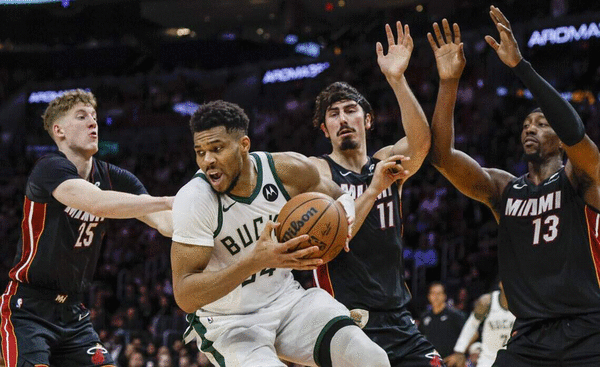
MIAMI — Yes, the Miami Heat’s world changed dramatically Monday, from lost at sea in the wake of four consecutive trips to the play-in round to Pat Riley reeling in Giannis Antetokounmpo.
But it was as if the perception of the before and after also changed dramatically.
In the weeks and months ahead of Riley’s biggest move over the past decade, the external viewpoint was the Heat not having enough to offer to complete such a dramatic move, a viewpoint further cemented when the Heat fell short as the last suitor standing for Antetokounmpo at February’s NBA trade deadline.
And yet in the minutes, hours and days after the league’s biggest personnel move in years, the critique from many was that the Heat gave up too much.
So, to reset the 180 twist in perspectives:
— The Heat did not have enough to get Giannis.
— The Heat, with their abundance of quality trade components, gave up too much.
Under different circumstances, with Giannis without the ability to move into free agency a year from now, the Heat arguably would not have had enough. Typically, to get a superstar in his prime, you have to give up a superstar, or at least an All-NBA talent.
But under these circumstances, the Bucks had to do something, internally aware for months that Antetokounmpo was not going to re-up, could walk into 2027 free agency, and that something is better than nothing.
But the Heat offer was not nothing. It was a lot, with as many player and pick tentacles as anything offered for an NBA leading man in years — four players and five draft components, four of which involved the first round.
Which brings it back to whether Riley was played by the Bucks, or even by the Celtics, who swooped in with a package built around Jayen Brown.
Typically, a player of Brown’s status would be enough to push such a package over the top, a replacement leading man and accompanying draft assets.
But Boston also was in position to draw a line, a team coming off a 56-26 season and just one and two years removed from 61-21 and 64-18 records, with an NBA title in 2024. They were in position to bow out when the Bucks also requested intriguing prospects Hugo Gonzalez and Baylor Scheierman.
The Heat were in no such position, coming off those four consecutive trips to the play-in round and failing to make the playoffs this past season for the first time in seven seasons.
Now the pipeline of quality youth had been restocked, allowing for the trade to be made.
This was the time, for myriad reasons.
Having bypassed Tyler Herro’s extension window in October, there otherwise would have to be a return to such a high-stakes decision when his extension window opened in July.
With Erik Spoelstra saying all the right things but belying them with his actions, the Kel’el Ware-Bam Adebayo pairing appeared to have a limited future.
With Jaime Jaquez Jr. emerging with a breakout third season, finishing as runner-up for Sixth Man of the Year, he, too, would become extension-eligible this offseason, leaving the Heat to debate the outlay for a reserve.
And if ever there was a case to sell high on rookie surprise Kasparas Jakucionis, this, too, might have been the moment.
So the requested package was there: Herro, Ware, Jaquez, Jakucionis.
Typically, that would be where leverage would enter the equation, of offering some but not all. But leverage left the building when Brad Stevens and the Celtics entered the equation by putting Brown into play.
Which brings it back to where Riley, in his heisting heyday, stood in the 2004 offseason, when Kobe Bryant v. Shaquille O’Neal suddenly had Shaq up for bid.
So Lamar Odom, Brian Grant and a first-round pick? No, the Lakers also wanted Caron Butler. As in culture-to-the-core Caron Butler. As in current Heat assistant coach Caron Butler, a seeming Heat lifer throughout.
Barely a blink. Butler headed west. The Heat’s first championship, in 2006, followed.
So this time could the Heat afford to draw the line at Jakucionis? Imagine the fallout if that became a talking point.
As for all the draft capital that went out, with the exception of the No. 13 pick utilized for the Bucks on Tuesday night for Nate Ament, none of it comes into play until 2030, and even then only a pick swap. So for all the draft consternation from those who saw the Heat giving up too much, the Heat still will be left with first-round picks in four of the next six drafts.
After that? Undeniable draft deprivation.
But that also is how the game has come to be played in a league that has had eight different champions in the last eight years. You pick your window, then seize upon that opportunity.
So, yes, the Heat did possess enough to get a deal done.
And, no, the Heat did not give up too much, because such is the price to open a contention window.
That doesn’t mean that the youth traded won’t flourish, that the draft capital surrendered won’t turn into stars of the next generation.
After the Shaq trade, for example, Odom went on to win NBA championships with the Lakers in 2009 and 2010, with Shaq not winning one again. But it doesn’t mean the Heat, for even a moment, regretted the decision that led to their 2006 title.
The Heat and Bucks both can come out winners from this. The difference for the Heat is that it has to be sooner rather than later.
©2026 South Florida Sun-Sentinel. Visit sun-sentinel.com. Distributed by Tribune Content Agency, LLC.




Comments