Bob Wojnowski: Pistons must find help for Cade Cunningham, whatever it costs
Published in Basketball
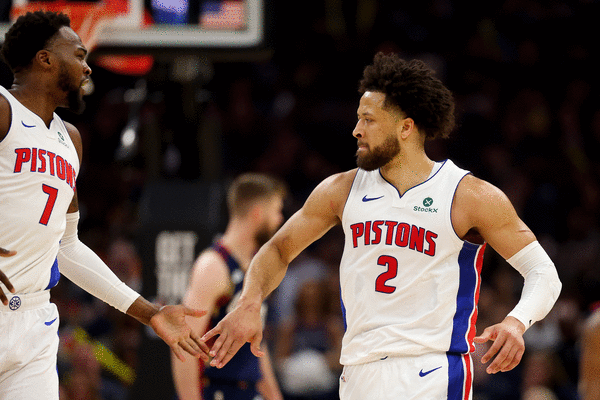
DETROIT — Now it changes even more, and they know it. The Pistons stopped being the NBA’s admirable outlier, the remarkable surprise story, about halftime of Game 7 against Cleveland.
When harsh reality hits, it bites. It also educates. The Pistons can’t suddenly transform from relentless defensive grinders into high-flyers, and they don’t need a complete transformation. But they need adjustments, perhaps significant adjustments, if they want to climb higher.
Cade Cunningham can’t do it all, even when it looks like he can. That’s the biggest offseason priority, by far, finding someone who can handle the playmaking and scoring duties of a true No. 2 guy. If it comes at the expense of surrendering a key piece of their defensive identity, they have to consider it, and I think they will.
This isn’t based on one 31-point loss to the Cavaliers (although that provided graphic clarity). It’s based on how difficult the postseason is, and how dramatically different it is from the regular season. We saw it in both seven-game series against Orlando and Cleveland, when the Pistons persevered but didn’t look like your typical 60-win No. 1 seed. That’s because they weren’t, which makes it more impressive what team president Trajan Langdon and coach J.B. Bickerstaff put together.
They should be lauded. But they get no laurels to rest upon.
Two years ago, this was a 14-win team and anything positive was noted, but the shelf time on the out-of-nowhere narrative is expiring. In some ways, the challenge is greater now, especially with the Eastern Conference expected to get healthy and treacherous again. The Pistons could run it back next season with the same personnel and win 55-60 games but I don’t think they’d win the East. And they’d have no shot against San Antonio, Oklahoma City or the other Western Conference powers.
That shouldn’t change the Pistons’ strategy. But their mindset should be altered, with urgency and expectations automatically ratcheted.
“I think we are one of the youngest No. 1 seeds in the history of the NBA,” Langdon said Tuesday at his end-of-season news conference. “We went from hunting teams to being the hunted, in one season. You don’t learn that until you go through it. It’s a completely different mindset, psychologically different.”
Langdon is still learning — and trying to explain — how different it is, especially in the playoffs, where every opponent is giving maximum effort and exploiting weaknesses. It’s been a whirlwind since he arrived two years ago, when he figured he’d have plenty of time to set his course and his roster. He certainly didn’t expect he’d already have to consider a big move to enhance the Pistons’ contender status.
“We didn’t think it’d come this fast,” Langdon said. “Two years ago, nobody in here thought I’d be getting championship-contender questions now. But here we are.”
It’s a great place to be, and a tough place to be. Langdon proudly lauded his team, its chemistry, its resiliency, trying to properly celebrate a breakthrough season, while acknowledging the difficult decisions ahead.
Jalen Duren and Ausar Thompson made gigantic leaps to become defensive forces, and both have pending contract negotiations. Thompson, 22, is a rare, pure defensive star, and I doubt he’s going anywhere. Duren, also 22, was powerful during the regular season — 19.5 points, 10.5 rebounds per game — but diminished in the playoffs — 10.2 and 8.5 — when defenses packed the paint and kept him from the rim. Another top-five pick, Ron Holland, 20, shows great promise, but mostly with defense and energy.
Two of the Pistons’ three most-important players are essentially non-shooters from outside six feet, which destroys the spacing for 3-pointers. The Pistons had the second-lowest 3-point attempt rate in the league, a deficiency especially problematic in the playoffs.
The Pistons can keep both defensive difference-makers, and my guess is they will, at least for now. But to get an offensive difference-maker, they’d have to surrender something valuable. Langdon has options but they quickly decrease if Duren and Thompson are locked up long term. Duren is due to become a restricted free-agent and it certainly sounds as if the Pistons plan to keep him. Pending negotiations, of course.
“J.D. had a fantastic season,” Langdon said. “I have no doubt we’ll put a plan together and he’ll attack it this summer, just like he did last summer, and he’ll come back a better player from his experience. We look forward to coming together with his representative and getting a deal done, and for him to continue to be a Piston.”
It’s prudent to judge Duren more on 70 regular-season games than 14 playoff games, although his postseason struggle might limit the market for him. It has to give Langdon pause, but seldom is it wise to move on from a 22-year-old All-Star.
A year ago, after their 44-win breakthrough, Langdon said the Pistons weren’t “skipping steps,” sticking to marginal moves. That’s what they did, adding Duncan Robinson and Caris LeVert, veterans who fit nicely. At the trade deadline, Langdon searched again but only landed Kevin Huerter, who was injured and lightly used.
It should be more urgent now. Tobias Harris is a valuable leader and a team favorite, but also a free agent who wore down in the playoffs. Langdon suggested he could be more aggressive this offseason and mentioned all possible avenues — free-agency, trades, draft picks. Does he have any untouchables on the roster?
“We’ll look at everything, but you guys can do the math,” Langdon said. “Obviously, JD and (Thompson) will be expensive, and once that happens, the optionality decreases.”
That said, one option absolutely must be filled — help for Cunningham. He was a warrior, carrying the team though the playoffs after missing three weeks recovering from a collapsed lung and fractured ribs. He never complained but it affected his conditioning, compounded by his enormous workload, hounded by multiple defenders every game. Daniss Jenkins helped, but he’s another young guy finding his way.
When the Pistons’ defense wasn’t forcing turnovers and creating transition baskets, the halfcourt offense was a disaster.
“The more ballhandling on the floor, the better,” Langdon said. “You see these teams that are successful have a lot of people, whether they initiate and bring the ball up, or execute in the halfcourt. The more guys like that, the more difficult it is to guard. Addressing those things could help. Again, those things are hard to find, and they’re expensive, and sometimes other teams don’t want to part ways with them.”
No one’s saying it’d be easy to make a dramatic move. Any of the most-discussed possibilities — Trey Murphy III, Michael Porter Jr., Lauri Markkanen — would be excellent, and expensive. More likely, there will be mid-tier scorers worth taking a chance on.
It takes some pain — particularly playoff pain — to grow, and the Pistons got their blast right in the face in Game 7. Now it’s up to Langdon, who must weigh painful decisions for the Pistons to grow.
©2026 www.detroitnews.com. Visit at detroitnews.com. Distributed by Tribune Content Agency, LLC.






Comments