Stephon Marbury has the answers to the Knicks' playoff questions
Published in Basketball
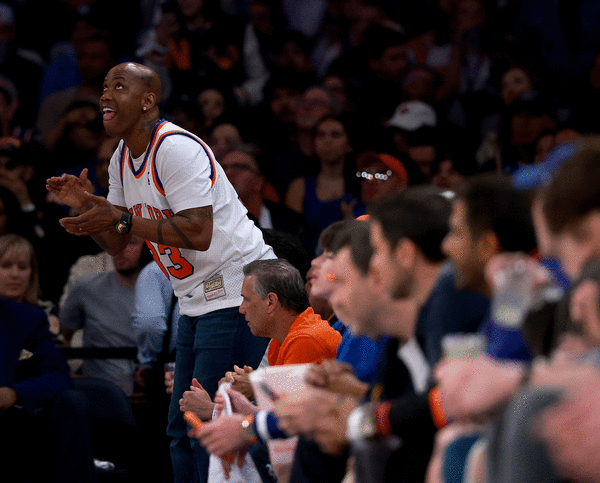
NEW YORK — Stephon Marbury is asking for a pen and paper. The waitress brings him an envelope.
To Marbury, the envelope, like many things in his life, has become a basketball court. On this court, constructed with a few strokes of a pen, Jalen Brunson sits at the center. And he’s on an island defending C.J. McCollum, the Atlanta Hawks guard who scored 32 points to hand the Knicks their first loss of the playoffs to even the series at one game apiece on Monday.
Four of his six of his fourth-quarter points, McCollum admitted after the victory, came via brush screens intentionally designed to switch Brunson onto the Hawks’ crafty-scoring guard. On one possession, McCollum used a between-the-legs dribble into a crossover, the “UTEP two-step,” to knock the Knicks’ captain off-balance.
“It’s gonna come down to strategy with Mike Brown,” says Marbury, seated on the 100th floor of a sleek high-rise overlooking Central Park. “It’s gonna come down to structure and strategy with Mike Brown — and I believe he’s going to make the adjustments.”
The Knicks head to Atlanta with more questions than answers as a team with an NBA Finals mandate that has now ceded home-court advantage. Chief among those questions is what adjustments the Knicks will make on both ends of the floor around Brunson, who holds the keys to the Knicks’ title run.
And their future as currently constructed.
“You know that they’re running a high pick and roll. It’s really like a brush screen, just so you can switch. And it’s slow. Like, it’s like stand there, touch his body, drag him down,” Marbury explains. “And now you’ve gotta switch. And it’s embarrassing if you don’t switch, ‘cause you on the court, on the island, by yourself in the NBA. So you standing there like, 'Damn.’
“I could literally walk real slow and just grab you like, ‘it’s time,’ and that’s the switch. Now, you’ve gotta stomp your feet, slap the ground, and just get ready every time.”
That future could very well hinge on how effectively the Knicks can cover for their All-Star scoring guard on the defensive end. McCollum called Brunson’s number over and over to help his Hawks win Game 2. Marbury offered a solution, a newer defensive coverage teams have deployed in recent months to keep weaker defenders off of premier scoring threats.
But it will require all five Knicks on the floor to be on a string.
“Jalen will have to get over the screen on C.J.’s hip and push him downhill, then whoever’s man is creating the switch, they’ll stay in the help position to make C.J. pass the ball. Then, the wing man will cheat over to the middle, and the [Knicks’] corner man will have two men: [Atlanta’s] wing man and the corner man,” Marbury explains. “If Jalen blitzes the screen, now if C.J. goes to drive and the help defender is in the blue position, Jalen can switch back to his man. He can switch to the other guy.
“And that’s how you kill it. Now we’re gonna watch, and we’re gonna see if they’re gonna make that adjustment. Because [Atlanta is] gonna run the same play. They’re gonna do it old-school and make us adjust.”
Disturbing freedom
These days, Marbury spends his time building WellBall, what he calls the “pickleball of basketball.” That time was interrupted on Monday.
Because, of course, he saw the tweet.
Words Marbury never associated with his Knicks career reached nearly 1 million viewers when a NY Post reporter denigrated the ex-point guard’s time with the franchise. The post included a video from the Knicks’ own social media account of Marbury supporting the team courtside during Game 1.
“The celebration of Stephon Marbury is such a strange thing,” the NY Post reporter wrote. “He was a terrible Knick. Dragged down the franchise for five years. Won zero playoff games.”
Those words are buried inside the archives of Marbury’s iMessage app, incoming and outgoing messages alike, disturbing the freedom he’s worked hard to create.
“I get it. I understand. Things happen. Things didn’t go well,” he says. “But the purity of New York basketball is in my DNA.
“I’m the wrong one. I’m the kid from Coney Island, for real.”
Marbury amassed a 113-174 record during his four-plus seasons in New York. His Knicks went to the playoffs once and were swept by the New Jersey Nets, who lost in the second round to the eventual NBA champion Detroit Pistons.
Marbury was in his late 20s then. Twenty years have passed since his final season in New York. Today, he wants to see the Knicks — yes, the “Nova Knicks” — reach heights he couldn’t during his time in orange and blue.
“I was a Knicks fan before I was ever a Knick. My mom was a Knicks fan. I was a Knicks fan in the womb. I’m almost close to half of a century living on this Earth being a Knicks fan,” he says. “This is why people in your industry are being replaced by former players. What [the NY Post reporter] said doesn’t matter. It gets voided when real people who’ve been on the hardwood speak.”
Marbury admits his years in New York weren’t the best. But when he first joined the Knicks, he got on a plane with then president of basketball operations Isiah Thomas. Thomas, who took the Bad Boy Detroit Pistons to back-to-back NBA titles, gave him a blueprint on leading a team through tumultuous times as a floor general.
“He said, ‘Teams bring you in when there’s a s--- storm. You are able to weather the storm when things are going bad, and you’ll come in and just play and do what you do,’ ” Marbury recalled. “I’ll put on my sneakers. I’m gonna lace them up. I’m gonna play. A lot of people have their opinion about how I played, and I can submit in the moment that I wasn’t perfect in all of what I’ve done.
“But I tried. I was trying, and I came ready, and I came prepared. People that are unprepared, I think those are the people who [critics] will be able to look at and contest. Some of the people that are in my draft class, I lap them. And I’m talking about years played. Not even talent or stats.”
Nothing with Cap
Marbury and Brunson don’t have a relationship, but the former Knick sees a little bit of himself in New York’s current captain.
“His ground attack is crazy, but right now he makes a lot of moves, and when you make a lot of moves, it takes a lot of energy,” Marbury says. “It’s a lot of movement to breathe through all that. He’s conditioned to do it, so he makes it look easy. But it’s super hard to do.”
Marbury believes Brunson has what it takes to make good on James Dolan’s January mandate: that he can lift the Knicks to their first NBA title since 1973.
“We’re behind [Jalen]. We support him, but we also want him to make adjustments,” he says. “Jalen is the guy that we want and we love because he’s a great human being. Now, he’s in the process of making his adjustments towards being a leader worthy of building two statues outside (Madison Square) Garden.
“You’d have to literally build him, then build one with him, Clyde and all the other dudes, if he wins a title.”
To get there, Brunson has to adjust, not just on the defensive end, but offensively, too. He can get his own shot at any moment, but far too often, the offense stagnates: It happened in crunch time against the Hawks when Brunson took eight shots in the final eight minutes while Karl-Anthony Towns took just two.
“I feel like Jalen Brunson has to play like Allen Iverson and John Stockton. He has to find the balance. I don’t think it’s a hard transition for him because he’s smart, and he’s astute, and because he’s smart and astute, he’s aware of what happened,” Marbury says. “Right now, this is the first four years of him being the man where he’s making decisions and he’s going on the court. He’s playing at the highest level and everything is in his hand.
“And he’s got all of the support. We are going to support him because we believe him and we trust him. We believe that. I believe that.”
In the locker room after the Game 2 loss, several Knicks players pointed to the same issue: a lack of ball movement and fluidity down the stretch, when the Hawks closed on a 20-9 run to erase a 14-point deficit.
“We’ll wait and watch and see if that’s something that [Jalen’s] going to do. Because if he makes that adjustment — if he plays like Stockton and Iverson — yeah. We’re going to witness what we all started to believe in and trust in,” Marbury says. “And why we call him Mr. Clutch.”
Marbury also believes Brunson needs more help — from both his coach and his co-star. He wants the Knicks to run more traditional high pick-and-roll with their two All-Stars — “not that Spain action,” he says — and believes Towns has to be more forceful in demanding the ball.
“KAT’s not going to get plays drawn up in this system with Coach Brown. He has to assert himself. He has to demand — he has to demand the ball come his way, man,” Marbury says. “It’s different when you demand something. When you command it, now it’s like, ‘OK, that’s what we’re doing. We’re going there.’ When he puts his hand up and demands the ball, everybody knows to throw it.”
That’s one side of the ball.
The other is Brunson’s own matchup. Because McCollum isn’t going anywhere. And a player used to diagnosing opposing defenses now must do the same to his own.
“What he takes from [Game 2] and how he grows from that night — that’s him. That’s going to be the truth and true honesty in the next game,” Marbury said. “It’s not about playing harder or scoring more or not missing any shots. That’s not it. It’s evaluating how they play him. How am I going to play defensively?
“Am I going to submit and say, look, this is where I need help at? Am I thinking about knowing that I have a weakness right now and now everyone sees it? Everybody in the gym knew it. The whole world sees I can’t defend C.J. McCollum, and I’m gonna have to guard him in the next game.
“How are we gonna prep? And how are you gonna prepare to play against him?”
©2026 New York Daily News. Visit nydailynews.com. Distributed by Tribune Content Agency, LLC.





Comments